Trading Psychology That Protects Your Account

A prop-firm evaluation can be going well at 9:45 a.m. and feel completely out of control by 10:15. One missed move turns into a chase. One red trade turns into a larger position. Before long, a trader who had a solid plan is staring at a drawdown they did not need to create.

That is why trading psychology is not a side topic for futures traders. It is the skill that keeps your strategy, risk limits, and funded-account goals intact when the market gives you a reason to abandon them.

You do not need to predict every move to pass an evaluation or earn payouts. You need to make repeatable decisions, protect the account, and be ready for the next high-quality setup. That sounds simple. It becomes difficult when money, time pressure, and a recent loss are involved.

Why Trading Psychology Matters in Prop Trading

Prop trading puts a bright spotlight on behavior. Evaluation rules give you a profit target, a trailing drawdown, daily loss limits, and sometimes consistency requirements. Those rules do not care how confident you felt about a trade. They only measure what you did.

A trader can have a strong charting system and still fail multiple evaluations because of one emotional session. They may double size after a loss, take five trades outside their plan, or refuse to stop after hitting a daily goal. The issue is rarely a lack of market information. It is the inability to execute the same process when the stakes feel higher.

This is also where the right perspective matters. An evaluation is not a race to make the target in one morning. It is a risk-management test. Your job is to preserve the opportunity to trade tomorrow. Small, controlled gains can move an account forward. One oversized loss can erase a week of disciplined work.

The Four Emotions That Blow Accounts

Every trader experiences emotion. The goal is not to become robotic or pretend you never feel fear. The goal is to recognize when an emotion is starting to make decisions for you.

Fear makes good traders hesitate

Fear often appears after a losing streak or a painful blown account. You see your normal setup, but you hesitate. Then you enter late after the move has already started, which creates a worse entry and a tighter stop. Or you skip the trade entirely, watch it work, and feel pressure to force the next one.

The answer is not to take random trades to prove you are confident. It is to reduce size until executing your plan feels manageable again. A one-contract trade taken correctly builds more useful confidence than a large trade taken out of frustration.

Greed turns a good day into a bad one

Greed does not always look like wanting a huge win. Sometimes it looks like refusing to stop after reaching your daily target because the market is still moving. You tell yourself you are seeing everything clearly. Then a reversal takes back the profit, and the desire to get it back creates more damage.

Set a daily goal and a daily stop before the opening bell. When you reach either number, your default decision should be to step away. There are exceptions for experienced traders with a written plan, but exceptions should be planned, not invented in the heat of the moment.

Revenge trading demands immediate relief

Revenge trading is the urge to fix a loss right now. The trader is no longer focused on a valid setup, risk-to-reward, or market structure. They are focused on making the account balance look better.

That urgency is expensive. A loss is information and a business expense when it stays within your rules. It becomes a problem when you treat it like a personal insult. After a full stop loss, take a break from the screen. Review whether the setup followed your plan. If it did, the loss may simply be part of trading. If it did not, do not give yourself another chance to repeat the mistake immediately.

Overconfidence removes the guardrails

A winning streak can be as dangerous as a losing streak. After several green days, traders often increase size too quickly, loosen their entry criteria, or believe they can trade through any market condition. The market eventually reminds them that no setup works all the time.

Confidence should come from evidence: a tested setup, clean execution, a defined stop, and a record of following your rules. It should not come from one big day. Keep your risk consistent while you build a track record. Scale only when your data supports it, not because you feel invincible.

Build a Routine That Makes Discipline Easier

Willpower is unreliable when the market is moving fast. A routine reduces the number of decisions you have to make under pressure. It gives you a process to follow before emotion gets a vote.

Start your session by defining the market context. Mark key levels, identify the trend or range, and decide which setups you are willing to take. If you use TradingView indicators or algorithms, let them support your decision-making rather than replace it. A signal is not permission to ignore risk or enter without understanding where your stop belongs.

Then write down three numbers: your maximum risk per trade, your maximum loss for the day, and your realistic daily target. These numbers should fit the rules of your specific prop firm account. A trader in a tight trailing-drawdown phase may need to trade smaller than they would in a more established funded account. That is not weakness. That is adapting to the account objective.

After the session, review your execution before reviewing your profit and loss. Ask whether you traded your planned setup, honored stops, respected your limits, and stopped when you said you would. A green day with poor discipline is not a win worth celebrating. It teaches habits that can hurt you later.

Use a Trading Journal to Find the Real Problem

Most traders remember emotional trades more clearly than disciplined ones. That makes memory a poor coach. A trading journal gives you facts.

For every trade, record the setup, entry, stop, target, position size, time of day, and result. Add a short note about your mental state. Were you patient, rushed, tired, trying to recover a loss, or trading because you were bored? You do not need to write a novel. You need enough information to spot patterns.

After 20 to 30 trades, the truth gets easier to see. Maybe your first setup of the day performs well, but your trades after 11:00 a.m. create most of your losses. Maybe your strategy is profitable when you use one or two contracts, but you lose control when you size up. Maybe your biggest issue is not entries at all – it is moving stops.

That is a powerful shift. Instead of saying, “I just need to be more disciplined,” you can create a specific correction: no new trades after two losses, no size increase until 20 clean sessions, or no trades outside your highest-conviction window.

Separate Your Identity From One Trade

A losing trade does not mean you are a bad trader. A winning trade does not mean you are ready to abandon your rules. This separation is essential because prop trading creates visible scoreboards. You see the balance, the target, and the drawdown every day.

Your identity should be tied to your process: “I am a trader who manages risk and takes qualified setups.” That mindset gives you room to take a planned loss without spiraling. It also keeps a winning day from turning into a reckless one.

The same applies to evaluations. Failing an evaluation is feedback, not a verdict on your potential. Review the account with honesty. Did you need a better strategy, smaller size, a clearer routine, or stronger limits after losses? Fix the one or two behaviors that caused the failure before buying another evaluation. Repeating the same approach with a fresh account is not persistence. It is paying tuition without taking the lesson.

Accountability Changes What You Tolerate

Trading alone makes it easy to bend your own rules. Nobody sees the extra contract, the late entry, or the decision to keep going after your stop. That is why community and coaching can matter. When you regularly review trades with people who understand evaluation rules and futures market structure, excuses become easier to spot.

At CK Trader Pro, the focus is not on pretending every day will be green. It is on helping traders build the habits that give them a real chance to pass, protect funded accounts, and pursue payouts over time. The trader who can follow a plan on a slow Tuesday is building the same skill they will need during a fast, high-pressure session.

Before your next session, make one commitment that is easy to measure: honor every stop, stop after your daily limit, or take only your best setup. Keep that promise for a week. The market will always offer another trade. Your account needs you to be disciplined enough to take the right one.
How to Integrate AI TradingView Indicators with Your Prop Firm Strategy

The trading landscape in 2026 has shifted. The days of staring at raw price action and guessing where the big money is moving are over. If you want to secure capital from leading prop firms like Lucid Trading or Apex Trader Funding, you can no longer rely on gut feelings or cluttered charts. You need a systematic, high-probability prop firm trading strategy that leverages the most advanced technology available.

I’m CK, and I’ve spent years on the floor and in the digital trenches. I’ve seen traders blow thousands of dollars trying to "find" the trend. At CK TRADING INSTITUTE OF TECHNOLOGY LLC., we teach you a different path: using AI-powered TradingView indicators to remove the noise and execute with the precision of a professional.

THE PROBLEM: THE NOISE THAT KILLS ACCOUNTS

Most traders fail their evaluations not because they lack passion, but because they are overwhelmed by "market noise." They have ten different indicators on their screen, all screaming different things. This leads to hesitation, overtrading, and ultimately, a blown account.

In prop firm trading, consistency is everything. Firms aren't looking for a "one-hit wonder" who got lucky on a news spike; they are looking for disciplined traders who can manage risk. This is where AI integration becomes your greatest asset.

THE SOLUTION: THE AUTOMATED TRADE ASSISTANT (ATA)

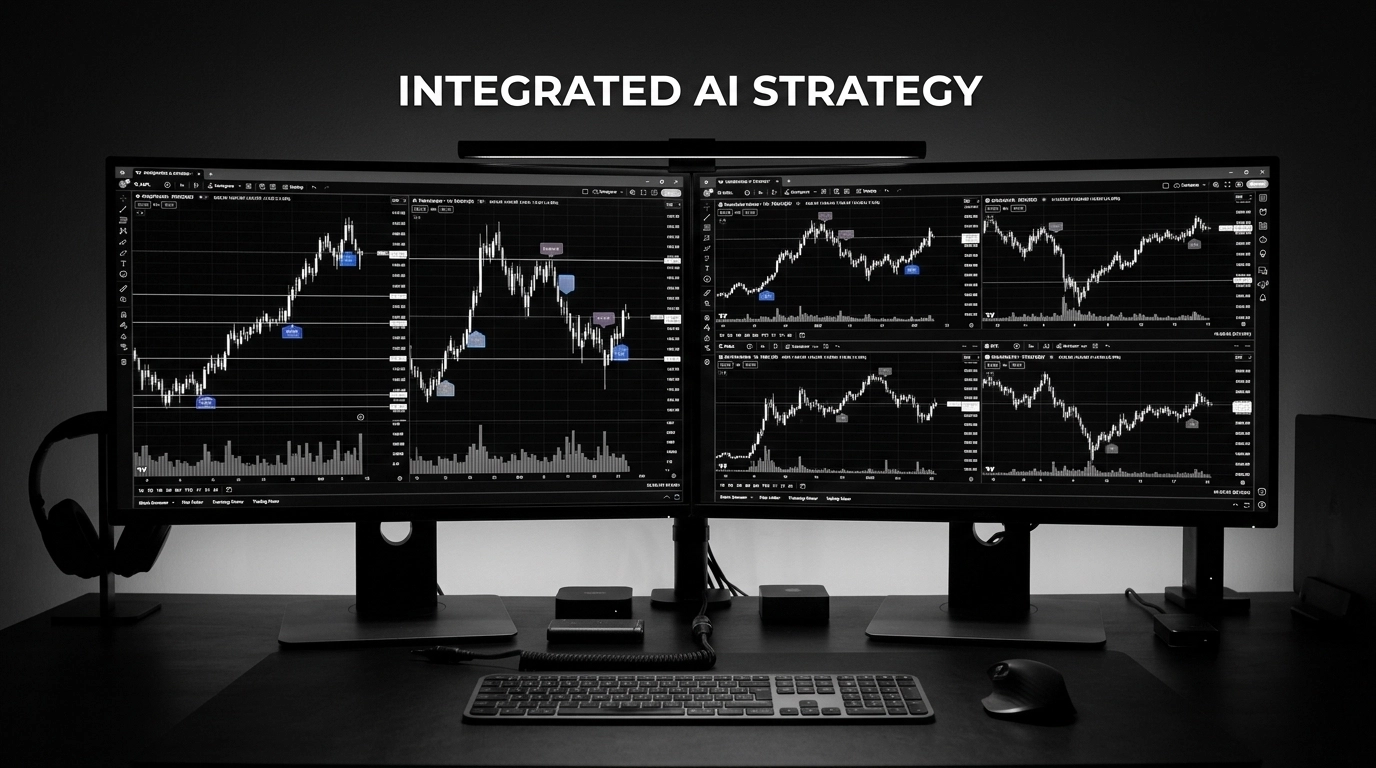
We’ve developed the ATA (Automated Trade Assistant) specifically to solve the problem of human error. By integrating AI directly into TradingView, we’ve created a system that identifies macro and micro trends, flags high-probability supply and demand zones, and gives you clear entry and exit signals.

TradingView Technical Interface

When you integrate AI indicators like the ATA into your strategy, you aren't just following a "buy/sell" button. You are using an algorithm coded to detect institutional order flow.

Why AI Integration is Mandatory for Scaling:

  1. Emotionless Execution: The AI doesn't get "revenge" after a loss. It stays focused on the data.
  2. Clean Charting: Our tools are designed to strip away the clutter, showing you only what matters for risk management day trading.
  3. Efficiency: Why spend 8 hours scanning charts when an AI can alert you to the perfect setup in seconds?

STEP-BY-STEP: INTEGRATING AI INTO YOUR WORKFLOW

To pass a prop firm evaluation, you need a repeatable process. Here is how we recommend integrating AI tools into your daily routine:

1. Define the Macro Trend

Before you look at a 1-minute or 5-minute chart, our AI indicators analyze the higher timeframes. Are we in a macro bullish or bearish cycle? If the ATA shows a macro bearish trend, we are only looking for short opportunities. This single rule prevents 90% of unnecessary losses.

2. Identify Key Zones

The ATA automatically plots supply and demand zones. These aren't just "support and resistance" lines; they are areas where professional capital is sitting. When price enters an AI-identified demand zone, your probability of a successful long trade skyrockets.

3. Wait for the AI Signal

Once price is in a zone, we wait for the micro-confirmation. The AI will generate a signal based on volume, momentum, and price action. Seize the opportunity. This is where your mastery comes into play: executing without hesitation when the conditions are met.

Prop Firm Strategy Analysis

RISK MANAGEMENT: THE $20 REVOLUTION

One of the biggest hurdles for new traders is the fear of losing their own money. We’ve eliminated that. At CK Trading, we teach you how to leverage prop firm capital so you are risking as little as $20 to $50 of your own money to control an account worth $50,000 or more.

Compare that to the old way: risking $2,500 of your hard-earned savings to make a few hundred bucks. The math doesn't work. By using a disciplined risk management day trading approach coupled with AI, you can 10x your potential returns while keeping your personal exposure to a minimum.

Financial Growth and Leverage

THE PATH TO FINANCIAL FREEDOM

We don't just give you a tool and leave you to figure it out. We provide comprehensive training: from beginner to advanced: that covers futures, stocks, currencies, and options. Our community is led by experts who have 28 years of floor trading experience. We provide live sessions where you can see these AI indicators in action, in real-time.

Passing a prop firm evaluation is the fastest way to replace your daily job income. Once you pass, you get access to significant leverage. We've seen traders earn thousands with just one payout in as little as 8-10 days. But it all starts with the right setup.

"The ATA changed the way I look at charts. I used to be a 'click-happy' trader, always chasing moves. Now, I wait for the AI to confirm the zone and the signal. It's transformed my consistency." : Testimonial from a CK Trader Pro Member

YOUR ACTION PLAN: JOIN THE ELITE

If you are tired of blowing accounts and feeling lost in the charts, it's time to upgrade your tech stack. Stop trading with "dumb" indicators and start using AI that works for you.

STEP 1: GET THE EDUCATION & TOOLS

Head over to www.cktraderpro.com to access our AI-powered algorithms and join our expert-led community. We’ll show you exactly how to set up your TradingView environment for maximum profit and minimum noise.

STEP 2: CHOOSE YOUR PROP FIRM

We have partnered with the best in the industry. For the most streamlined path to a funded account, we recommend Lucid Trading. They offer a 1-day evaluation and a reputation for fast payouts.


PROMOTIONAL OFFER: START YOUR JOURNEY TODAY

PRIMARY RECOMMENDATION: LUCID TRADING
Get funded faster with the industry's most reliable firm. Use our link and code for the best possible entry into your evaluation.

SECONDARY OPTION: APEX TRADER FUNDING
Leverage massive capital through one of the most established firms in the space.


Professional Trader at Desk

FINAL THOUGHTS

Mastery is not about knowing everything; it's about focusing on what works. Integrate AI into your prop firm trading strategy, manage your risk like a professional, and stop gambling with your future. We are here to guide you every step of the way.

LEVERAGE the technology. MAXIMIZE your capital. SEIZE your financial sovereignty.

See you on the charts,

George Ama (CK)
CEO, CK TRADING INSTITUTE OF TECHNOLOGY LLC.

How Funded Trading Accounts Work for Futures

You do not need a five-figure personal trading account to start building futures trading skills. That is the appeal of proprietary trading firms. But understanding how funded trading accounts work matters before you pay for an evaluation, place a trade, or start counting payout money that has not been earned yet.

A funded account is not a shortcut around learning to trade. It is a structured performance opportunity. You pay a relatively low evaluation fee, follow a firm’s rules, prove you can manage risk, and may earn access to an account with greater buying power than you would want to fund yourself.

For traders who keep blowing evaluations, the answer usually is not another account. It is a better process: smaller risk, cleaner setups, and the discipline to protect the account when the market is not giving you your trade.

How Funded Trading Accounts Work Step by Step

Most futures prop firms follow a similar path. The details vary, but the core process is simple: choose an account size, pass an evaluation, complete any required transition steps, then trade under the rules for the chance to request payouts.

1. You choose an account and pay for an evaluation

A futures prop firm may offer several account sizes, often tied to different profit targets, drawdown limits, and permitted contract sizes. Bigger is not automatically better. A larger account can allow more contracts, but it can also tempt a newer trader to take oversized positions.

The evaluation fee is typically a subscription or monthly charge, sometimes with promotions that reduce the upfront cost. It is the cost of participating in the firm’s assessment process, not a deposit into a brokerage account that belongs to you.

Before choosing an account, read the current rule set. Look closely at the profit target, maximum drawdown, daily loss limit if one applies, minimum trading days, news or overnight restrictions, and payout eligibility requirements. A rule you do not understand can end an otherwise solid run.

2. You trade to a profit target while staying inside risk limits

During the evaluation, your job is not to make the biggest day possible. Your job is to reach the target without violating the firm’s risk rules.

For example, an evaluation might require a trader to earn a set amount while avoiding a trailing drawdown. A trailing drawdown is one of the rules that catches traders off guard. As your account reaches new highs, the drawdown threshold may rise with it. If you give back too much from those gains, you can fail even if your account is still above its starting balance.

That changes the game. A trader who makes a huge first-day profit and then keeps swinging can create a much tighter cushion than expected. Controlled daily gains often give you more room to operate than one emotional home-run trade.

3. You meet the firm’s consistency and trading-day requirements

Many firms want to see that your performance was not built on a single lucky trade. That is why some programs use minimum trading-day rules, consistency rules, or limits on how much of your profit can come from one day.

These requirements are not there to make trading impossible. They are there to test whether you can repeat good decisions. A trader who can take one or two high-quality setups, manage the position, stop when the plan is done, and come back tomorrow has a more durable edge than someone trying to force a $2,000 day every morning.

4. You move into a funded or performance account

After passing, you may move into what the firm calls a funded account, performance account, or paid account. The exact structure depends on the firm. With many futures prop firms, evaluation trading occurs in a simulated environment, and the funded stage may also be simulated while the firm uses its own risk systems and discretion to manage exposure.

That does not make payouts imaginary. It means you should understand the agreement rather than assuming you are personally trading a live brokerage account with cash assigned directly to you. The firm sets the rules, determines eligibility, and can change policies under its terms.

This is why professional behavior matters. Treat every account as a business arrangement: know the rules, save your records, follow the contract limits, and never trade based on assumptions.

The Numbers That Can Make or Break Your Account

A funded account is often won or lost long before a major market move. It is lost when a trader ignores the math of drawdown.

Say your account has a limited loss buffer. If you risk too much per trade, two or three normal losses can put you at the edge of failure. Then the pressure starts. You revenge trade, increase size to recover, and turn a manageable red day into a blown account.

A better approach is to decide your maximum loss before the session begins. Your plan should account for the instrument you trade, the time of day, your stop size, and the actual amount of drawdown available. Micro futures can be a smart tool for newer traders because they allow more precise position sizing while you learn to execute consistently.

There are four numbers worth checking before every session:

  • Your remaining drawdown or loss buffer
  • Your maximum planned loss for the day
  • Your risk per trade, including a defined stop
  • The number of contracts that keeps that risk reasonable

Those numbers are not exciting. They are what keep you in the game long enough for your skill to show up.

Why Traders Fail Evaluations Even When Their Strategy Is Good

A strategy can be profitable and still fail inside a prop-firm evaluation. The issue is often execution under rules, not a lack of market knowledge.

Some traders take too many setups. Others trade through low-volume chop, chase a move after it has already extended, or hold a loser because they want to be right. A few good chart reads do not offset poor risk control when the account has a firm drawdown limit.

The traders who improve usually simplify. They define the market trend, mark key levels, wait for their setup, and take only the trades that fit their plan. If the setup is not there, sitting out is a decision. You are not paid for activity. You are paid for protecting capital and executing well.

This is where a repeatable routine helps. Review the economic calendar and market conditions before the open. Set your levels in TradingView. Decide what would confirm a long or short idea. Decide where the trade is wrong. Then let the market come to your area instead of inventing a reason to enter.

Passing Is Only the First Milestone

Getting funded feels like a win because it is one. But the traders who earn payouts understand that passing an evaluation and managing a funded account require the same discipline at different stages.

Once you are eligible for payouts, it can be tempting to press hard and get money out quickly. That depends on your account rules and your available cushion. In many cases, protecting the account after a payout is more valuable than making a bold attempt to rebuild immediately.

Think in terms of longevity. A smaller, repeatable payout process can be more meaningful than one big month followed by account failures. Build a trading model you can execute when you are confident, tired, frustrated, or coming off a losing day. If it only works when everything feels perfect, it is not a professional process yet.

Build a Funded Trader Process, Not a Lucky Streak

The opportunity is real, but so is the responsibility. Funded trading accounts give retail futures traders a way to pursue larger buying power while limiting the amount of personal capital exposed to market losses. They do not remove risk, guarantee income, or replace the work of becoming consistent.

At CK Trader Pro, the focus is on helping traders turn rules into a process: understand the evaluation, read the chart, control the trade size, and show up with accountability. The right algorithm, live guidance, or community can support your progress, but no tool can take a trade with discipline for you.

Your next evaluation does not need a dramatic comeback story. It needs a plan you can follow one session at a time. Protect the account first, and give your edge the room to perform.

Prop Firm Payout Secrets Revealed: What Experts Don’t Want You to Know

The dream is simple: trade someone else’s money, keep 80-90% of the profit, and walk away with a life-changing payout. You’ve seen the screenshots of $10,000, $20,000, or even $50,000 payouts on social media. But here is the cold, hard truth that most "gurus" won’t tell you: 95% of traders fail their evaluations, and of those who pass, less than 1% ever see a second payout.

Why? It’s not because they can’t read a chart. It’s because they are playing a game designed for them to lose. At CK TRADING INSTITUTE OF TECHNOLOGY LLC., we’ve spent years deconstructing the prop firm model. Lead instructor CK (George Ama), a 28-year floor trader veteran, has seen it all. We don’t just teach you how to trade; we teach you how to beat the house and secure your financial sovereignty.

If you are tired of blowing accounts and want to know the "underground" secrets to consistent payouts, listen up. This is the blueprint for mastering prop firm capital.


Secret #1: The "Home Run" is a Death Trap

Most beginners enter a prop firm evaluation with a "lottery ticket" mentality. They risk the maximum allowed amount, hoping to hit one massive trade that clears the profit target in 48 hours.

The Reality: Prop firms love "home run" hitters because they are statistically the most likely to blow their drawdown on the next trade.

The Secret: Stack small, boring wins. Experts don't go for $5,000 in a day. They go for a consistent $200–$500. By stacking small gains, you stay well above your trailing drawdown. This is about professional-level consistency, not gambling. When you use our Automated Trade Assistant (ATA), the goal is to identify high-probability setups that offer a 2:1 or 3:1 reward-to-risk ratio, allowing you to build a "buffer" that protects your account from market noise.

TradingView Chart Analysis
Our custom TradingView algorithms identify supply and demand zones to find these high-probability "buffer" trades.


Secret #2: You Are Trading Against a "Trailing" Clock

One of the biggest hurdles in firms like Apex is the Trailing Drawdown. If your account goes up by $1,000, your "failure line" moves up by $1,000 in real-time. If you don't understand how to manage this, you'll be stopped out even while your account is in profit.

The Secret: Switch to firms that offer End-of-Day (EOD) Drawdown or have more flexible rules. This is why we currently recommend Lucid Trading as our primary partner. Their 1-day evaluation process and reputable payout structure allow you to trade with more breathing room.

ACTION STEP: START YOUR EVALUATION TODAY

Stop risking $2,500 of your own savings when you can leverage $50,000+ for the price of a dinner.

PRIMARY CHOICE: LUCID TRADING

  • Benefit: 1-Day Evaluation, industry-leading reputation.
  • Link: Get Started with Lucid Trading
  • Discount Code: Use CKGA3 at checkout for the best available rate.

Secret #3: Leverage the "20 vs 2500" Rule

The most powerful secret to financial freedom in 2026 isn't about having a huge bank account; it's about asymmetric risk.

Most retail traders think they need to save up $5,000 or $10,000 to start day trading futures or stocks. If they lose that $10,000, they are out of the game.

The Secret: At CK Trading Institute, we teach you to trade with as little as $20 of your own money. By purchasing a discounted evaluation for $20, you get access to $50,000 in buying power.

  • Worst Case Scenario: You lose $20.
  • Best Case Scenario: You pass and earn a $2,000 payout in 10 days.

That is a 100x return on your investment. We provide the education and AI-powered tools at www.cktraderpro.com to ensure you are on the "Best Case" side of that equation.

Precision Trading


Secret #4: The "Noise" is Your Enemy

Look at a typical amateur's screen, and you’ll see ten different indicators: RSI, MACD, Bollinger Bands, and enough lines to look like a bowl of spaghetti. This is "noise," and it leads to analysis paralysis.

The Secret: Clean Charting. CK teaches a "No-Nonsense" approach. We focus on macro and micro trends, liquidity zones, and price action. Our AI-powered algorithms are designed to remove the clutter, giving you clear entry and exit signals. When you remove the noise, you remove the emotion. When you remove the emotion, the payouts start flowing.


Why Mentorship is the Final Piece

You can have the best algorithm in the world, but if you don't have the discipline to follow the plan, the market will take your money. This is where the CK Trading Community comes in.

We provide live trading sessions and expert-led support. Having a mentor like CK: who has spent decades on the floor: means you aren't guessing. You are following a proven path to success. We help you navigate the psychological minefield of prop trading so you can replace your daily job income and seize your financial sovereignty.


Ready to Claim Your First Payout?

The difference between a "struggling trader" and a "funded professional" is the tools they use and the community they belong to. Don't let another month go by blowing accounts on your own. Leverage our AI, our experience, and our partner discounts to scale your trading business.

OFFICIAL PARTNER DISCOUNTS

LUCID TRADING (Highly Recommended)
Experience the fastest path to funding with their 1-day evaluation and top-tier support.

APEX TRADER FUNDING
A titan in the industry with massive payout history. Leverage their capital today.

STAY CONNECTED: Join the elite circle of traders mastering the markets at www.cktraderpro.com. Access our ATA algorithm, live sessions, and the full “Prop Firm Mastery” curriculum.


Disclaimer: Trading involves significant risk. The "20 vs 2500" rule refers to the cost of an evaluation vs the potential capital access. Past performance is not indicative of future results. Always trade responsibly.

How Funded Accounts Can Build Trading Capital

A $50,000 or $100,000 trading account sounds exciting. But funded accounts are not a shortcut around skill. They are a structured opportunity to prove you can protect capital, follow rules, and execute the same setup without turning one bad trade into a blown account.

For retail futures traders, that structure can be a major advantage. Instead of putting thousands of dollars of personal savings at market risk, you can pay for an evaluation, trade under defined risk rules, and work toward access to a larger account. The opportunity is real. So is the responsibility.

What Funded Accounts Actually Are

A funded account is an account provided through a proprietary trading firm after you meet its qualification requirements. In most cases, you begin with an evaluation. The firm gives you a profit target, a maximum drawdown, position-size limits, and other trading rules. Your job is to show consistent performance while staying inside every one of those limits.

If you pass, you may move into a performance or funded stage where you can trade under the firm’s rules and become eligible to request payouts. The exact process varies by firm, which is why reading the current rule set matters just as much as reading a chart.

This model is especially attractive in futures because traders can access buying power tied to products such as the E-mini S&P 500, Nasdaq, crude oil, gold, or micro futures without depositing the full capital amount themselves. But do not confuse account size with money you can freely lose. Your real operating room is defined by the drawdown rule.

A $50,000 evaluation with a $2,500 drawdown does not give you $50,000 of risk capacity. It gives you a relatively narrow loss limit that must be protected. Think like a risk manager first and a trader second.

Why Traders Choose Funded Accounts

The biggest benefit is capital access with reduced personal market exposure. A trader may spend a comparatively small amount on an evaluation rather than risking a large personal brokerage balance. That does not make the evaluation fee meaningless, and it does not eliminate losses. It changes where the primary market risk sits while giving the trader a professional framework to work inside.

The second benefit is accountability. Many retail traders do not fail because they cannot identify a trend or draw support and resistance. They fail because they oversize after a loss, revenge trade after missing a move, or keep trading when their best window has passed.

Funded-account rules force the issue. You cannot casually ignore a daily loss limit or trail a drawdown into the ground without consequences. For the trader willing to respect the process, that pressure can develop better habits faster than trading a small personal account with no guardrails.

There is also a practical scaling opportunity. Once a trader has a repeatable system and understands a firm’s rules, managing multiple qualifying accounts may create a path to larger payout potential. That is not a reason to multiply risk before you are ready. It is a reason to build one clean process that can eventually be repeated.

The Rules That Make or Break Funded Accounts

Profit targets get the attention, but drawdown rules decide most evaluations. A trader can be right about direction and still fail by using too much size, holding through unnecessary heat, or giving back gains because they have no stop-loss discipline.

Know Your Drawdown Type

Some firms use a trailing drawdown, meaning the loss threshold can rise as your account reaches new highs. Others use an end-of-day calculation or a static threshold. These differences are not small details. They change how aggressively you can manage winners and how much open profit you can afford to give back.

Before placing a trade, know the answers to three questions: Where is your drawdown right now? Does it trail with intraday gains or close-of-day balances? What is the exact dollar amount you can lose before violating the account?

If you cannot answer those questions immediately, you are not ready to increase size.

Respect Daily Loss Limits

A daily loss limit exists to stop a bad session from becoming a damaged week. Build your personal limit below the firm’s maximum. If the firm allows a $1,000 daily loss, your own stop might be $300 or $500, depending on your account size, setup quality, and number of contracts traded.

That buffer matters. Platform issues, slippage, commissions, and a fast-moving market can all affect the final number. Leaving room between your personal stop and the firm’s hard rule is a professional decision, not a fearful one.

Watch Consistency and Payout Requirements

Some programs require a certain number of trading days, limit the percentage of profits earned in one day, or set rules around news events, position holding, and payout eligibility. A huge first day may feel like a win, but it can create problems if it represents most of your total profit.

The better approach is controlled progress. A series of smaller green days built from repeatable trades is more useful than a home-run day followed by emotional giveback. Your goal is not to impress anyone with one screenshot. Your goal is to remain eligible, funded, and capable of receiving payouts.

A Better Process for Passing an Evaluation

The traders who last in this space tend to simplify. They do not trade every candle, chase every breakout, or force a trade because they logged in at market open. They wait for a defined setup, use fixed risk, and accept that some sessions will offer no clean opportunity.

Start by selecting one or two markets. For many beginners, micro futures are a smart place to learn execution because the dollar movement per tick is smaller than standard contracts. Build familiarity with how that market moves during your preferred trading hours before adding more symbols or more contracts.

Then define your setup in plain language. It might involve the higher-timeframe trend, a key support or resistance level, a pullback into a moving average, and confirmation from price action. The exact method can vary. What matters is that you can identify it before the trade, define the invalidation point, and know where you will take profit.

At CK Trader Pro, the focus is on pairing chart structure and TradingView-based tools with prop-firm-specific risk management. Tools can help you see a trend or organize a plan, but they cannot prevent emotional decisions. That part comes from rules you are willing to follow when the market is moving fast.

Keep risk fixed while you are evaluating. For example, decide your maximum dollar risk per trade and your maximum number of attempts per session before the opening bell. A trader who risks $100 per trade and stops after two losses has a much better chance of protecting an account than a trader who starts small, doubles down, and hopes the third entry saves the day.

After every session, review more than profit and loss. Did you trade your planned window? Did every entry meet your criteria? Did you honor stops? Did you take a trade because it was valid, or because you felt pressure to make money? Those answers reveal the behavior that a P&L statement often hides.

Common Mistakes That Blow Good Opportunities

The most expensive mistake is treating an evaluation like a casino chip. When the fee feels small compared with the account size, traders can become careless. They take oversized positions because they want to pass quickly, then purchase another evaluation after the account is lost. That cycle can become far more expensive than learning patience from the beginning.

Another mistake is changing strategies every few days. One week the trader is scalping breakouts. The next week they are fading every move. Then they buy a new indicator and abandon the prior plan. No method gets enough repetition to produce useful data.

Finally, many traders fail to stop after reaching a reasonable daily target. If your plan is to make a controlled $200 and you are up $250, continuing to trade just because the market is still open can turn a quality session into a frustrating loss. There will always be another trading day. Protecting a win is part of getting paid.

Build for Payouts, Not Just Passes

Passing an evaluation is a milestone, not the finish line. Funded status calls for even more discipline because now your decisions affect payout eligibility and your ability to keep the account active.

Use the same position size that helped you pass until you have a meaningful sample of disciplined funded trades. Do not instantly raise risk because the account has changed labels. Track your drawdown, preserve a cushion, and treat every payout as evidence that your process can produce under pressure.

The market does not owe you a daily profit target. Your edge may show up three times a week, once a day, or only during specific conditions. Let your data tell you how often to trade. Patience is not sitting on your hands. It is refusing to spend risk on trades that do not meet your standard.

Your next funded account should be built one controlled decision at a time: protect the downside, trade the plan, and give consistency enough time to become your advantage.

The Evaluation Blueprint: Why Our Masterclass Students Pass Faster

In the world of high-stakes day trading, the barrier to entry used to be six figures of your own capital. Today, that barrier has crumbled, replaced by the Prop Firm Evaluation. But while the door is open, the gatekeepers: like Apex Trader Funding and Take Profit Trader: are rigorous. Most traders approach these evaluations like a lottery, hoping for a lucky streak.

At CK Trading Institute of Technology, we don't believe in luck. We believe in blueprints.

The CK Masterclass was built with one mission: to take the guesswork out of funding and replace it with a systematic, low-risk approach that leverages 28 years of institutional floor trading wisdom. Here is the blueprint our students use to pass evaluations faster, trade larger capital, and reclaim their financial sovereignty.

1. THE 28-YEAR FLOOR TRADER EDGE

Most "gurus" in the trading space learned to trade in a bull market on a laptop. CK (George Ama) learned in the pits. Transitioning from the high-energy, high-stakes environment of a floor trader to the digital screen requires a specific set of skills that most retail traders never see.

CK brings nearly three decades of institutional knowledge to the Masterclass. This isn't just about reading a chart; it’s about understanding market psychology, liquidity, and how "the big money" moves. When you join the Masterclass, you aren't just learning a strategy: you are inheriting a professional's perspective.

We strip away the retail noise and focus on Institutional Order Flow and Macro/Micro Trends. This clarity is why our students don’t just pass; they survive the funded phase.

2. CLEAN CHARTING: REMOVING THE NOISE

If your screen looks like a bowl of alphabet soup with fifty different lagging indicators, you’ve already lost. High-frequency algorithms and institutional desks don't trade off cluttered "retail" indicators. They trade off price, volume, and key levels.

Clean TradingView Chart Analysis

Our Masterclass emphasizes Clean Charting. We teach you how to identify:

  • Supply and Demand Zones: The real areas where institutional orders are waiting.
  • Algorithmic Trade Signals: Identifying where the bots are likely to pivot.
  • Market Structure: Understanding if the market is trending, consolidating, or preparing for a reversal.

By focusing on clean charts on platforms like TradingView, our students gain the "Executive Profile" view of the market. This technical efficiency is what allows for the precision required to pass an Apex evaluation without hitting your trailing drawdown.

3. THE ATA ALGORITHM: YOUR AI-POWERED ASSISTANT

Even with a perfect blueprint, human emotion is the #1 account killer. FOMO (Fear Of Missing Out) and revenge trading account for 90% of failed evaluations.

This is why we integrated the Automated Trade Assistant (ATA). Coded specifically for TradingView, the ATA algorithm acts as your secondary set of eyes. It doesn't just give you a signal; it validates the institutional setups we teach in the Masterclass.

Why the ATA is a Game-Changer for Evaluations:

  • Removes Emotional Bias: The algorithm doesn't care about your "gut feeling." It cares about data.
  • Precision Entry/Exit: In an Apex or Take Profit evaluation, every tick matters. The ATA ensures your entries are sharp and your stops are placed strategically.
  • All Market Conditions: Whether you are trading Futures, Stocks, or Forex, the ATA adapts to volatility.

4. THE RISK-TO-REWARD RATIO: $2,500 VS. $20

The most powerful value proposition we offer is the ability to Leverage Capital. Why risk $5,000 of your own hard-earned money when you can risk $20?

By leveraging our partnership with Apex Trader Funding, our students can access evaluations for the price of a lunch. Once you pass a simple evaluation using the CK Blueprint, you are granted access to professional capital: up to $300,000 per account.

Mastery over Capital: With just one successful payout in as little as 8-10 days, you can earn thousands of dollars. We teach you how to minimize your risk while maximizing a 10x return potential.

Trading Success and Growth

5. SPECIFIC STRATEGIES FOR APEX & TAKE PROFIT

Passing an evaluation requires a different mindset than trading a personal account. You are trading against a Trailing Drawdown.

In the Masterclass, we provide specific "Evaluation Checklists" for firms like Apex and Take Profit:

  1. The 1-3 Trade Structure: We focus on high-probability A+ setups that target 2:1 or 3:1 Reward-to-Risk.
  2. Drawdown Management: We teach you how to adjust your position sizing as you approach your profit target to ensure the trailing drawdown never catches up to you.
  3. News Avoidance: Most traders blow their accounts during FOMC or NFP. We teach you when to stay out to protect your progress.

🚀 TAKE ACTION: START YOUR JOURNEY TODAY

Are you ready to stop gambling and start trading like a professional? The CK Masterclass is your direct path to financial sovereignty. Join a community of dedicated traders and learn directly from a 28-year floor veteran.

CLICK HERE TO SIGN UP FOR THE CK MASTERCLASS


🎯 SPECIAL OFFER: PASS YOUR EVALUATION FOR LESS

We have partnered with Apex Trader Funding to give our community the best possible start. Use the link below to get up to 90% OFF your next evaluation.

AFFILIATE CODE: KZRKEGJN
LINK: Access Apex Trader Funding Now

PROMOTIONAL OFFER

Unlock your trading potential with APEX TRADER FUNDING.

Use code KZRKEGJN at checkout for the biggest available discount!

GET FUNDED NOW


6. THE COMMUNITY ASPECT: YOU ARE NOT ALONE

Trading is often a lonely endeavor. In the Masterclass, you gain access to our Expert-Led Community. This is where the theory meets the reality of the live markets.

We host live trading sessions where CK breaks down the charts in real-time. You see the entries, the exits, and the rationale behind every move. This "look over the shoulder" education is why our students have a significantly higher success rate than those trying to figure it out on YouTube.

7. SECURE YOUR FUTURE

At CK Trading Institute, we take your education and your security seriously. We provide a professional, no-nonsense environment designed for one thing: Results.

Secure Trading Environment

We have removed the clutter, the noise, and the "get rich quick" fluff. We offer a technical, serious, and highly effective roadmap to professional trading. Whether you are a beginner looking to learn the right way or an experienced trader looking to scale up with prop firm capital, the CK Masterclass is your evaluation blueprint.

SEIZE YOUR FINANCIAL FREEDOM.
AMPLIFY YOUR PROFITS.
MASTER THE MARKETS.

JOIN THE CK MASTERCLASS NOW


Lucid Trading Affiliate Details Coming Soon : Stay Tuned!

Daily Loss Limit Strategy for Prop Traders

One oversized red trade can turn a strong prop evaluation into another reset fee. That is why a daily loss limit strategy is not a boring rule you add after the fact. It is the line that keeps one emotional session from taking away the account, the confidence, and the progress you built all week.

For futures traders working toward funded status, survival is performance. You do not need to catch every move in the Nasdaq or force a reversal in crude oil. You need to protect your drawdown, take qualified setups, and show up tomorrow with the ability to execute again.

Why a Daily Loss Limit Strategy Changes Results

Most traders do not fail evaluations because they cannot find a winning setup. They fail because a normal losing trade turns into a revenge-trading session. A $100 loss becomes $300. Then it becomes a series of rushed entries, bigger size, and a decision to keep trading because the market “owes” them a comeback.

The market does not care where your day started. Prop-firm rules do care about your account balance, drawdown threshold, and ability to remain inside the rules. Your own daily limit creates a buffer before a bad session reaches the point where it damages the account beyond repair.

Think of the limit as your emergency brake. You hope not to use it, but you set it before emotions take control. When the limit is hit, the decision is already made: trading is done for the day. No exceptions because a setup looks perfect. No attempt to win it back before lunch.

That discipline also gives you cleaner data. If you cap your losses consistently, you can review whether the issue was market conditions, execution, position size, or your setup selection. If you trade until the account is nearly gone, every lesson gets buried under emotional damage.

Build Your Daily Loss Limit Strategy Around Drawdown

A daily limit should never be a random dollar amount copied from another trader. It has to fit your account size, the prop firm’s drawdown structure, your normal stop size, and the number of trades you need to take without forcing action.

Start with the maximum loss the account can realistically absorb before its rules become uncomfortable. Then set your personal daily stop well inside that number. The goal is not to trade right up to a firm’s line. The goal is to leave room for normal variance and protect the evaluation from one off day.

For example, if your risk plan allows a $50 stop per micro-contract trade and you normally take one or two contracts, a daily loss limit of $150 might equal roughly three full-risk losses. Once you hit it, you stop. That is a far better outcome than taking eight trades, increasing size, and putting the entire evaluation at risk.

Your calculation should account for four things:

  • Your available drawdown and the firm’s specific rules
  • Your planned risk per trade, including commissions and slippage
  • Your usual number of high-quality setups in a session
  • Your current consistency, not the best day you have ever had

If you are new, smaller limits are usually smarter. A trader who has not yet proven consistent execution does not need more room to make mistakes. They need a tighter process that makes mistakes affordable.

It also depends on the product. A trader using micro contracts on MES may need a different dollar limit than someone trading multiple contracts on NQ. The principle stays the same: size the risk so a losing day is manageable, repeatable, and emotionally survivable.

Use a Stop That Ends the Session, Not Just the Trade

A stop-loss order protects one position. A daily loss limit protects the trader operating the positions. You need both.

Set a hard number before the opening bell. Put it in your written plan and, if your platform supports it, use risk controls that help prevent new orders after that threshold. Technology can support discipline, but it cannot replace it. You still need to respect the rule when the urge to re-enter shows up.

A strong structure is to have two levels. Your first level is a pause point, perhaps after two consecutive losses or a smaller dollar amount. Step away, review the chart, and ask whether you are following your plan. The second level is the non-negotiable daily stop. When that is reached, close the platform and move into review mode.

Match Position Size to the Limit

A daily loss limit only works if your position size makes sense. Many prop traders set a $200 daily stop, then trade enough contracts that one fast candle can put them down $180. That is not a strategy. That is hoping volatility stays polite.

Work backward from the limit. If your daily maximum is $150, risking $75 on every trade gives you only two attempts. That can be appropriate for a highly selective trader, but it is often too tight for someone still building consistency. Reducing position size may give you three or four planned attempts while keeping total exposure controlled.

The best size is not the size that produces the biggest green screenshot. It is the size that lets you follow your entry, stop, and exit rules without panicking. If a normal pullback causes you to move your stop, close early, or double down, your size is too large.

This is where micro contracts can be valuable during an evaluation. They allow you to practice the same chart-reading process with less dollar pressure. Once your execution is consistent, scaling can be earned through results rather than emotion.

What to Do After You Hit Your Limit

Stopping is the trade. Do not turn a red day into a full-day research project while you are still frustrated. Walk away from the screens first. Go for a walk, eat lunch, exercise, or do anything that breaks the loop of watching every candle after you are no longer allowed to trade it.

Later, review the session with a clear head. Identify the exact reason for each entry. Was it a planned setup? Did you respect the stop? Did you trade during a choppy period when your system performs poorly? Did you take an extra trade because you were trying to recover?

Do not label every losing day a failure. A trader who loses the planned amount, honors the limit, and protects the account had a disciplined day. That behavior is what keeps you in the game long enough for your edge to play out.

Keep the review simple. Screenshot the chart, note the setup, write down the mistake or confirmation, and prepare one adjustment for tomorrow. Avoid changing your entire system after one session. Look for patterns across multiple trading days.

Avoid the Limits That Create More Problems

Some traders set their daily stop so tight that they are afraid to take valid entries. Others set it so wide that it becomes meaningless. The right number should create respect, not fear.

Avoid moving the limit after a loss. If your plan says stop at $200 and you change it to $300 because “the next setup is obvious,” you have taught yourself that rules are optional. The same applies to using a second account as an excuse to keep trading recklessly. Separate accounts do not erase the habit that caused the loss.

Also avoid judging the strategy only by whether you hit the limit. A good day can include a loss if the trades were clean. A green day can still be dangerous if it came from oversized risk and random entries. Your daily process matters more than a single P&L number.

At CK Trader Pro, the focus is on building the repeatable habits that help traders approach evaluations and funded accounts like a business. Charts, tools, and live guidance can sharpen your execution, but your risk rules are what protect the opportunity.

Give Yourself a Reason to Trade Tomorrow

Prop trading rewards the trader who can stay in the fight. Your daily loss limit strategy is a commitment to capital preservation, cleaner decisions, and long-term progress over one dramatic session.

Set the number before the market opens. Trade small enough to honor it. When the limit is hit, protect the account without debate. Tomorrow’s setup is worth far more than today’s revenge trade.

Futures Position Sizing Calculator for Prop Traders

One oversized trade can erase a week of disciplined work. That is exactly why a futures position sizing calculator belongs in your pre-market routine, especially when you are trading a prop firm evaluation or managing a funded account. Your entry can be solid and your chart read can be right, but if your size does not match your stop loss and account rules, one bad decision can put your payout goals out of reach.

Position sizing is not exciting. It does not create a perfect setup or guarantee a green day. It does give you something better: control. When you know your maximum loss before you enter, you can trade the plan instead of negotiating with yourself after the market moves against you.

Why Prop Traders Need Position Sizing

A prop firm account gives retail traders access to more buying power without risking thousands of dollars of personal savings in the market. But buying power is not permission to trade large. The real number that matters is your allowable drawdown.

Many traders see a $50,000 or $100,000 evaluation and immediately think about how much they can make. Professional thinking starts with a different question: how much can I lose on one trade without damaging the account?

That shift matters because prop firm rules are built around loss limits. There may be a trailing threshold, daily loss limit, maximum drawdown, consistency expectation, or payout rule that affects how you should operate. Rules vary by firm and account type, so always verify the current details for your specific account. Still, the principle stays the same: your position size must protect the account first.

If you repeatedly risk too much, even a strategy with a decent win rate can blow an evaluation. If you risk a controlled amount, you give your edge enough trades to play out. That is how traders move from emotional resets to consistent execution.

What a Futures Position Sizing Calculator Does

A futures position sizing calculator turns four numbers into a clear decision: how many contracts can you trade?

You need your planned dollar risk, your stop-loss distance, the instrument’s dollar value per point or tick, and the number of contracts you want to calculate. The core formula is simple:

Contracts = Dollar Risk ÷ (Stop Distance × Dollar Value Per Point)

Always round down. If the calculation says you can trade 2.6 contracts, your answer is two contracts, not three. Trading is not the place to round up and hope.

For example, imagine you are trading Micro E-mini S&P 500 futures, known as MES. MES moves $5 per point per contract. If your chart-based stop is 8 points away and you want to risk no more than $80, the math looks like this:

$80 ÷ (8 points × $5) = 2 contracts

With two MES contracts, your total risk is $80 before commissions and fees. Three contracts would create $120 of risk. That may not sound huge, but repeated over-sizing is how a manageable red day turns into a rule violation.

The same setup on the standard E-mini S&P 500 contract, ES, is very different. ES moves $50 per point per contract. An 8-point stop would risk $400 on just one contract. That can be reasonable for a larger account and a proven trader, but it can be far too aggressive for someone trying to protect a tight drawdown.

This is why micro contracts are valuable. They let you use a logical stop based on market structure while keeping your dollar risk under control. You do not need to force a tiny stop just because a full-size contract is too large for your account plan.

Build Your Futures Position Sizing Calculator Around Risk

The calculator is only as useful as the inputs you give it. Your stop should come from the chart, not from the number of contracts you want to trade.

Start by identifying where your trade idea is invalid. Maybe it is below a demand zone, above the prior swing high, outside a consolidation range, or past the level that proves your setup failed. That is where the stop belongs. Once that distance is defined, calculate the size that fits your risk limit.

Do not reverse the process by deciding, “I want to trade five contracts,” then squeezing your stop until the math works. That creates a stop that serves your emotions instead of the market structure. A tight stop can look efficient on paper, but if normal price movement hits it constantly, you are not managing risk. You are paying for repeated losses.

For most developing prop traders, a fixed dollar risk per trade creates the discipline they have been missing. The exact number depends on your account rules, your drawdown cushion, and how often you trade. A trader early in an evaluation may choose to risk $50 to $100 per trade using micros. A trader with more buffer and demonstrated consistency may have room for more. The goal is not to copy someone else’s number. The goal is to choose a number you can follow without breaking rules after two losing trades.

Know the Contract Before You Click Buy or Sell

Different futures contracts move at different dollar values. A 10-point stop does not mean the same thing on every market.

MES is $5 per point, while ES is $50 per point. Micro E-mini Nasdaq-100 futures, MNQ, is $2 per point, while NQ is $20 per point. Those differences can change your risk tenfold with the same chart setup.

Traders also need to account for ticks. MES has a minimum tick of 0.25 points, worth $1.25 per contract. ES has the same 0.25-point tick size, but each tick is worth $12.50. If you are entering around fast news, opening volatility, or a high-volume breakout, understanding that tick value keeps you from underestimating how quickly risk can expand.

Commissions and exchange fees should also be included in your plan. They are usually small compared with a full stop, but they matter over dozens of trades. If your max risk is $100, do not structure the position to lose exactly $100 at the stop before costs. Leave a little room.

Set a Daily Loss Limit Before the Session Starts

Per-trade risk is only half the equation. You also need a daily loss limit.

A simple framework is to cap the day at two or three full planned losses. If you risk $75 per trade, a daily stop might be $150 or $225, depending on your strategy, evaluation rules, and ability to stay disciplined. When you reach that number, the trading day is over.

This is not weakness. It is account protection. Most blown accounts do not come from one ordinary losing trade. They come from the trade after the loss, then the revenge trade after that, followed by larger size because the trader wants to get back to even before the close.

A calculator cannot stop revenge trading by itself. What it can do is remove the excuse that you did not know the risk. Put your numbers in writing before the market opens: planned risk per trade, maximum contracts, maximum daily loss, and the number of quality setups you are willing to take.

A Simple Pre-Trade Routine That Builds Discipline

Before every entry, pause long enough to answer a few direct questions. Where is my invalidation level? How many points or ticks is my stop? What is the dollar risk for one contract? What size keeps me under my maximum planned loss?

Then check one more thing: does this trade fit your daily risk budget? If you already took two losses and your rules say you are done, the next setup is not your opportunity. It is your test of discipline.

At CK Trader Pro, the focus is not on chasing every candle. It is on building the repeatable habits that help traders pass evaluations, protect funded accounts, and stay in the game long enough to earn payouts. Charting skill matters. TradingView tools matter. Live coaching and community accountability matter. But none of those advantages can save a trader who refuses to control position size.

The Goal Is to Stay Eligible for the Next Good Setup

A winning trader is not the person who takes the biggest position when confidence is high. It is the person who can take a loss, keep the account intact, and show up clear-headed for the next high-quality setup.

Use a futures position sizing calculator before every trade until the process becomes automatic. Let the chart determine the stop, let the math determine the size, and let your risk rules protect the opportunity you worked hard to create. Small, controlled decisions are how prop traders earn the right to trade bigger over time.

How to Recover After a Failed Prop Evaluation

A failed evaluation can sting harder than the fee you paid. You were close, you saw good setups, and then one oversized loss, one revenge trade, or a slow string of poor decisions put the account out of reach. But you can recover after failed prop evaluation attempts without jumping straight into another account and repeating the exact same pattern.

The goal is not to prove you can make back what you lost in a day. The goal is to become the trader who can protect a funded account once you pass. That requires an honest reset, smaller decisions, and a process built around the rules that actually matter: drawdown, daily losses, consistency, and execution.

Stop Treating the Failed Evaluation as Bad Luck

Most failed prop evaluations are not caused by one bad market day. The final trade may have blown the account, but the failure usually started earlier. Maybe you increased size after a winner. Maybe you kept trading after hitting your planned daily target. Maybe you entered a choppy session because you felt like you had to make something happen.

That is good news, even if it does not feel like it. A market you cannot control is frustrating. A behavior you can identify and change is a real opportunity.

Before opening another evaluation, review the last one like a business report. Do not just look at profit and loss. Look at how the loss happened. Was your strategy wrong, or did you break the strategy? Did you trade outside your best hours? Did you use a stop every time? Did your size match the remaining drawdown?

Ask yourself four direct questions:

  • Which trade or decision created the biggest damage?
  • Did I follow my written risk limit on every trade?
  • What time of day produced my best and worst decisions?
  • Was I trading a tested setup or reacting emotionally to price?

You do not need a complicated spreadsheet to find the pattern. A simple trade journal with entry reason, contract size, stop size, result, and a note about your mindset will show you more than another week of random chart watching.

How to Recover After Failed Prop Evaluation Attempts

Your next evaluation should not be a redemption mission. It should be a controlled test of a new operating system. If you feel urgency to pass immediately, you are more likely to force trades and increase risk when the market does not cooperate.

Start with a reset period. That may be one trading day, a weekend, or a full week depending on how emotional the loss was. The purpose is not to avoid trading forever. It is to make sure you are no longer carrying the last account into the next trade.

During that reset, review only your A-plus setups. These are the patterns you understand, have seen repeatedly, and can explain before you enter. For a futures trader, that might mean waiting for a clean trend, a clear support or resistance reaction, confirmation from your charting tools, and a defined place where the trade is invalidated. If the setup cannot tell you where your stop belongs, it is not a clean setup.

Then return to simulation or a smaller evaluation with one priority: perfect execution at reduced size. A trader who cannot follow rules with one micro contract will not suddenly become disciplined with multiple minis. Reduced size may feel slow, but it gives you room to learn without letting a normal losing trade turn into a drawdown emergency.

Build Risk Rules Around the Drawdown, Not the Profit Target

The profit target gets most of the attention because it is the finish line. The drawdown is what decides whether you get there. Successful evaluation traders think about preservation first and opportunity second.

Every prop firm has specific rules, and those rules can change. Read the current terms for the account you choose, especially the drawdown method, daily loss limits, position limits, news policies, and payout requirements after funding. Do not build your plan around what another trader says worked months ago.

Once you know the rules, create personal limits that are tighter than the firm limits. If the firm allows a larger daily loss than you can emotionally handle, your personal rule should be smaller. If your account has limited drawdown room, your stop size and contract size must reflect that reality.

A practical approach is to decide your maximum loss before the session begins, then divide it into a limited number of attempts. For example, if your daily risk budget allows three normal losses, you stop after the third loss. No doubling size. No taking one more trade because the next setup “looks perfect.” The session is over.

The same rule applies after a strong winner. Many evaluations are damaged by traders who hit their daily goal, feel invincible, and give it all back trying to turn a good day into a great day. Take the win. Consistency is more valuable than a highlight-reel session.

Trade Fewer Setups With Clear Conditions

Overtrading is often a confidence problem dressed up as effort. You may believe more trades create more chances to pass. In reality, more trades usually create more opportunities to make an impulsive decision.

Define the market conditions where your approach performs best. Are you strongest in the opening volatility, a trend continuation, or a measured reversal from a key level? Do you perform better when price is moving cleanly or when it is balancing in a range? There is no prize for trading every market condition.

Use your charting process to reduce decisions, not add noise. Too many indicators, alerts, and opinions can make a simple trade feel confusing. A focused TradingView layout, clear levels, and rules for your entry and exit are enough for many traders. Your tools should help you wait for confirmation, not give you an excuse to chase.

This is where live education and community accountability can make a difference. At CK Trader Pro, traders can see how a structured process is applied in real time, ask questions, and avoid the isolation that often leads to impulsive trading. But no tool, coach, or algorithm can press the discipline button for you. You still have to honor the stop and walk away when your plan says the day is done.

Separate Skill Building From Account Passing

A prop evaluation is not the place to discover whether your strategy works. It is where you execute a strategy you have already practiced.

Keep two tracks. The first is skill building: replaying sessions, marking levels, reviewing entries, and practicing your setup in simulation. The second is evaluation execution: trading only the setups that have earned a place in your plan. When you mix those tracks, you start experimenting with real drawdown on the line.

Measure progress with more than account balance. Track whether you followed your maximum trade count, respected your daily stop, waited for your setup, and avoided adding to losers. A green day with broken rules is not a successful day. It teaches the worst possible lesson: that poor discipline gets rewarded.

On the other hand, a small red day where you followed every rule can be a win for your development. It proves you can take a loss without turning it into a disaster. That is a core skill for passing evaluations and managing funded capital.

Create a Simple Restart Plan

Your restart plan should fit on one page. If it takes ten pages to explain, it will be hard to follow during a fast market. Write down your approved setups, preferred trading window, maximum daily loss, maximum number of trades, contract size, and exact stop rule.

Also decide what makes you stop for the day. It could be your daily loss limit, two rule violations, three consecutive losses, or reaching your planned daily target. The right number depends on your setup, account size, and firm rules. What matters is deciding before emotions enter the picture.

For your next ten sessions, make process your scoreboard. Do not judge the plan after one trade or one day. Markets rotate, and even a strong setup will have losing periods. Give yourself enough clean data to see whether you are executing consistently.

A failed evaluation is only expensive if you refuse to learn from it. Slow down, protect the drawdown, trade your best conditions, and let disciplined repetition rebuild your confidence. The next account does not need a hero. It needs a trader who can follow the plan when it matters most.

The $20 Roadmap: How the CK Masterclass Turns Beginners into Funded Pros

For decades, the barriers to entry in the world of professional trading were nearly insurmountable. If you wanted to trade the big markets: futures, stocks, or currencies: you needed a massive bankroll, institutional connections, or the willingness to risk your life savings on a single bad "fill."

Those days are over.

At CK TRADING INSTITUTE OF TECHNOLOGY LLC, we’ve pioneered a new path. We call it the $20 Roadmap. It’s a strategic framework designed to take a complete beginner and transform them into a professional trader managing five or six figures in capital: all while risking as little as $20 of their own money.

If you’ve been struggling with "noise" in the markets, blowing up personal accounts, or failing prop firm evaluations, the solution isn't to work harder. It's to leverage a proven institutional system.


THE ARCHITECT: 28 YEARS OF FLOOR TRADING WISDOM

You can’t learn institutional-grade trading from someone who has only ever traded behind a bedroom screen. You need someone who has seen the "belly of the beast."

The CK Masterclass is led by CK (George Ama), a veteran trader with 28 years of experience on the trading floor. CK doesn't just teach you how to read a chart; he teaches you how the market actually functions at a structural level.

THE TRANSITION FROM FLOOR TO SCREEN

The pits were chaotic, but the rules were clear. When trading shifted to digital, most retail traders got lost in the "indicators." They added every ribbon, oscillator, and cloud to their screens until they couldn't see the price action anymore.

CK’s philosophy is different: Remove the noise.

By focusing on clean charting and identifying the macro and micro trends that the big banks are moving, our students gain an unfair advantage. We don't guess where the price is going; we follow the footprint of the institutional money.

Institutional Chart Analysis


STRIPPING AWAY THE NOISE: THE CLEAN CHARTING METHOD

Most traders fail because they are over-stimulated. Their charts look like a bowl of neon spaghetti. In the CK Masterclass, we teach the "Institutional Edge": a clean, high-contrast approach to technical analysis that prioritizes logic over luck.

MACRO AND MICRO TRENDS

Success in trading is about alignment. If the macro trend is bullish, but you’re trying to scalp a micro-reversal, the odds are against you. We teach you how to:

  • Identify the Macro Trend to determine the market’s primary direction.
  • Drill down into Micro Trends for high-precision entries.
  • Utilize Supply and Demand zones instead of generic "support and resistance."

When you strip away the clutter, the path to profitability becomes visible. It’s about technical efficiency and removing the emotional weight of a cluttered screen.


THE AI ADVANTAGE: ENTER THE ATA ALGORITHM

Even with the best education, the "human element" is the biggest risk factor in trading. Greed, fear, and hesitation lead to missed setups and blown accounts.

To solve this, CK developed the Automated Trade Assistant (ATA): an AI-powered algorithm coded directly in TradingView.

WHY ATA IS A GAME-CHANGER:

  1. Objective Signals: No more second-guessing. The ATA identifies high-probability setups based on the core CK strategies.
  2. Risk Management: The algorithm is designed to minimize risk while maximizing the 10x potential of every trade.
  3. Market Adaptability: Whether the market is trending or ranging, the ATA adjusts to the current volatility.

This isn't a "black box" that you turn on and walk away from. It’s a professional-grade tool that acts as your co-pilot, ensuring you stay disciplined and focused on the setups that actually matter.

AI-Powered Trading Excellence


LEVERAGE: TRADING WITH THEIR MONEY, NOT YOURS

The core of the $20 Roadmap is the use of Prop Firm capital. Why risk $25,000 of your own money when you can pass a simple evaluation and get access to it for the price of a dinner out?

Through our partnership with Apex Trader Funding, our students can secure accounts ranging from $50,000 to $300,000.

THE MATH OF SUCCESS

  • The Old Way: Risking $5,000 of your savings to try and make $500. One bad day wipes out weeks of work.
  • The CK Way: Spend ~$20 on a discounted evaluation. Pass the evaluation using CK’s clean charting and ATA algorithm. Get funded with $50,000. Earn your first $2,500 payout in as little as 8-10 days.

This is what we mean by Financial Sovereignty. We are teaching you how to build a business where your overhead is minimal, but your leverage is massive.


YOUR ROADMAP TO FUNDED STATUS (STEP-BY-STEP)

The CK Masterclass isn't just a series of videos; it's an actionable blueprint. Here is how we take you from $20 to your first payout:

1. THE FOUNDATION

You begin by learning the core CK curriculum. We remove the bad habits you’ve picked up from YouTube and replace them with institutional floor-trading logic.

2. THE SIMULATION

Before you spend a dime on an evaluation, you practice in a live-simulated environment with the ATA algorithm. We make sure your execution is flawless.

3. THE EVALUATION

Leverage our exclusive partnership with Apex Trader Funding. Using our coupon code, you can secure an evaluation account for a fraction of the standard price.

4. THE PAYOUT

Once you hit your profit target and follow the rules, you move to a Performance Account. From there, you can start requesting payouts. Imagine earning thousands of dollars from a single trade, knowing that your maximum personal risk was only the initial evaluation fee.


SPECIAL OFFER: SECURE YOUR SEAT & YOUR CAPITAL

We believe in creating a community of elite traders. To help you get started on your path to financial freedom, we’ve secured a massive discount with our preferred prop firm partner.

EXCLUSIVE APEX TRADER FUNDING OFFER

Stop risking your own capital. Use the link and code below to get up to 90% OFF your evaluation accounts. This is the exact tool our Masterclass students use to secure their funded status.


THE CK MASTERCLASS: ENROLLMENT IS OPEN

If you are ready to stop "playing" trader and start becoming one, the CK Masterclass is your next step. You will get direct access to:

  • Live Trading Sessions: Watch CK apply 28 years of wisdom to the current markets.
  • The ATA Algorithm: Our proprietary AI tool for TradingView.
  • The Community: Surround yourself with traders who are hitting payouts every month.

We also support other top-tier firms like TakeProfitTrader and are integrating with Lucid Trading (Details Coming Soon!).

JOIN THE ELITE

Don't let another year go by while you stay stuck in the "retail trap." Leverage the experience of a floor trader, the power of AI, and the capital of prop firms.

CLICK HERE TO ENROLL IN THE CK MASTERCLASS


SOCIAL PROOF: REAL RESULTS

"I was blowing accounts for two years. Within 3 weeks of the CK Masterclass, I passed my first $50k Apex eval. The ATA algorithm is like having a pro sitting right next to me."Verified Student

Prop Firm Trading Success

Your path to financial sovereignty starts here. Master the trade. Secure the capital. Change your life.

Explore Our Pricing Plans | Contact Our Team | About CK