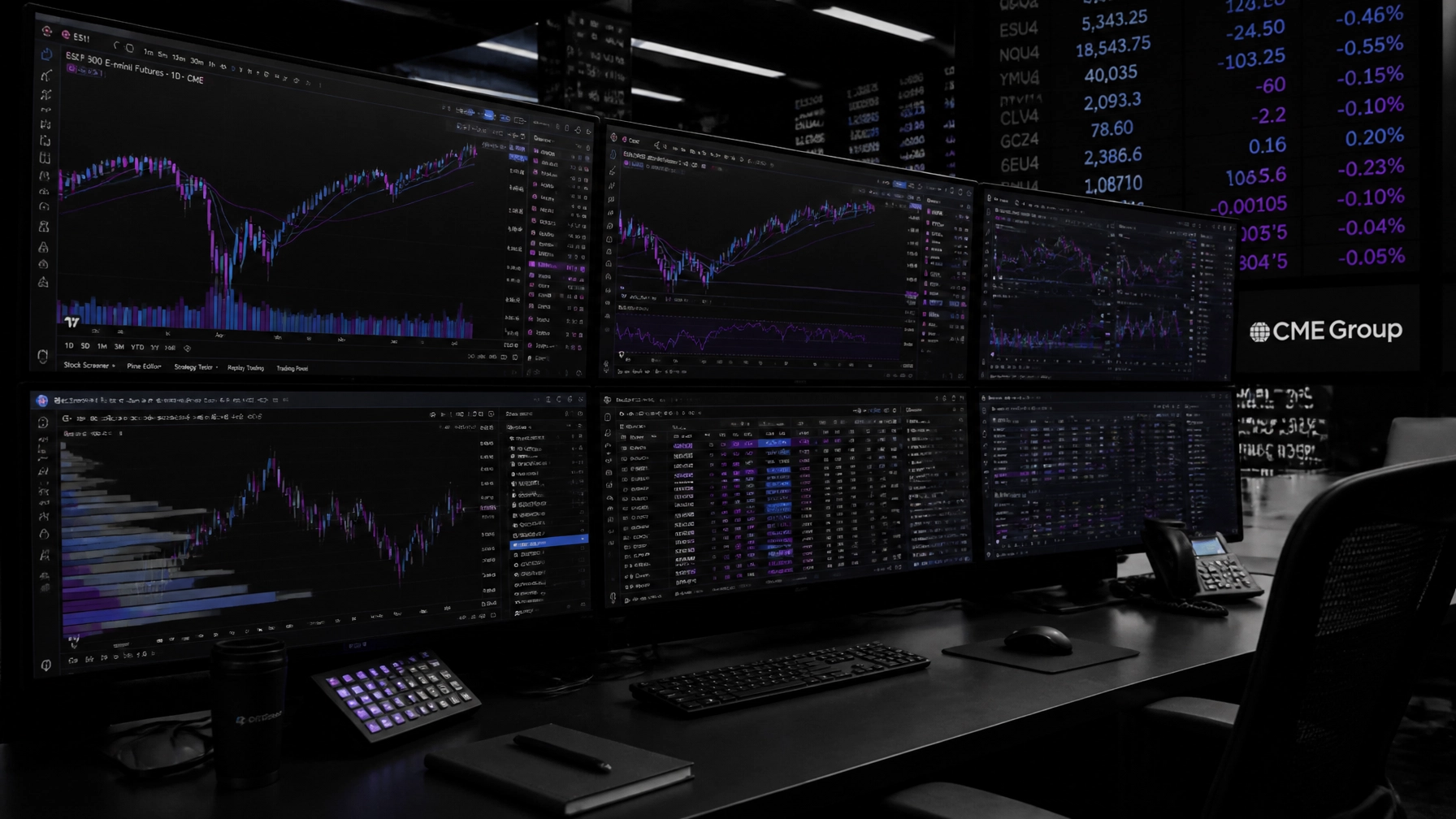
JOIN THE ELITE COMMUNITY

Trading can be a lonely profession, but it doesn't have to be. In the CK Masterclass, you aren't just a number; you are part of a brotherhood of traders. We share wins, analyze losses, and push each other toward that next payout.

With CK’s guidance, you’re not just learning a skill: you’re adopting a lifestyle of discipline, clarity, and success.

Are you ready to remove the noise?

Enroll in the CK Masterclass Today


Disclaimer: Trading involves significant risk. Results are not guaranteed. Always trade with capital you can afford to lose. We focus on low-risk entry through prop firm capital to protect your personal assets.

Prop Firm Drawdown Management That Keeps You Funded

A prop account is not usually lost because a trader cannot find a winning setup. It is lost because one oversized trade, one revenge-trading session, or one ignored loss limit puts the account too close to its drawdown line. Prop firm drawdown management is the skill that keeps a good trading idea from turning into a blown evaluation.

That matters because the goal is not to hit a home-run day. The goal is to pass, protect funded capital, and put yourself in position to request payouts again and again. You do not need to be perfect. You need a process that leaves room for normal losing trades without putting your account at risk.

What Drawdown Actually Means in a Prop Account

Drawdown is the amount your account can decline before you violate the firm’s rules. It is your financial boundary. Cross it, and the evaluation or funded account can be closed, even if your next trade would have been a winner.

The confusing part is that prop firms do not all calculate drawdown the same way. Some use a trailing threshold that rises as your account balance rises. Others use an end-of-day calculation, where the threshold updates after the session closes. Many firms also have a separate daily loss limit.

Those details change how you should trade. A trader who treats every drawdown rule the same may accidentally take risk that looks reasonable on the chart but is dangerous for the account.

Trailing Drawdown Changes the Game

A trailing drawdown follows your high-water mark. If you start an evaluation with a $50,000 account and build a profit cushion, the drawdown threshold may move upward with you. A big winning day can feel exciting, but it can also tighten the room you have to absorb a normal pullback.

This is why aggressive traders often create a problem after a strong start. They make $1,500, feel ahead of schedule, then give back $1,200 trying to make another $1,500. Their chart reading may not be the issue. Their account management is.

With a trailing threshold, profits are not just money on a screen. They affect the amount of breathing room available for the next trade. Learn exactly when your firm calculates the threshold and whether unrealized gains affect it. Rules can change, so always verify the current terms for the specific account you are trading.

Daily Loss Limits Are a Separate Wall

Your total drawdown tells you how much the account can lose overall. A daily loss limit tells you how much damage is allowed in one session. You can be safely above your overall drawdown and still fail the account by violating the daily limit.

Treat the daily limit as an emergency stop, not as your planned risk amount. If your firm permits a $1,000 daily loss, planning to lose $950 is not disciplined. One slippage event, a missed stop, or an unexpected news spike can put you over the line.

A smarter approach is to create your own daily stop well before the firm’s number. That personal stop is where you step away, review your execution, and protect the opportunity to trade tomorrow.

Build Your Risk Plan Before the Market Opens

The market moves fast. Your risk plan cannot begin after you are already down two trades. Decide your limits before the opening bell, when you are calm and not trying to recover money.

Start with the exact numbers: your account balance, drawdown threshold, daily loss limit, contract size, and stop-loss distance. Then calculate what one losing trade costs. If one trade risks $250 and your personal daily stop is $500, you have room for two full-risk losses. That tells you immediately that taking five random attempts is not an option.

Your plan should answer three questions: How much can I lose on one trade? How much can I lose today? At what point do I stop trading even if I still feel confident?

For many evaluation traders, a practical rule is to risk only a small fraction of the available drawdown per trade. The right number depends on the account rules, your setup quality, and how consistently you honor stops. The key is that a single trade should never have the power to end your evaluation.

Size Positions for Survival, Not Excitement

Contract size is where discipline becomes visible. A setup can be valid, but the position can still be too large for the account.

New traders often choose size based on how much they want to make. Professional-minded traders choose size based on how much they can afford to lose. That shift changes everything.

If a normal stop on NQ is 20 points, trading multiple contracts may create a dollar risk that is too large for your daily plan. You may have a clean entry, a clear trend, and a strong TradingView signal, but none of that removes the need for appropriate size. The same setup with one micro contract can keep you in the game. The oversized version can end the account in minutes.

There is a trade-off here. Smaller size means slower progress. It may take longer to pass an evaluation or reach a payout target. But slower progress is better than constantly restarting. The trader who protects capital gets more repetitions, more data, and more chances to improve.

Create a Hard Stop for the Day

A hard daily stop is one of the strongest tools in prop firm drawdown management. It prevents a bad session from becoming a disaster.

Your stop can be based on dollars, a number of losing trades, or both. For example, you might stop after two full stop-outs or after reaching your personal daily loss amount, whichever comes first. The rule should be simple enough to follow without negotiation.

The most dangerous moment is often after the second loss. You may see another setup and tell yourself it is the one that will fix the day. Sometimes it may work. But if your edge requires you to trade emotionally after breaking your plan, it is not an edge you can build a business around.

Close the platform, write down what happened, and come back with a clear head. A red day is part of trading. A blown account from refusing to stop is a decision.

Protect Profits Once You Build a Cushion

Passing an evaluation requires a different mindset than protecting a funded account, but both demand restraint. Once you have a profit cushion, your first job is to defend it.

Suppose you are up $1,200 and your next setup would risk $400. That trade may fit the firm’s rules, but it may not fit your current objective. If your account has a trailing drawdown, risking a large portion of your newly earned cushion can put you back under pressure quickly.

This does not mean you should stop taking valid setups every time you are green. It means your size and frequency should reflect the account’s position. Some traders reduce size after a strong day. Others set a daily profit target, then stop when it is reached. Either approach can work if it protects consistency rather than feeding the urge to maximize every session.

Trade Fewer, Better Setups

Overtrading is usually a drawdown problem before it becomes a strategy problem. More trades create more opportunities for fees, slippage, impulsive entries, and rule-breaking.

Build a short list of setups you understand. Maybe you trade a trend continuation after confirmation, a key support or resistance reaction, or a specific opening-range move. Use your charting tools to identify the conditions, then wait for the market to meet them. Do not force trades because you are bored or because you want to make back a loss.

At CK Trader Pro, the focus is on structured execution: read the trend, identify the level, define the risk, and let the setup earn the trade. That process helps beginners avoid random entries and gives experienced traders a way to tighten up the habits that keep causing failed evaluations.

Review Drawdown Like a Coach, Not a Critic

Every losing day gives you information if you review it honestly. Record your entry, stop, size, market condition, and reason for taking the trade. Then ask whether the loss came from a valid setup that simply failed or from a rule you ignored.

Those are very different problems. A valid loss belongs in the plan. A loss caused by doubling size, moving a stop, or trading during a news spike without preparation needs a correction.

Watch for repeated patterns. If most of your drawdown happens between 9:30 and 10:00 a.m. Eastern, you may need to trade smaller during the open. If your biggest losses come after your first green trade, you may be giving profits back through overconfidence. The goal is not to shame yourself. It is to find the exact leak and close it.

Make the Next Session Boring on Purpose

The best drawdown management often looks boring. It is one or two planned trades, defined stops, controlled size, and the discipline to walk away when the plan says you are done.

That is how you turn a low-cost evaluation into a real capital opportunity. Protect the account first. Let consistency do the heavy lifting. Before your next session, write down your personal daily stop, your per-trade risk, and the one setup you are willing to wait for. Then trade that plan like the funded trader you are working to become.

Apex Trader Funding Evaluation Tips That Work

Most traders do not fail an Apex evaluation because they cannot find a winning setup. They fail because one oversized trade turns a normal red day into a drawdown problem. These Apex Trader Funding evaluation tips are built around the skill that actually gets traders through: protecting the account long enough for your edge to do its job.

An evaluation is not the place to prove how aggressive you can be. It is a controlled performance test. Your mission is to reach the profit target while respecting every active rule, keeping your decisions repeatable, and avoiding the emotional trades that blow accounts. Pass it clean, then carry that same process into funded trading and toward payouts.

Start With the Rules, Not the Profit Target

Before you place a trade, know exactly what your selected Apex account requires. Rules, account options, and policy details can change, so review the current terms for the specific account you purchased. Do not trade based on a screenshot from a Discord group or a rule you remember from a previous evaluation.

Focus on the numbers that shape every decision: the profit target, maximum drawdown threshold, whether the drawdown trails, contract limits, news or trading-hour restrictions if applicable, and the conditions for funded-account eligibility. The profit target gets attention because it feels like the goal. The drawdown is what determines whether you get another chance tomorrow.

Think of your available drawdown as business inventory. Once it is gone, your evaluation is over. A trader who protects it can take dozens of high-quality attempts. A trader who risks a huge portion of it on one trade is depending on luck, not skill.

Choose an Account Size You Can Actually Manage

Bigger buying power can look exciting, but it does not automatically make an evaluation easier. Larger account sizes often tempt traders to use too many contracts, widen stops, and chase a larger daily number. That is where discipline disappears.

Choose an account size that matches your experience, your preferred futures product, and the dollar amount you can comfortably risk per trade. If you are learning to trade the E-mini Nasdaq-100, for example, start with micros if they allow you to keep your stop logical without putting too much money at risk. Micro contracts are not a sign that you are thinking small. They are a professional tool for controlling exposure while building consistency.

The right size is the one that lets you execute your plan without feeling like every tick is a crisis. Once you can do that consistently, scaling becomes a decision based on data, not excitement.

Build Your Evaluation Around a Daily Loss Limit

Set a personal daily loss limit that is tighter than the firm’s maximum drawdown. This is one of the most useful Apex Trader Funding evaluation tips because it stops a difficult session from becoming a failed evaluation.

Your limit should fit your account and setup, but the principle stays the same: after a predetermined amount of loss, you are done for the day. No revenge trades. No doubling size to get back to green. No searching for a trade because you are frustrated.

A simple risk framework might include these four rules:

  • Risk a fixed dollar amount or a small fixed percentage of your available drawdown on each trade.
  • Stop trading after two or three planned losing trades.
  • Set a daily profit goal that is realistic, then protect gains rather than forcing more trades.
  • Never increase size after a loss to recover faster.

This approach can feel slow when social media is full of huge winning screenshots. But evaluations are passed through controlled repetition. A series of modest green days is far more valuable than one massive day followed by an account-ending loss.

Trade One or Two Setups, Not Every Market Move

The market gives you endless reasons to trade. A trend continuation, a breakout, a reversal, a news reaction, a support-and-resistance bounce. Trying to trade all of them usually leads to inconsistent entries and random risk.

Pick one or two setups that you can define clearly. At CK Trader Pro, the focus is on helping traders read trend, structure, key levels, and confirmation rather than treating every candle as a signal. Your setup should answer basic questions before you enter: What is the market trend? Where is the invalidation level? What confirms the entry? Where is the first logical target?

For example, a trader may only take pullbacks in the direction of the higher-timeframe trend after price reacts at a marked level. Another may specialize in opening-range breaks with a defined stop. The exact setup matters less than your ability to recognize it, execute it, and review it.

If the setup is not present, your best trade may be no trade. That is not lost opportunity. It is account protection.

Let the Stop Define Position Size

Never choose your contract size first and then force a tight stop to fit it. Start with the technical stop. Place it where your trade idea is proven wrong, then calculate how many contracts keep the dollar risk within your limit.

This is especially critical in faster products such as Nasdaq futures. A stop that looks small on a chart can carry meaningful dollar risk when size is too high. Use micros when needed. The goal is not to make every trade feel exciting. The goal is to stay in the game while your best setups play out.

Treat the First Hour With Respect

The market open can create excellent opportunity, but it also creates fast movement, wider emotion, and impulsive decisions. Many evaluation accounts are damaged before the trader has even had time to settle in.

You do not have to trade the first minute to be a real day trader. Let initial volatility show its hand. Mark your levels before the session, identify whether the market is trending or rotating, and wait for your criteria. If you trade the open, reduce size until you have proven that your plan works in that environment.

The same goes for major economic releases. A scheduled report can invalidate a technically clean setup in seconds. Know the calendar. If high-impact news is part of your plan, trade it with specific rules. If it is not, stand aside until conditions become readable again.

Protect Green Days From Becoming Red Days

One of the biggest mindset shifts in prop trading is understanding that you do not need to squeeze every dollar out of every session. Once you hit a solid daily goal, the quality of your decision-making can decline. You start seeing trades that are not really there because you want a bigger number.

Create a daily “done” point. It may be a dollar target, a number of quality trades, or a time-based rule after a strong session. When you reach it, either stop or trade only your highest-conviction setup at reduced risk.

This does not mean you must quit after every small winner. It means your plan should tell you when enough is enough. Traders often give back profits because they do not have a process for protecting success.

Journal the Trades That Nearly Broke Your Rules

A trade journal should not be a collection of entry prices and vague notes. Record the reason for the trade, the market condition, the stop and target, the result, and whether you followed your rules. Most importantly, write down the moments when you wanted to break discipline.

Did you enter early because you feared missing the move? Did you move a stop because you did not want to accept a loss? Did you add contracts without a valid setup? Those decisions reveal more about your evaluation results than a single winning trade.

Review your journal weekly. Look for repeated errors, not just repeated losses. A losing trade that followed the plan may be completely acceptable. A winning trade that ignored the plan is dangerous because it teaches the wrong lesson.

Pass the Evaluation, Then Keep Trading Like You Are Evaluating

Passing can create a new problem: traders relax their risk rules the moment they see funded status. They increase size, chase payouts, and forget the discipline that got them there. The habits that pass an evaluation are the same habits that give you a real chance to manage funded capital over time.

Keep your personal daily loss limit. Keep using defined stops. Keep trading your best setups and recording your decisions. A funded account is not a finish line. It is an opportunity to show that your process works under pressure.

Your next evaluation does not need a heroic trade. It needs a calm plan, controlled size, and the patience to let consistency compound. Run your own race, protect the drawdown, and make every session a professional one.

Apex Vs TakeProfitTrader: Which Is Better For Your Futures Trading?

Choosing a prop firm is the single most critical decision you will make as an aspiring futures trader. It is the difference between struggling with your own hard-earned capital and leveraging institutional-grade liquidity to achieve true financial sovereignty. Today, two titans dominate the landscape: Apex Trader Funding and TakeProfitTrader.

Both offer a path to trading five, six, or even seven-figure accounts. Both provide the leverage you need to escape the "small account" trap. But their rules, drawdown structures, and payout philosophies are worlds apart.

At the CK Trading Institute of Technology, we don't just watch the markets: we live them. With over 28 years of floor trading wisdom, CK (George Ama) has seen every "gimmick" in the book. Our mission is to strip away the noise and give you the raw, technical edge required to pass these evaluations and, more importantly, keep the funding once you get it.

In this deep dive, we compare Apex vs TakeProfitTrader to see which firm aligns with your strategy and how the CK Masterclass provides the missing piece of the puzzle: Precision Execution.


Apex Trader Funding: The Scaler’s Powerhouse

Apex Trader Funding is the undisputed heavyweight when it comes to sheer scaling potential and profit-sharing generosity. If your goal is to manage a massive portfolio of accounts and maximize every dollar of profit, Apex is built for you.

The Apex Edge

The most compelling reason to choose Apex is the economics. They offer a 100% profit split on your first $25,000 in profits per account. After that, you still retain a massive 90%. For a trader running the maximum of 20 accounts, the math becomes life-changing very quickly.

  • Scaling: Up to 20 accounts and roughly $3,000,000 in total funded capital.
  • Low Barrier to Entry: Evaluations often start as low as $20 during major promotions.
  • Speed: You can pass an evaluation in as little as one trading day during specific promo periods.

The Challenge: The Trailing Drawdown

Apex isn't for the faint of heart. Their primary hurdle is the Intraday Trailing Drawdown. Unlike static drawdowns, this limit moves up in real-time as your open profit increases. If you are up $1,000 in a trade and let it pull back to break even, you may have already "trailed" your drawdown into a violation.

This requires a "no-nonsense" approach to trade management. You cannot afford "messy" charts or emotional exits. This is where the CK Automated Trade Assistant (ATA) becomes your greatest ally. By identifying clean macro and micro trends, our AI-powered algorithms help you lock in profits before the trailing drawdown catches up.

LEVERAGE THE APEX EDGE TODAY:
Use code KZRKEGJN for up to 90% OFF your evaluation.
GET STARTED WITH APEX TRADER FUNDING HERE


TakeProfitTrader: The King of Simplicity

If Apex is the institutional powerhouse, TakeProfitTrader (TPT) is the streamlined execution specialist. Their philosophy is centered on removing the "gotchas" that cause traders to fail.

Trader execution focus high-contrast B&W

The TPT Edge: End-of-Day Drawdown

The biggest selling point for TakeProfitTrader is the Static End-of-Day Drawdown. Unlike Apex, TPT only calculates your drawdown based on your closed balance at the end of the trading day. This means you can breathe. Intraday volatility won't kill your account as long as your final daily balance stays above the threshold.

  • Immediate Payouts: Withdraw profits from Day 1 of your funded "Pro" account.
  • No Minimum Payouts: If you make $100, you can withdraw $100.
  • Simplified Rules: No complex consistency caps or "safety nets" to worry about before your first check.

The Trade-off

The cost of this simplicity is the profit split and scaling. You typically keep 80% to 90% of profits, and you are limited to 5 accounts. For many, this is a fair price for the peace of mind that comes with a static drawdown.


Side-By-Side: Apex vs TakeProfitTrader

Feature Apex Trader Funding TakeProfitTrader
Drawdown Type Intraday Trailing End-of-Day Static
Profit Split 100% of first $25k, then 90% 80% (Pro) or 90% (Pro+)
Max Accounts 20 5
Payout Speed Every 8-10 days (Structured) Same-Day / Daily (Flexible)
Evaluation Cost Extremely Low (w/ Code KZRKEGJN) Moderate
Consistency Rule Stricter (30% Rule) Flexible

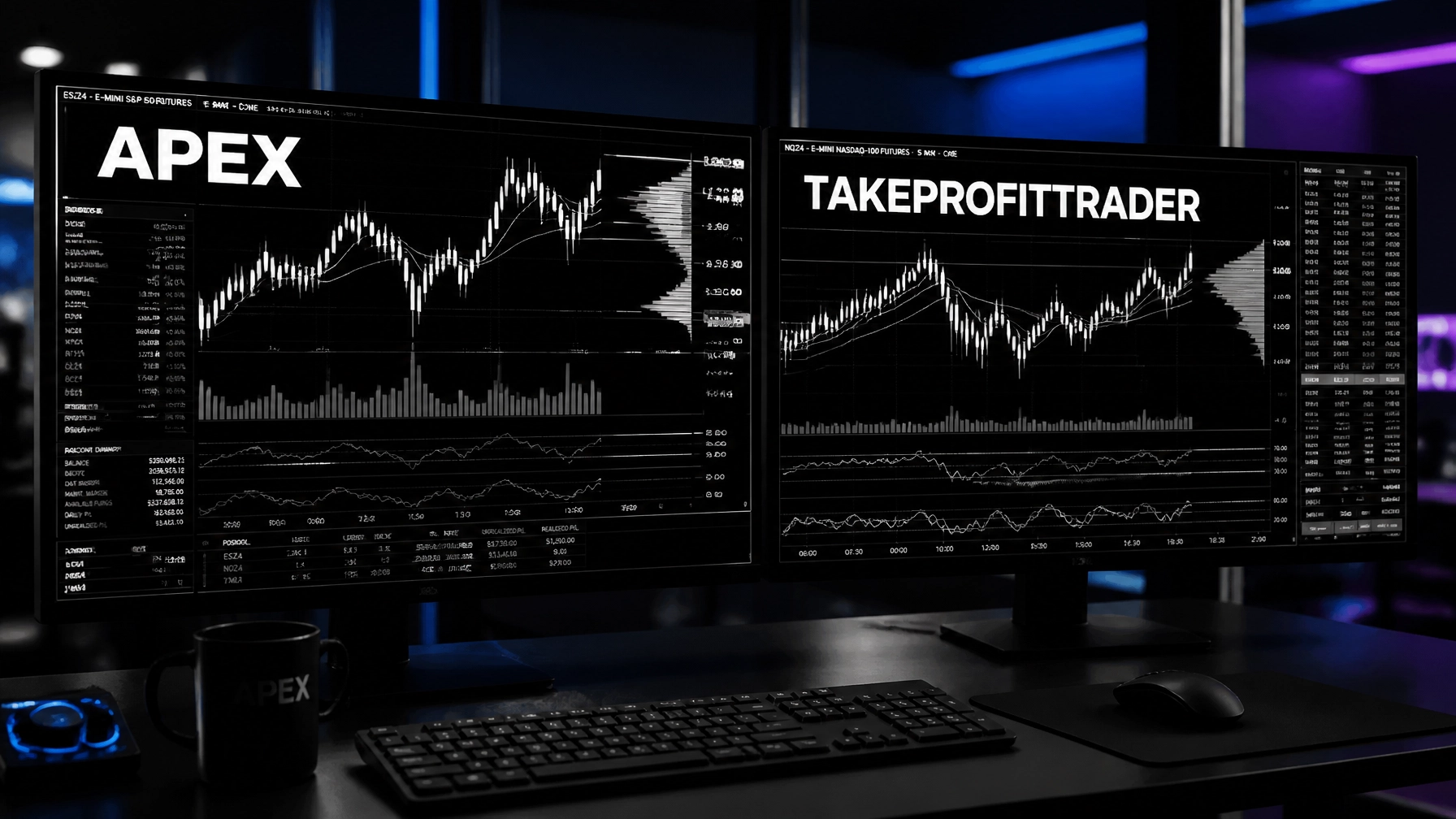
Comparison of trading interfaces B&W high contrast


Why Education is the "Force Multiplier"

Whether you choose the high-scaling potential of Apex or the simplified rules of TakeProfitTrader, the firm is only providing the capital. You provide the skill.

Most traders fail because they treat prop firms like a lottery. They "gamble" $20 to try and win $50,000. This is a recipe for disaster. To succeed, you must adopt the mindset of a Floor Trader.

The CK Masterclass Advantage

CK (George Ama) brings 28 years of institutional floor trading experience to your screen. We teach a "Clean Charting" methodology that removes the indicators that lag and the noise that distracts.

  1. Macro/Micro Trend Alignment: We show you exactly where the big money is moving so you aren't caught on the wrong side of a trailing drawdown.
  2. AI-Powered Algorithms: Our custom TradingView scripts, including the ATA, provide objective entry and exit signals. This removes the "hope" and "fear" from your execution.
  3. Risk Mitigation: Learn to trade with just $20 of your own money to access $50k, $100k, or $150k in buying power. We focus on 10x potential while keeping your personal risk near zero.

CK Trading Institute Clean Charting Analysis

"The markets don't care about your feelings. They care about liquidity and levels. Once you see the clean chart, you see the truth." : CK


Authentic Results: The Proof is in the Payouts

We don't just teach; we produce funded traders. Our community is filled with individuals who have transitioned from "blown accounts" to consistent payouts.

  • “I struggled with the Apex trailing drawdown for months. CK showed me how to read the micro-trends and use the ATA. I just received my first $3,000 payout in 10 days.” : James R.
  • “TakeProfitTrader’s EOD drawdown combined with CK’s clean charting is a cheat code. I’m finally trading without the stress of intraday swings killing my account.” : Sarah L.

The Verdict: Which Should You Choose?

Choose Apex Trader Funding if:
You are a disciplined trader who wants to manage 20 accounts and maximize your profit share. You understand trailing drawdown and want the lowest entry cost possible.

  • Action: Sign up with code KZRKEGJN for the best possible discount.

Choose TakeProfitTrader if:
You prefer a "hands-off" drawdown approach and want the ability to withdraw your profits immediately without waiting for structured payout windows.

  • Action: Choose the Pro+ plan for the best profit split.

Final Step: Seize Your Financial Sovereignty

Don't let another day pass trading with a small account that limits your potential. Leverage the capital of these prop firms and the wisdom of the CK Trading Institute of Technology. Whether you want to replace your daily job income or build a massive trading empire, the path is clear.

Amplify your success. Leverage our expertise. Seize your future.


🔥 LIMITED TIME OFFER: APEX TRADER FUNDING DISCOUNT 🔥

Ready to pass your evaluation? Use our exclusive link and coupon code to get the lowest price in the industry.

Coupon Code: KZRKEGJN (Up to 90% OFF)
Affiliate Link: Claim Your Discounted Evaluation Here

PROMOTIONAL ALERT: APEX TRADER FUNDING

Get funded with up to $300,000 per account. Use the link below and apply code KZRKEGJN at checkout for the maximum available discount.

JOIN APEX TRADER FUNDING NOW


Prop Firm Trading Success Starts With Risk Control

A $50,000 or $150,000 prop account can make trading feel like the opportunity finally got bigger. But prop firm trading success is rarely decided by account size. It is decided in the small moments: whether you honor your stop, whether you stop after a bad trade, and whether you avoid turning one red morning into a blown evaluation.

That is the shift many traders need to make. You are not trying to hit a home run on every session. You are building a controlled process that can meet a prop firm’s rules, protect the account, and give your edge enough repetitions to work.

Why Good Traders Still Fail Prop Evaluations

A trader can read trend, spot support and resistance, and still fail evaluation after evaluation. The usual issue is not a lack of market knowledge. It is a lack of structure under pressure.

Prop firm rules amplify mistakes. A trailing drawdown, daily loss limit, or profit target creates a specific environment where oversized positions and revenge trades are punished fast. You may be right on your market direction, but if you take too much risk before the move develops, the account can be done before the setup has a chance to play out.

The goal is not to trade scared. It is to trade with a plan that makes one losing trade ordinary rather than emotional. When a loss is within your predetermined risk, you can review it, reset, and wait for the next clean opportunity. When the loss is too large, your decision-making usually gets worse from there.

This is why passing is not the finish line. A trader who passes with random sizing and no rules may struggle to keep a funded account. The habits that protect an evaluation are the same habits that help make a payout possible.

Build Your Prop Firm Trading Success Plan Before the Open

Your best decision of the day should happen before the market starts moving. Define what you will trade, where you will trade it, how much you will risk, and what will make you stop. If those answers change every few minutes, you are reacting instead of executing.

Start with one market and a manageable account size. Futures traders often get distracted by having too many products available. They jump from the E-mini S&P 500 to Nasdaq, crude oil, gold, and back again, chasing whichever chart appears active. That creates inconsistent reads and inconsistent risk.

Choose a primary market and learn its behavior during the sessions you trade. Pay attention to how it reacts around prior-day high and low, overnight range, major support and resistance, and the opening range. You do not need ten indicators to develop this skill. You need repeated screen time and a clear charting process.

Define a Setup You Can Explain

A tradable setup should be simple enough to state before you enter. For example: the market is trending higher, pulls back into a key level, confirms buyers are stepping back in, and gives a defined stop location below the setup. That is very different from entering because a candle moved quickly and you are afraid to miss it.

Your setup needs three parts: context, entry trigger, and invalidation. Context tells you why the area matters. The trigger tells you when to act. Invalidation tells you where the trade idea is wrong.

TradingView-based tools and algorithms can help organize that process by making trend, levels, and potential shifts easier to see. They are not permission to enter every signal. The trader still has to decide whether the market context matches the plan and whether the stop fits the available risk.

Set Risk in Dollars, Not Feelings

Before entering, know your maximum loss for that trade and your maximum loss for the session. Those numbers should fit comfortably inside your prop firm’s drawdown rules, with room for normal trading variance.

A practical approach is to set a small fixed risk per attempt, then use a hard daily stop after a limited number of losses. The right dollar amount depends on your account rules, instrument, stop size, and experience level. A newer trader may need smaller risk than someone with months of proven data. What matters is that the number is set before the trade, not expanded after the trade goes against you.

Avoid treating the daily loss limit as your intended risk budget. That limit is a guardrail, not a target. If your platform allows automated risk controls, use them. An Automated Trade Assistant can help make stop placement, position management, and daily discipline more consistent, but it works best when it supports a written plan rather than replaces one.

Trade the Evaluation, Not Your Ego

The fastest way to turn a solid trading day into a disaster is to force the profit target. Traders see the finish line getting close and suddenly double size, take lower-quality entries, or hold winners without a plan. The same thing happens after a loss when someone feels the need to get back to even immediately.

Neither response is professional. An evaluation is a risk-management test as much as a profit test. The firm wants to see that you can operate within defined limits. Your job is to show steady execution, not prove that you can predict every move.

There will be days when the market does not give your setup. Flat, choppy sessions can tempt you into overtrading because the screen is open and you want progress. Taking no trade can be a strong decision when your edge is absent. Capital preservation is still progress.

If you hit your daily goal early, consider whether continuing to trade improves your odds or simply increases exposure. There is no prize for being active all day. Many accounts are damaged after the trader has already made enough because they keep looking for one more move.

Create a Routine That Holds Up on Red Days

Motivation helps you start. Routine is what carries you through a losing streak without abandoning your system.

Keep a trading journal that captures more than profit and loss. Record the market condition, setup type, entry reason, stop size, target plan, and whether you followed your rules. A screenshot of the chart before and after the trade can reveal patterns that a number alone will miss.

At the end of the week, review execution before results. Did you enter only planned setups? Did you respect stops? Did you trade beyond your session limit? A green week built on poor habits is not necessarily a win, because those habits can fail when volatility changes. A small red week with disciplined execution may be far more valuable data.

Accountability speeds this process up. Trading alone makes it easy to justify a bad entry or ignore an oversized loss. A community of traders working from structured rules gives you perspective when you are tempted to break yours. At CK Trader Pro, the focus is on helping traders build that repeatable process through live guidance, chart education, and practical prop-firm risk management.

Know When to Scale and When to Stay Small

More contracts do not automatically create more income. They magnify every part of your execution, including hesitation, poor entries, and undisciplined exits. Scale should be earned through consistent data, not confidence after one strong day.

Consider increasing size only after you have a meaningful sample of trades showing that you can follow your plan, maintain controlled drawdowns, and avoid emotional decisions. Even then, make changes gradually. One additional contract can be enough to test whether your process remains stable.

It also depends on the market. A stop that is reasonable in a quiet session may be too tight during major economic news or fast volatility. If the proper stop becomes wider, reduce size or stand aside. Forcing the same position size into every condition is not consistency. It is ignoring risk.

The Real Edge Is Staying in the Game

Prop trading gives retail traders a path to pursue larger buying power without putting thousands of personal dollars directly at risk in the market. That does not make it easy money. Evaluation fees, rules, and losses are real, and no strategy guarantees a pass or a payout.

What it does offer is a clear structure for learning professional habits. Read the chart. Wait for your setup. Define the risk. Execute without drama. Stop when your rules say stop. Repeat that process long enough to collect honest data.

Your next trade does not need to change your life. It needs to be a trade you would be proud to document, review, and take again under the same conditions. That is how a funded account becomes something you can manage with confidence rather than something you are constantly trying to save.

How to Pass a Prop Firm Evaluation Without Blowing It

A prop firm evaluation is rarely lost because a trader cannot find a good setup. It is usually lost because one emotional trade turns a manageable red day into a blown account. If you want to learn how to pass prop firm evaluation rules, start with this mindset: the goal is not to make the most money possible today. The goal is to protect the account long enough for your edge and discipline to do their job.

A low-cost futures evaluation can give you a path to larger buying power without putting thousands of your own dollars on the line. But that opportunity comes with rules. Profit targets, trailing drawdowns, consistency expectations, and payout requirements all reward traders who can execute with control. Treat the evaluation like a professional audition, not a casino run.

Know the Rules Before You Place a Trade

Every prop firm and account type can have different requirements. Before the market opens, know your exact profit target, maximum drawdown, daily loss limit if one applies, contract limits, minimum trading days, and rules for holding positions through news or overnight.

Do not trade based on what you think the rules are. Pull them up, write them down, and build your plan around the strictest number. A trader who has a $2,500 drawdown does not have $2,500 available to risk. That drawdown is the business capital that keeps the evaluation alive.

This matters even more with trailing drawdown rules. In many evaluations, the drawdown follows your account balance as you make money. A fast profit day can raise the threshold you must protect. That means a big win followed by oversized risk can put you right back in danger.

The best approach is simple: understand how much room you have, then trade as if you have less. If your account gives you room for five poor trades, plan for two. That buffer changes your decision-making when the market gets choppy.

Build a Passing Plan, Not a Lottery Ticket

The fastest path to failure is trying to pass an evaluation in one trade. You might see traders posting huge days online, but you do not see every reset, every blown account, or every bad decision behind the screenshot.

A passing plan starts with a realistic daily target. If the profit target is $3,000, you do not need a $1,000 day. A series of controlled $150 to $300 days can get you there while keeping your drawdown intact. The exact number depends on your account size, setup quality, and risk tolerance, but the principle does not change: small, repeatable gains beat unpredictable hero trades.

Set three numbers before each session: your daily profit goal, your maximum daily loss, and your maximum number of trades. Once you hit your profit goal, seriously consider stopping. Once you hit your loss limit, stop without negotiation. And if you have taken your planned number of trades without a clean result, step away.

That last rule protects traders from revenge trading. After two or three losses, the market has not personally wronged you. You may simply be trading during poor conditions, forcing entries, or reading the session incorrectly. Walking away is not weakness. It is account protection.

Trade One or Two Setups You Can Explain

You do not need ten indicators, five markets, and a new strategy every week to pass. You need a setup you can recognize, define, and execute repeatedly.

For many futures traders, that means focusing on one primary market, such as the E-mini S&P 500 or Nasdaq futures, during a specific time window. It may mean waiting for a trend continuation after a pullback, a key support or resistance reaction, or a breakout that holds after retesting a level. The setup itself matters less than your ability to follow its rules.

Before entering, you should be able to answer four questions:

  • What is the market trend or directional context?
  • Where is my entry level, and what confirms it?
  • Where is my stop, based on structure rather than hope?
  • Where is my first realistic target?

If you cannot answer those questions in seconds, you probably do not have a trade. You have an impulse.

TradingView-based charting tools and algorithms can help you organize trend direction, key levels, and possible entries. But no tool removes the need for risk control. An alert is not a command to enter. Let the chart, the market context, and your written rules line up before you commit capital.

Risk Small Enough to Stay Calm

Most traders do not fail because their strategy has a 0% win rate. They fail because their risk per trade is too large for the account and too large for their emotions.

When one losing trade feels devastating, you will start moving stops, adding contracts, closing winners too early, or taking low-quality trades to get back to even. Your position size should be small enough that a normal loss is boring.

For a newer trader, that may mean starting with one micro contract instead of a mini contract. Yes, the gains are smaller. So are the mistakes. Micro contracts give you room to practice execution, learn how the market moves, and build confidence without allowing one bad click to destroy your evaluation.

As your account gains a cushion, you can carefully scale. But scaling should come from consistency, not excitement. If you cannot follow your plan with one contract, adding size will only make the same problem more expensive.

A strong risk framework might include a fixed stop for every trade, a maximum loss per setup, and a hard daily shutoff. It can also include a rule that you stop after your first clean target is reached. There is no prize for trading all day. The payout comes from protecting profits and repeating good decisions.

Stop Treating Every Market Move Like an Opportunity

The market will move all day. That does not mean you need to participate in all of it.

Some sessions are clean and directional. Others are slow, headline-driven, or trapped in a tight range where both buyers and sellers get chopped up. Your job is to identify whether conditions fit your setup. If they do not, waiting is a valid position.

News events deserve extra respect. Major economic reports, Federal Reserve announcements, and unexpected headlines can create fast moves, wider spreads, and sudden reversals. Some prop firms also have specific rules around news trading. Know the policy, then decide in advance whether you will trade around the event or sit out.

The traders who pass evaluations are often not the ones who trade the most. They are the ones who recognize that a mediocre setup is not worth risking a good account.

Track Execution, Not Just P&L

A green day can come from bad trading. A red day can come from good trading. If you only judge yourself by profit and loss, you will miss the habits that determine whether you can stay funded.

Keep a simple journal after each session. Record the market, setup, entry reason, stop size, result, and whether you followed your rules. Add a quick note about your emotional state. Were you patient? Did you chase? Did you take a trade because you were bored? Did you stop when you said you would?

After a week, patterns become obvious. Maybe your best trades happen in the first hour and your worst losses happen after lunch. Maybe you do well trading pullbacks but lose money forcing breakouts. That information is valuable because it gives you a specific problem to fix.

This is where community accountability can make a real difference. At CK Trader Pro, traders learn to focus on structured execution, chart reading, risk management, and repeatable routines instead of chasing random calls. The goal is to help you become the trader who can pass an evaluation and manage a funded account with the same discipline.

How to Pass a Prop Firm Evaluation After a Loss

You will have losing trades. You may have losing days. That does not mean the evaluation is over.

The wrong response is increasing size to recover quickly. The right response is reducing the next decision to something manageable. Review whether the loss came from a valid setup, a rule break, or poor market conditions. If it was a valid loss, accept it and move on. If it was a rule break, correct the behavior before taking another trade.

When your drawdown gets tight, your priority changes. You are no longer trying to make fast progress. You are trying to stabilize. Trade smaller, take only your highest-quality setup, and give yourself time to rebuild. Sometimes the smartest decision is to pause for the day and come back with a clear head.

Passing is not about being perfect. It is about avoiding the kind of mistakes that make recovery impossible.

Your next evaluation does not need a better guess or a bigger contract. It needs a calmer process: know the rules, define the risk, wait for your setup, and let disciplined days stack up. That is how traders give themselves a real shot at getting funded and staying there.


Apex Vs TakeProfitTrader: Which Is Better For Your Futures Trading?

Choosing the right funded trader program is the first major hurdle on your path to financial sovereignty. In the world of futures trading for beginners, the landscape is dominated by two heavyweights: Apex Trader Funding and TakeProfitTrader. Both offer a gateway to significant capital, but they cater to very different types of traders.

At CK TRADING INSTITUTE OF TECHNOLOGY LLC., we focus on one thing: helping you master prop firm trading with minimal risk. Whether you are looking to trade with $20 instead of $2,000 or you want to scale up to $3 million in capital, understanding the technical nuances between these two firms is critical.

In this guide, we’ll break down the "Problem-Solution-Action" framework to help you decide which firm fits your strategy and how our lead instructor, CK, uses AI-powered algorithms to pass these evaluations with precision.

The Problem: High Barrier to Entry and Risk

Most aspiring traders face the same bottleneck: they have the skill (or the desire to learn), but they don’t have the $50,000 or $100,000 required to trade futures effectively without risking their life savings. Traditional brokerage accounts demand high margins, leaving beginners vulnerable to "blowing up" their personal accounts.

The Solution: Funded Trader Programs

Proprietary (prop) firms like Apex and TakeProfitTrader solve this by providing the capital. You pass an evaluation, and they give you a funded account. However, the "catch" lies in the rules. If you don’t understand the drawdown and consistency rules, you’re just donating evaluation fees to the firms.


Apex Trader Funding: The Volume King

CK Analyzing Trading Charts

Apex Trader Funding is widely considered the industry leader for traders who want to scale fast and keep costs at an absolute minimum.

1. Cost and Accessibility

Apex is the undisputed champion of affordability. With frequent promotions: including our exclusive 90% OFF coupon code 'KZRKEGJN': you can often start a $50,000 evaluation for as little as $15 to $20.

2. The Payout Powerhouse

Apex offers a massive incentive: you keep 100% of your first $25,000 in profits per account. After that, the split remains a highly competitive 90/10. With the ability to hold up to 20 accounts simultaneously, the math is simple: Apex is designed for the trader who wants to maximize their take-home pay.

3. The Challenge: Trailing Drawdown

The main hurdle with Apex is the Intraday Trailing Drawdown. This means your maximum loss limit follows your highest profit point during the trade. If you are up $1,000 and the market retraces, your drawdown moves up with you. This requires professional-level discipline and a technical "no-nonsense" approach to profit taking: exactly what we teach at the CK Trading Institute.


TakeProfitTrader: The Premium Choice

TakeProfitTrader positions itself as a "premium" alternative, focusing on trader-friendly rules and flexibility over raw account volume.

1. End-of-Day Drawdown

The single biggest advantage of TakeProfitTrader is the End-of-Day (EOD) Drawdown. Unlike Apex, your drawdown only updates at the end of the trading day. This is a game-changer for futures trading for beginners, as it allows you to weather intraday volatility without your "trailing stop" being moved against you in real-time.

2. Day-One Payouts

TakeProfitTrader is famous for its "PRO" accounts that allow for withdrawals on day one. There are no strict minimum trading day requirements before you can see your first check, provided you are in the profit zone. For those seeking immediate "financial freedom" and cash flow, this is an attractive proposition.

3. The Trade-Off: Higher Fees and Fewer Accounts

Quality comes at a price. TakeProfitTrader evaluations are significantly more expensive than Apex, and they do not offer the 90% discounts that make Apex so accessible. Additionally, you are limited to 5 accounts, compared to Apex’s 20.


Technical Comparison: At A Glance

Feature Apex Trader Funding TakeProfitTrader
Best For Scaling, Max Profit, Low Entry Cost Intraday Volatility, Fast Payouts
Drawdown Type Intraday Trailing (Live) End-of-Day (EOD)
Max Accounts 20 5
First Profit Perk 100% of first $25,000 N/A
Cost (50K Eval) ~$17 (with 90% OFF) ~$150+
AI/EA Friendly Yes (ATA and Algos allowed) Limited / Manual focus

The CK Advantage: Why the Firm is Only Half the Battle

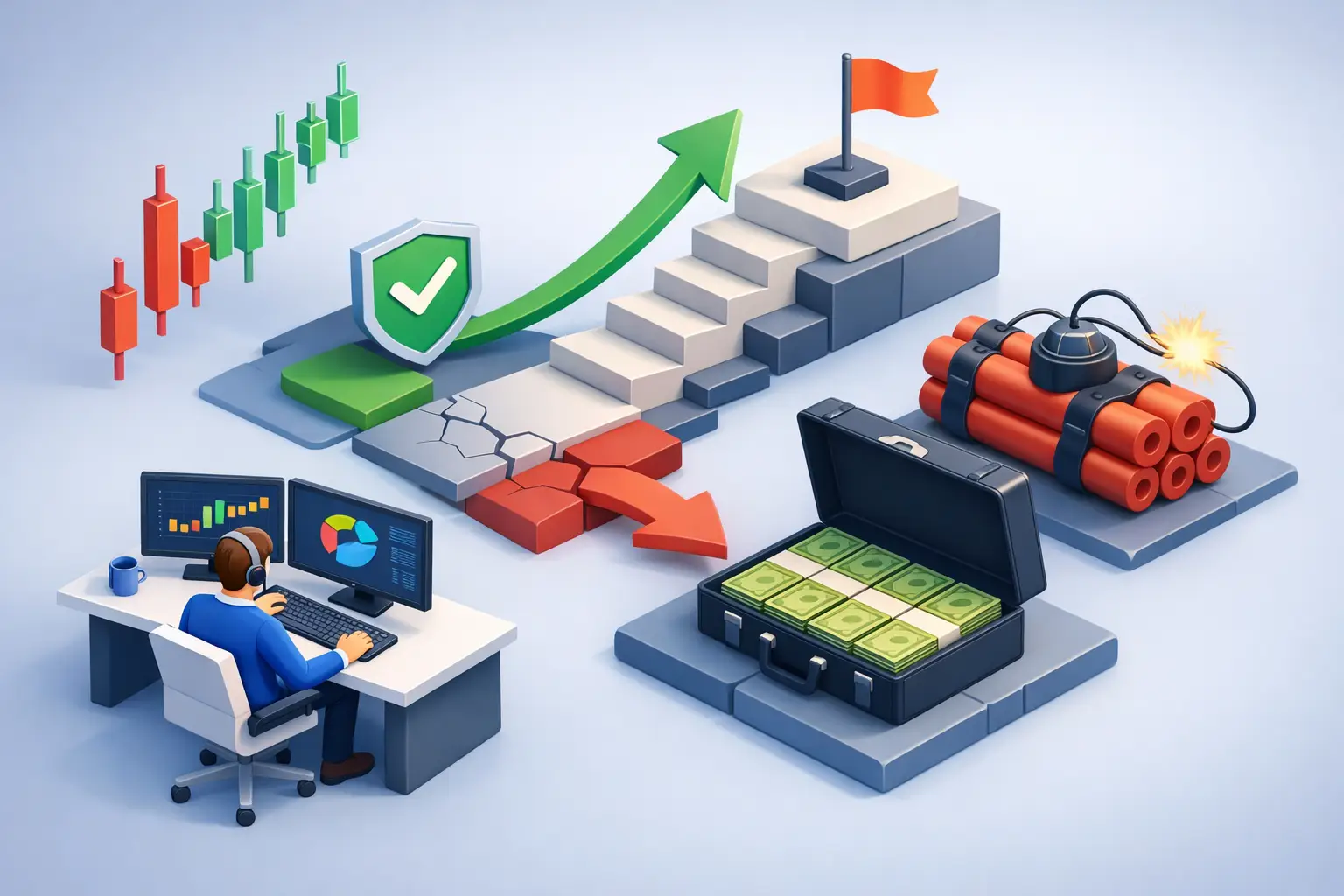
Low Risk High Reward Concept

Choosing between Apex and TakeProfitTrader is like choosing between a Ferrari and a Lamborghini: it doesn't matter which one you pick if you don't know how to drive.

Instructor CK (George Ama) emphasizes that passing these evaluations isn't about luck; it's about removing the noise. Most traders fail because they use cluttered charts and emotional decision-making. We provide the roadmap to mastery through:

  • Clean Charting: Learn to identify macro and micro trends without the "fluff."
  • The ATA (Automated Trade Assistant): Our AI-powered algorithm coded in TradingView. It helps you stay on the right side of the trend and automates the technical heavy lifting.
  • Risk Management: We teach you how to trade with $20 of your own money to unlock $50k+ in capital. Leverage is a tool; we teach you how to wield it without cutting yourself.

"I spent years on the floor of the exchange. The secret isn't a magic indicator; it's a systematic approach to risk. We don't guess. We execute." : CK

Social Proof: Real Results

  • "I passed my 50k Apex evaluation in 8 days using the ATA. One payout more than paid for my entire year of education." : Verified Student
  • "CK's method for handling the trailing drawdown is the only reason I'm still funded. Most people ignore the math; he makes it the priority." : Futures Trader

AI-Powered Precision: Using Algorithms to Win

AI-Powered Precision Algorithm

If you are leaning toward Apex Trader Funding, you have a massive advantage: Automation.

Apex is highly compatible with algorithmic trading and copy traders. Our Advanced Trading Algorithms are designed specifically to navigate the tight rules of prop firms. By using the ATA, you can minimize human error and ensure your entries and exits align with high-probability institutional zones.

The Action: Seize Your Opportunity

Stop risking thousands of your own hard-earned dollars. The path to becoming a professional day trader is through leverage. Apex Trader Funding provides the most capital for the lowest entry price, making it our top recommendation for those who are ready to follow a disciplined, AI-enhanced system.

EXCLUSIVE OFFER FOR OUR COMMUNITY

We have partnered with Apex Trader Funding to give you the ultimate head start. Use the details below to secure your evaluation for a fraction of the cost.

🚀 READY TO GET FUNDED?

Get up to 90% OFF your Apex Trader Funding Evaluation!

Use Coupon Code: KZRKEGJN

CLAIM YOUR DISCOUNT NOW


Final Verdict: Apex or TakeProfitTrader?

Candlestick Chart Analysis

Choose Apex Trader Funding if: You want to manage multiple accounts, you want the lowest possible cost of entry (the $20 path), and you plan to use AI tools like our ATA to handle the trailing drawdown. The potential to earn 100% of your first $25k is simply too good to ignore.

Choose TakeProfitTrader if: You are a manual trader who struggles with the psychological pressure of a trailing drawdown and you want the ability to withdraw profits immediately without waiting for an 8-day cycle.

Whichever path you choose, remember that the capital is only the tool. The skill is the asset. Join CK and our community of elite traders today to ensure that when you get funded, you stay funded.

Leverage your future. Maximize your returns. Seize your financial sovereignty.


5 Steps to Pass Your Apex Evaluation and Get Funded (Easy Guide for Beginners)

Are you tired of watching the markets move from the sidelines because you don’t have enough capital to make a real impact? Most traders believe they need $50,000 of their own cash to start futures trading for beginners. The truth is, you can control that same amount of capital for as little as $20.

At CK TRADING INSTITUTE OF TECHNOLOGY LLC., we specialize in helping traders bridge the gap between "aspiring" and "funded." By leveraging funded trader programs like Apex Trader Funding, you can stop risking your hard-earned savings and start trading with professional-level capital.

But passing the evaluation isn’t just about clicking "buy" or "sell." It requires a strategy. Under the mentorship of CK (George Ama), we’ve distilled the process into five actionable steps.


STEP 1: CHOOSE THE RIGHT EVALUATION SIZE

The first mistake beginners make is over-leveraging. While a 300K account sounds impressive, the profit target and drawdown are significantly higher. For most beginners, we recommend starting with a 50K or 100K evaluation.

In 2026, Apex has standardized the profit target at 6% of the starting balance.

  • 50K Account: $3,000 Profit Target | ~$2,000 Drawdown
  • 100K Account: $6,000 Profit Target | ~$3,000 Drawdown

By starting with a manageable size, you reduce the psychological pressure. Remember, the goal is to pass and get paid, not just to see a big number on your dashboard.

Professional trader at a modern desk with multiple monitors

STEP 2: MASTER THE TRAILING DRAWDOWN

The "Evaluation Killer" is the trailing drawdown. Unlike a static loss limit, the trailing drawdown follows your peak balance in real-time. If you are up $500 in a trade but don't close it, and the market pulls back, your drawdown limit moves up with that peak equity.

CK’s Pro Tip: Focus on "clean" trades with high-probability exits. Don't let winning trades turn into losers, as the trailing drawdown is unforgiving. We teach our students to prioritize risk management over home-run trades. This is how you protect your "cushion" and stay in the game.

STEP 3: LEVERAGE AI-POWERED CLEAN CHARTING

The biggest obstacle to success is "noise." Beginners often clutter their charts with dozens of lagging indicators that provide conflicting signals. At CK TRADING, we use a No-Nonsense approach.

We utilize advanced AI-powered algorithms coded in TradingView, including our Automated Trade Assistant (ATA). These tools remove the guesswork by identifying macro and micro trends with precision.

CK Trading S&P 500 Analysis on TradingView

As you can see in our chart analysis above, we focus on demand and supply zones. When you trade with the trend and use AI to confirm your entries, your win rate increases, and your stress levels decrease.

STEP 4: ADOPT A LOW-RISK EXECUTION STRATEGY

Why risk $2,500 of your own money when you can risk $20? The beauty of funded trader programs is the asymmetrical risk-to-reward ratio.

By using our strategies, you are taught to trade futures: like the S&P 500 (ES) or Nasdaq (NQ): using prop firm capital. One successful payout can result in thousands of dollars in your pocket in as little as 8-10 days. We focus on maximizing returns (10x potential) while minimizing your personal financial exposure.

"Financial sovereignty isn't about how much you have; it's about how much you can leverage safely." : CK

STEP 5: MAINTAIN DISCIPLINE AND ELIMINATE EMOTION

Trading is 20% strategy and 80% psychology. The evaluation phase tests your patience more than your technical skill. Since March 2026, Apex requires at least one trading day to pass. While you could pass in a single session, we encourage a steady, disciplined approach.

Join a community that supports your growth. Our expert-led live sessions provide the guidance you need to navigate market volatility without blowing your account. We strip away the complexity and teach you to trade like a professional floor trader.


START YOUR FUNDED JOURNEY TODAY

Ready to stop dreaming and start trading? We have partnered with Apex Trader Funding to give you the best possible start.

PROMOTION: Use code KZRKEGJN to get up to 90% OFF your evaluation!

SEIZE YOUR FUNDING NOW

Don’t wait for the “perfect” time. Start your evaluation with the industry leader.

GET 90% OFF WITH CODE: KZRKEGJN

Candlestick chart showing precision algorithmic signals

WHY CHOOSE CK TRADING INSTITUTE?

We aren't just another "signal room." We are a comprehensive education center. When you join our community, you get:

  • Comprehensive Training: From beginner basics to advanced macro trends.
  • AI Tools: Access to our proprietary algorithms that clarify price action.
  • Expert Support: Guidance from CK, a 28-year veteran of the trading floors.
  • Proven Results: We help you pass evaluations and, more importantly, keep the funded account.

Check out our Get Started page to see our full curriculum and pricing plans.

FINAL THOUGHTS

Passing an Apex evaluation is your ticket to financial freedom. By following these 5 steps: choosing the right size, mastering drawdown, using AI tools, managing risk, and staying disciplined: you are already ahead of 90% of other traders.

Amplify your potential. Seize your capital. Master your future.


5 Steps to Pass Your Apex Evaluation and Get Funded (Easy Guide for Beginners)

Are you tired of risking your hard-earned savings just to get a seat at the table? Imagine having access to $50,000, $150,000, or even $300,000 in trading capital while only risking about $20 of your own money.

This isn’t a pipe dream. It’s the reality of funded trader programs.

At CK TRADING INSTITUTE OF TECHNOLOGY LLC., we’ve helped countless traders transition from "account blowers" to "consistently funded" pros. The secret isn't a "magic indicator", it's a system. If you want to stop the cycle of frustration and finally see those thousands in payouts, you need a blueprint.

Here is our 5-step "no-nonsense" guide to passing your Apex Trader Funding evaluation and securing your financial sovereignty.


Step 1: Master the Rules (Respect the Trailing Drawdown)

The biggest reason beginners fail their evaluation isn't because they can’t pick a winning trade. It’s because they don’t understand the Trailing Drawdown.

In an Apex evaluation, your "Maximum Loss" limit isn't static. It follows your account's high-water mark. If you make $500, your allowable loss limit moves up $500. This is why we focus on "Clean Charting" and removing the noise. You can't afford "sloppy" trades that dip deep into your drawdown.

The CK Strategy: Treat your evaluation account like it’s your last $1,000. Many traders gamble because the entry fee is low (especially with our 90% off code KZRKEGJN), but if you trade like a gambler, the market will treat you like a donor.

Professional trader focused on market analytics

Step 2: Trade Micros – The Path of Least Resistance

When it comes to futures trading for beginners, the smartest move you can make is to trade "Micros" (MES or MNQ) rather than full-sized contracts.

Why? Because Micros allow you to manage your risk with surgical precision.

  • The Problem: Beginners try to pass a $50k evaluation in two hours by maxing out 10 contracts of NQ. One wrong move, and the account is blown.
  • The Solution: Trade 1–3 Micros. It allows you to stay in the game longer, handle market "breathing," and keep your emotions in check.

Remember, Apex requires a minimum of 7 trading days to pass. There is zero reason to rush. Slow is smooth, and smooth is fast.

Step 3: Leverage AI-Powered Algorithms (The ATA Advantage)

Why guess where the market is going when you can use the same tools the pros use? At CK TRADING INSTITUTE OF TECHNOLOGY, we provide our students with the Automated Trade Assistant (ATA).

AI-powered trading algorithm interface

The ATA doesn't just give you "signals"; it helps you identify macro and micro trends, removes the clutter from your charts, and keeps you on the right side of the trade. In a funded trader program, your edge is your ability to remain objective. Our AI tools do the heavy lifting, allowing you to focus on execution rather than emotion.

Step 4: Implement the "$20 vs. $2,500" Risk Mindset

Let's talk numbers. To trade a $50,000 account on your own, you’d need at least $5,000 to $10,000 in a personal brokerage to avoid immediate liquidation.

With Apex Trader Funding, you can access that same $50,000 account for a tiny fraction of that. By using our affiliate link and the coupon code KZRKEGJN, you can often start an evaluation for as little as $20-$40.

The Math of Success:

  • Your Risk: ~$20 (Evaluation fee)
  • Apex Capital: $50,000+
  • Potential Payout: Thousands in as little as 8-10 days.

This is how you amplify your gains without leveraging your life savings. We teach you to trade with the firm's money, not yours. That is the ultimate low-risk trading approach.

Algorithmic precision candlestick chart

Step 5: Stop Trading Alone – Join the Community

Trading is a lonely game, and the "lone wolf" usually gets eaten by the "market bears." To pass your evaluation, you need a mentor who has been there.

Our lead instructor, CK (George Ama), is a 28-year Floor Trader who has seen every market condition imaginable. When you join the CK TRADING INSTITUTE OF TECHNOLOGY, you aren't just getting a course; you’re getting a seat at the table with an expert who knows exactly what the prop firms are looking for.

We provide:

  • Live trading sessions.
  • Direct guidance on passing evaluations.
  • A community of like-minded traders who are all pushing for the same goal: Financial Freedom.

Ready to Claim Your Funded Account?

The path to mastery is right in front of you. Stop overcomplicating your charts and start following a proven system. Apex Trader Funding is currently offering massive discounts, and there has never been a better time to seize this opportunity.

SEIZE THE OPPORTUNITY: 90% OFF APEX EVALUATIONS

ACTION STEP: Click the link below and use our exclusive code to get started. You can pass this evaluation. We have the tools, the tech, and the community to get you there.

Affiliate Link: Start Your Apex Evaluation Here
Coupon Code: KZRKEGJN (Up to 90% OFF)

GET FUNDED TODAY

Don’t wait for “perfect” conditions. Use code KZRKEGJN at checkout to save up to 90% on your evaluation account.

CLAIM YOUR DISCOUNT NOW


Real Success Stories

"I struggled for a year trying to trade my own $2k account. I'd make $100 and lose $200. After joining CK and using the ATA algorithm, I passed my 50k Apex eval in 10 days. My first payout was $2,400. It changed everything." , Verified Student

CK Trading Institute Success illustration

FAQs

How long does it take to get paid?
Once you pass the evaluation and move to a PA (Paid Account), you can request your first payout in as little as 8-10 trading days, provided you follow the firm's consistency rules.

Is futures trading for beginners?
Yes, if you have the right education. We specialize in taking beginners from zero to hero by focusing on Micro futures, which are perfect for learning the ropes without high stress.

What is the ATA?
The Automated Trade Assistant is our proprietary TradingView algorithm designed to identify high-probability setups and manage risk automatically, ensuring you stay within the prop firm's guidelines.


7 Mistakes You’re Making with Futures Prop Firms (and How CK Fixes Them)

The allure of funded trader programs is undeniable. The promise is simple: pass a simple evaluation, and you’ll be handed five or six figures of professional capital to trade. You keep the lion's share of the profits, and the firm takes the risk.

But here is the cold, hard truth: 95% of traders fail their evaluations.

They aren't failing because they lack "passion" or because the market is "rigged." They are failing because they are making the same seven amateur mistakes that blow accounts within 48 hours. At CK TRADING INSTITUTE OF TECHNOLOGY LLC., led by 28-year floor trader CK, we don't just watch traders fail: we provide the AI-powered tools and clean-charting education to ensure they succeed.

If you’ve been struggling to pass your Apex Trader Funding or TakeProfit evaluation, one of these seven mistakes is likely the culprit. Here is how we fix them.

1. Over-Leveraging (The Account Killer)

The biggest mistake in futures trading for beginners is treating a $50,000 evaluation account like it actually has $50,000 of "wiggle room." Most traders see the high contract limits and immediately max out their position size.

The CK Fix: We teach a low-risk approach. Our Automated Trade Assistant (ATA) is designed to help you manage position sizing based on the actual drawdown, not the total account balance. By risking as little as $20 of your own money to gain access to professional capital, we emphasize longevity over "one-hit wonders."

2. Ignoring the "Trailing Drawdown" Fine Print

Many funded trader programs use a trailing drawdown, which moves up as your profit increases. Beginners often see their account up $1,000, think they have room to breathe, and then watch a reversal wipe out their evaluation because they didn't realize their "floor" moved up with them.

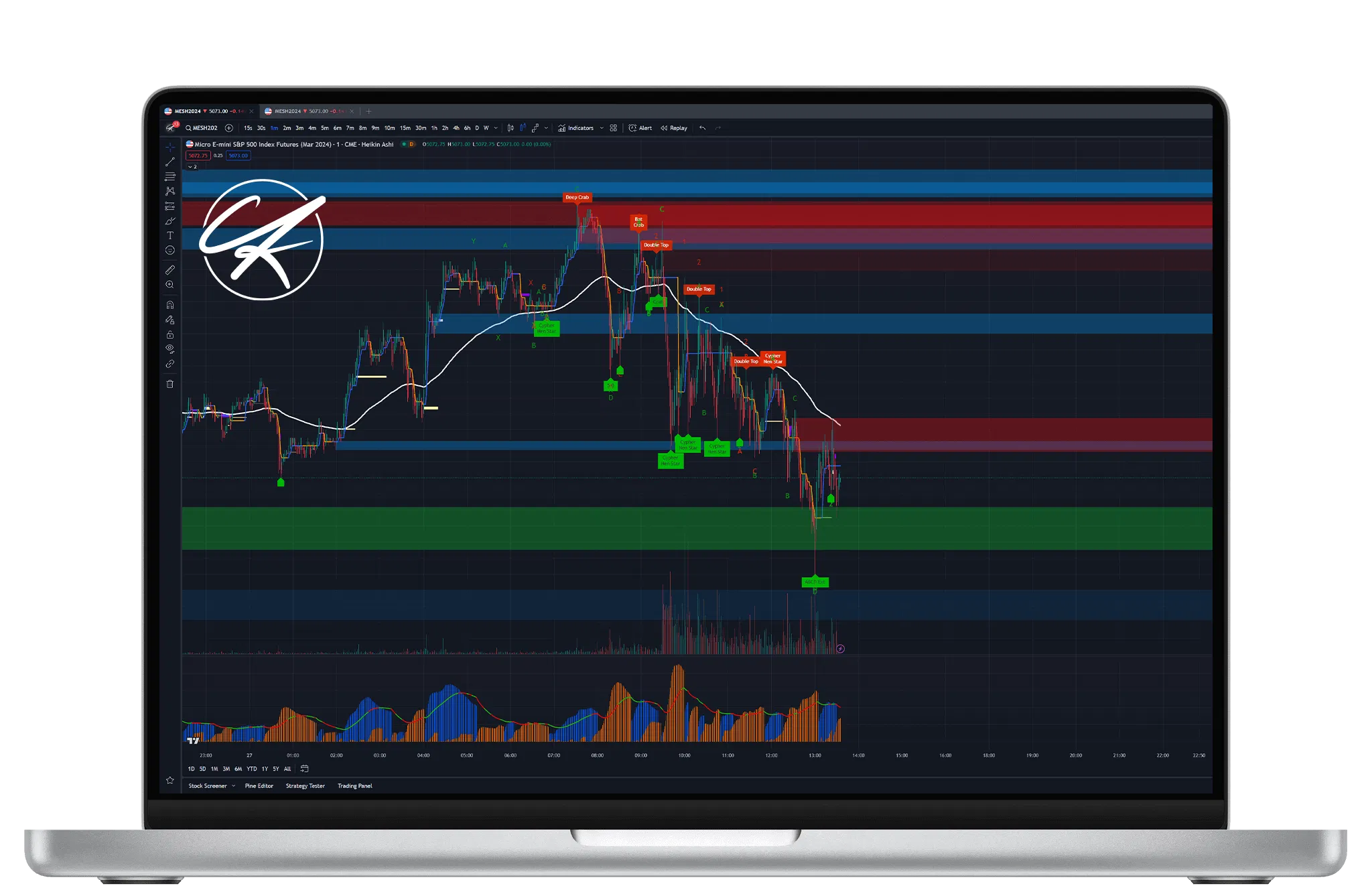
The laptop screen displays a TradingView chart for S&P 500 E-mini futures, featuring CK Trading Institute's custom indicators.

The CK Fix: CK teaches you to remove the "noise" and focus on clean charting. By understanding macro and micro trends, you can identify high-probability exits before the market reverses and eats into your trailing drawdown. Our AI-powered algorithms help you stay on the right side of the trend, minimizing unnecessary drawdowns.

3. Revenge Trading & Emotional Volatility

A single loss shouldn't blow an account. But for most traders, a loss leads to anger, which leads to "revenge trading": doubling down on a bad position to "get it back." This is the fastest way to lose your evaluation fee.

The CK Fix: We operate as a community. CK provides a "no-nonsense" mentor voice that prioritizes technical efficiency over emotional reaction. Our live trading sessions and expert-led support give you the psychological guardrails needed to walk away when the market isn't giving you a setup.

4. Trading the "Noise" Instead of the Trend

Beginners often clutter their screens with twenty different indicators that give conflicting signals. This leads to "analysis paralysis" or, worse, jumping into low-probability trades in the middle of a choppy range.

A professional trader sits at a modern desk, focused on multiple monitors displaying live trading charts and market analytics.

The CK Fix: CK’s 28 years of experience as a Floor Trader have been distilled into our proprietary algorithms coded in TradingView. We teach you how to identify clear supply and demand zones. Our goal is to make the big goals feel attainable by providing a clear, step-by-step instruction on what a high-probability setup actually looks like.

5. Rushing the Evaluation (The Gambler's Mentality)

Many traders try to pass their evaluation in one or two days. They treat futures trading like a lottery ticket. While it is possible to earn thousands in as little as 8-10 days with a payout, trying to force it usually results in a blown account.

The CK Fix: We advocate for financial sovereignty through a systematic process. By using our ATA and following our core strategies, you can scale up your capital access steadily. We help you move from a beginner seeking "quick cash" to a professional managing significant leverage.

6. Lack of a Proven Edge

Most traders enter the market with a "feeling" or a tip from a social media influencer. Without a coded, back-tested edge, you are simply gambling against institutional algorithms.

A close-up, high-contrast black and white shot of a trader's hands on a mechanical keyboard with a sharp yellow accent on the screen.

The CK Fix: Our USPs center around AI-powered tools and algorithms designed for all market conditions. Whether you are trading futures, stocks, or currencies, our tools provide the "edge" you need to compete. We provide the technology; you provide the discipline.

7. Risking Too Much Personal Capital

Traders often think they need to save up $10,000 of their own money to start trading futures. They risk their rent money or savings, which adds an unbearable amount of psychological pressure to every tick of the market.

The CK Fix: Why risk $2,500 of your own money when you can leverage prop firm capital for as little as $20? We show you how to pass simple evaluations using vetted partners like Apex Trader Funding. This shifts the risk from your bank account to the prop firm, allowing you to trade with a clear head and focus on mastery.


STOP GAMBLING AND START TRADING

If you are ready to stop making these mistakes and start your path toward financial freedom, it’s time to leverage professional tools and mentorship. CK TRADING INSTITUTE OF TECHNOLOGY LLC. provides the roadmap, the AI algorithms, and the community you need to conquer the futures market.

Seize your opportunity today. Join a community that prioritizes your success and provides the technical infrastructure to make it happen.

Explore our Pricing Plans and Get Started Today


EXCLUSIVE OFFER: GET FUNDED FOR LESS

We have partnered with Apex Trader Funding to help you access the capital you need to change your life. Don't risk thousands of your own dollars: use theirs.

SPECIAL PROMOTION:


Why Choose CK Trading?

  • Low-Risk Entry: Learn to trade with minimal personal capital.
  • 28 Years of Expertise: Learn directly from CK, an experienced Floor Trader.
  • AI-Powered: Use our Automated Trade Assistant (ATA) to remove human error.
  • Community Focused: You aren't trading alone; you are part of a mission.

Learn more about us and our mission here.