Prop Firm Payout Requirements for Futures Traders

A payout is the moment your trading work becomes real money in your bank account. But too many traders treat it like the finish line, then find out they missed a rule on minimum trading days, drawdown, consistency, or withdrawal timing. Understanding prop firm payout requirements before you request money is part of trading professionally – not an afterthought.

The good news is that payout rules are usually straightforward once you know what to look for. The challenge is that each firm and account type can use different terms, thresholds, and timelines. Your job is not to chase the biggest payout promise. Your job is to build profits in a way that keeps your account eligible to get paid.

What Prop Firm Payout Requirements Actually Mean

Prop firm payout requirements are the conditions you must meet before a firm allows you to withdraw profits from a funded trading account. They are designed to show that your results came from controlled execution, not one oversized trade that got lucky.

For futures traders, the biggest requirements usually revolve around profitability, risk control, account status, and time. A firm may require a minimum profit balance, a certain number of qualifying trading days, adherence to a trailing drawdown rule, and a waiting period after becoming funded. Some firms also limit how much can be withdrawn at one time, especially on newer accounts.

That does not mean payouts are impossible or that the rules are stacked against you. It means the same discipline that helped you pass the evaluation has to stay in place after you get funded. Many traders blow a funded account because they see available capital and start trading bigger. The smarter move is to protect the account that can keep producing payouts.

The Requirements That Matter Most

Every prop firm publishes its own policy, so always review the current terms for your specific program. Still, most payout structures come down to a few core areas.

Minimum profit and withdrawal thresholds

You generally need to earn more than a set amount before requesting a payout. For example, a firm may require you to generate a minimum amount of profit above your starting balance or above a protected drawdown threshold.

This is where traders need to think beyond the account balance shown on the screen. A $2,000 profit does not automatically mean $2,000 is available to withdraw. If your drawdown still trails closely behind your balance, taking out too much may leave the account with very little room to handle a normal losing day.

A better question is: after the payout, will this account still have enough cushion for me to trade my plan? If the answer is no, consider taking a smaller withdrawal and allowing the account to build a stronger buffer.

Minimum trading days

Many firms require profits to be earned over multiple trading days. This prevents a trader from hitting one big trade, requesting money immediately, and then failing the account the next session.

A qualifying day often means you must make at least a small minimum profit. It may not be enough to place a single trade and scratch for the day. Read the definition carefully. Some programs count calendar days, while others count only days that meet a profit target.

This requirement should shape your approach. If you need several qualifying days, there is no reason to force a huge win on day one. Take clean setups, stack controlled green days, and let the requirement work in your favor. Consistency is exactly what you want to build anyway.

Drawdown rules and account safety

Drawdown is where most payout plans either succeed or fall apart. Depending on the firm, the drawdown may trail your highest account balance, remain fixed, or change once you reach certain milestones. That detail matters more than almost anything else.

If you earn a strong profit and withdraw aggressively while the drawdown remains close, your account can become fragile. One ordinary red day can put the account at risk. Traders sometimes call this getting “payout rich and account poor.”

The answer is not to avoid payouts forever. The answer is to create a buffer first. Trade with a daily risk limit that makes sense for your account size, avoid revenge trades after a loss, and know exactly where your liquidation threshold sits before each session. A funded account is a business asset. Protect it like one.

Consistency rules

Some firms use a consistency rule to limit the percentage of total profits that can come from your best day. If your biggest winning day is too large compared with your total profit, you may need to keep trading until your overall profit catches up.

For example, if one $1,000 day makes up most of a $1,300 total profit, the firm may view the account as insufficiently consistent. You may need more profitable days before that $1,000 win represents an acceptable share of the total.

This is not a reason to stop taking A-plus setups. It is a reminder not to build your entire payout plan around one home-run trade. The goal is repeatable execution: identify the trend, wait for your setup, control your size, and take what the market gives you.

Payout timing and account age

Payouts are rarely available the same day you become funded. Most firms have a schedule that may require a certain number of trading days, a specified period after funding, or set request windows. Processing can also take time after the request is approved.

Plan for that delay. Do not trade a funded account like you need this week’s profits to pay an urgent bill next week. That pressure leads to forcing trades. Let the account mature, meet the rules cleanly, and use a steady process rather than emotional urgency.

How to Build a Payout-Ready Trading Plan

The fastest way to fail payout requirements is to trade without knowing where you stand. Before the market opens, know your account balance, drawdown level, daily loss limit, qualifying-day count, and the profit amount needed for your next payout request.

Then set a realistic daily objective. For many traders, one or two quality setups are enough. You do not need to trade all day to prove you are serious. In fact, overtrading is one of the most common ways traders give back a clean morning.

Your plan should include a daily stop that is smaller than the firm’s maximum loss threshold. The firm’s rule is the hard wall. Your personal stop should keep you far away from that wall. If your system says you are done after two losing trades or a set dollar amount, honor it. A red day managed correctly is far cheaper than a blown account.

At CK Trader Pro, the focus is on helping traders build this kind of structure: clear chart-based entries, controlled risk, and accountability around the rules that actually determine whether an account survives long enough to pay you.

Common Payout Mistakes to Avoid

The first mistake is requesting the maximum amount without considering the remaining drawdown cushion. A large payout feels good, but an account with no breathing room can disappear quickly. Smaller, repeatable withdrawals often create a better long-term outcome than one big request followed by a reset.

The second is changing your strategy after getting funded. Traders may pass an evaluation with patience, then increase size, trade lower-quality setups, or hold positions longer because the account feels more valuable. That is backwards. Your funded account deserves your most disciplined execution.

The third is assuming one firm’s rules apply everywhere. Terms such as trailing threshold, safety net, consistency, qualifying day, and payout cycle can mean different things across programs. Read the current rules every time you open a new account or move into a new funding stage.

Finally, do not treat a payout denial as proof that you cannot trade. If a request is denied because you missed a technical requirement, use it as feedback. Identify the exact rule, adjust your tracker, and trade forward with more awareness. A professional trader reviews the process instead of reacting emotionally.

Treat Payouts Like Part of the Strategy

The traders who receive payouts consistently are not usually chasing the biggest day in the room. They are managing risk, respecting their limits, and putting themselves in position to trade again tomorrow.

Build enough cushion before withdrawing. Track every requirement as closely as you track your entries. Then let disciplined green days do the heavy lifting. Your next payout should come from a process you can repeat – not a trade you need to recreate.
How to Avoid Overtrading Futures Without Forcing Trades

The fastest way to blow a futures evaluation is rarely one bad trade. It is the string of extra trades that follow: chasing a move after the entry is gone, trying to win back a small loss, or trading the midday chop because sitting still feels unproductive. Learning how to avoid overtrading futures is not about becoming passive. It is about putting your capital, your drawdown, and your decision-making under a process you can repeat.

For prop firm traders, this matters even more. You are not trying to catch every tick in the E-mini S&P 500, Nasdaq, or crude oil. You are trying to meet a profit target while protecting the account long enough to get funded and qualify for payouts. That requires patience that is planned before the market opens, not willpower you hope shows up after two losing trades.

Why Overtrading Blows Futures Accounts

Overtrading is not defined only by the number of trades you take. A trader can take six quick, rule-based scalps during an active opening range and remain completely disciplined. Another trader can take two oversized, emotional trades and do serious damage.

The real issue is taking trades that were not part of your plan. Those trades usually appear when you feel late, frustrated, bored, or overly confident after a win. Futures move quickly, and leverage makes every impulsive decision feel bigger. On a prop account, an unnecessary loss can also reduce the room you have to manage the next valid setup.

This is why more screen time does not automatically create better results. The market offers endless candles, but your edge may only appear once or twice. Professional execution means waiting for those moments instead of inventing reasons to trade.

How to Avoid Overtrading Futures Before the Open

Your best defense against overtrading is built before the opening bell. If you start your session with no clear levels, no defined setup, and no risk number, every market movement can look like an opportunity.

Begin with a short pre-market routine. Mark the prior day high and low, overnight range, major support and resistance, and the levels where you expect price to react. Check the economic calendar as well. A major CPI release, employment report, or Fed announcement can completely change the pace of the session. That does not mean you must avoid volatility, but you should know when it is scheduled instead of getting caught by surprise.

Then decide what you are actually allowed to trade. For example, you may only take a long when price reclaims a key level, confirms market structure, and gives you a defined stop location. Or you may trade a rejection at the high of day only when momentum stalls and your charting rules align. The exact strategy can vary, but the conditions need to be specific enough that you can say yes or no without negotiating with yourself.

A good question before every entry is simple: “Would I take this exact trade if I were still flat on the day?” If the honest answer is no, it is probably a revenge trade, a chase, or a boredom trade.

Set Limits That Make Discipline Automatic

Motivation is useful, but limits protect you when motivation disappears. Your daily risk plan should include a maximum loss, a maximum number of trades, and a point where you stop trading after reaching your daily goal.

For many evaluation traders, a daily loss limit that is well below the firm’s hard drawdown limit is essential. The firm’s limit is not your target. It is the emergency wall. Your personal stop should give you room to return tomorrow with a clear head.

Trade limits work the same way. If you know you tend to spiral after losses, set a cap such as three entries per session. If your strategy occasionally requires a re-entry, define what qualifies as a new setup versus what is simply another attempt to force the same idea. A re-entry can be valid when market structure changes and your setup returns. Repeatedly buying because you “know it has to go up” is not a strategy.

Your winning limit matters too. Traders often give back solid mornings because they stay at the screen looking for more. If your plan calls for a modest daily target, honor it. A green day does not need to become a home run to be valuable. Small, controlled gains can build consistency while preserving the drawdown cushion that keeps a funded account healthy.

Consider using practical guardrails:

  • Set your daily dollar loss before you place the first trade.
  • Decide your maximum number of entries for the session.
  • Use bracket orders with a defined stop and target whenever your platform allows it.
  • Step away for a scheduled reset after a loss or after hitting your daily goal.

These rules are not there to limit your potential. They are there to prevent one emotional hour from erasing a week of disciplined work.

Trade One Setup, Not Every Market Move

Many traders overtrade because their charts have too many signals and their rules are too loose. They see a breakout, then a reversal, then a moving average cross, then a random candle pattern. Soon, every direction looks tradable.

Reduce the number of decisions you need to make. Pick one or two high-quality setups and learn their behavior in different conditions. Know what they look like during a strong trend, inside a range, and around major levels. More importantly, know when they are not working.

For example, a breakout strategy may perform well when volume expands and price holds above a key level. In a tight midday range, the same breakout can become a trap. The answer is not to trade both sides faster. The answer may be to recognize that your setup has no edge in that environment and wait.

This is where replay, journaling, and live review create a real advantage. When you document your trades, do not just record profit and loss. Record the reason for entry, the time of day, whether it matched your setup, and what you were feeling. You will quickly see whether your best trades share common conditions and whether your worst losses came from the same emotional pattern.

Use a Reset Rule After a Loss

A loss is part of trading. The problem starts when a loss becomes a command to act immediately.

Create a reset rule that interrupts that reaction. After a full stop-out, walk away from the screen for five or ten minutes. After two losses, end the session or require a complete review before another entry. The right rule depends on your strategy and account size, but it must be firm enough to break the urge to make it back right now.

During the reset, ask what changed. Did you follow your plan and take a normal loss? If so, there may be nothing to fix except waiting for the next qualified opportunity. Did you enter late, ignore a level, or increase size? Then the next trade should not happen until you identify the mistake.

Do not confuse urgency with opportunity. The market will be open tomorrow. Your job is to make sure your account is too.

Size Down Until You Can Follow Your Rules

If you cannot respect your stop, your size is too large. This is especially common with newer futures traders who focus on the potential payout instead of the amount they can lose on each contract.

Trading smaller can feel slow, especially when you see big moves on the chart. But smaller size gives you room to practice clean execution without turning every tick into an emotional event. Once you can follow your rules consistently at a smaller size, you have evidence that you are ready to scale responsibly.

The goal is not to prove courage by holding more contracts. The goal is to become the trader who can protect capital, execute a plan, and show up the next day without needing a miracle trade.

Build Accountability Into Your Trading Day

Overtrading gets stronger in isolation because there is no pause between the impulse and the click. Accountability adds that pause.

Share your daily plan with a trading community, keep a written checklist beside your screen, or review your execution with a coach. At CK Trader Pro, the focus is not just finding entries. It is building the habits that help traders pass evaluations and manage funded accounts with discipline.

A simple end-of-day scorecard can be more valuable than obsessing over P&L. Grade yourself on whether you respected your loss limit, waited for valid setups, used proper size, and stopped when your plan told you to stop. A red day with clean execution can be a productive day. A green day built on reckless entries is a warning sign.

The next time you feel the urge to take “just one more” trade, pause long enough to name the reason. If it is not a setup you planned, protect the account and let it go. The trade you skip may be the one that keeps your evaluation, your confidence, and your long-term progress intact.

Institutional Edge: Why 28 Years of Floor Trading Wisdom is Your Secret Weapon

The trading world is divided into two distinct groups: those who react to the market and those who understand the machinery behind it. For decades, the "Institutional Edge" was a guarded secret, locked behind the heavy doors of the S&P pits and the exclusive desks of Wall Street. Retail traders were left with lagging indicators, cluttered charts, and a strategy that essentially amounted to "hope."

But the game has changed. At CK Trading Institute of Technology, we aren’t just teaching you how to click buttons. We are handing you the blueprints used by institutional veterans to navigate volatility with surgical precision.

Led by CK (George Ama), a 28-year floor trading veteran, our mission is to strip away the noise and give you the same tools used by the professionals. This isn't just about trading; it’s about financial sovereignty.

The Myth of the "Magic Indicator"

Most retail traders fail before they even place their first trade. Why? Because they are taught to look for a "holy grail" indicator: a green arrow or a flashing light that guarantees a win.

The reality of the floor is much different. Institutional traders don’t care about RSI crossovers or overbought signals on a 1-minute chart. They care about Order Flow, Key Decision Levels, and Risk Management.

TRADING PRECISION

When CK stood in the pits, the "edge" wasn't a secret algorithm; it was the ability to see where the big money was moving and moving with it. This is what we call Clean Charting. By removing the clutter and focusing on macro/micro trends, you stop being a victim of the "noise" and start becoming an architect of your own success.

The Problem: The Retail Trap

  • Over-complication: Too many indicators lead to "analysis paralysis."
  • Emotional Trading: Risking personal savings creates a fear-based mindset.
  • Lack of Capital: Most traders don't have enough capital to survive a natural drawdown.

The Solution: The CK Masterclass

The CK Masterclass is designed to solve these problems by bridging the gap between retail struggle and institutional mastery. We provide the education, the AI-powered tools, and the community support needed to scale your trading to a professional level.

SIGN UP FOR THE CK MASTERCLASS HERE

28 Years on the Floor: Experience You Can Trust

In an industry filled with "overnight experts," experience is the ultimate differentiator. CK (George Ama) didn't learn to trade from a YouTube tutorial. He spent nearly three decades in the trenches of the financial world.

This 28-year pedigree is baked into every lesson within the CK Masterclass. You aren't just learning a strategy; you are learning a philosophy of risk that has survived every market crash, bubble, and rotation in recent history.

CK TRADING FOCUS

As an authoritative mentor, CK guides you through the process of "unlearning" the bad habits taught by the retail industry. We focus on:

  1. Macro Analysis: Understanding the "Big Picture" before zooming in.
  2. Micro Precision: Identifying the exact entry points that minimize risk.
  3. Institutional Levels: Marking the areas where banks and hedge funds are actually transacting.

The Power of the ATA: AI Meets Institutional Wisdom

While floor trading wisdom is the foundation, we leverage the latest technology to give our students an unfair advantage. Our Automated Trade Assistant (ATA) is an AI-powered algorithm coded directly into TradingView.

The ATA doesn't replace your brain: it amplifies it. It scans for high-probability setups based on the same institutional principles CK used on the floor.

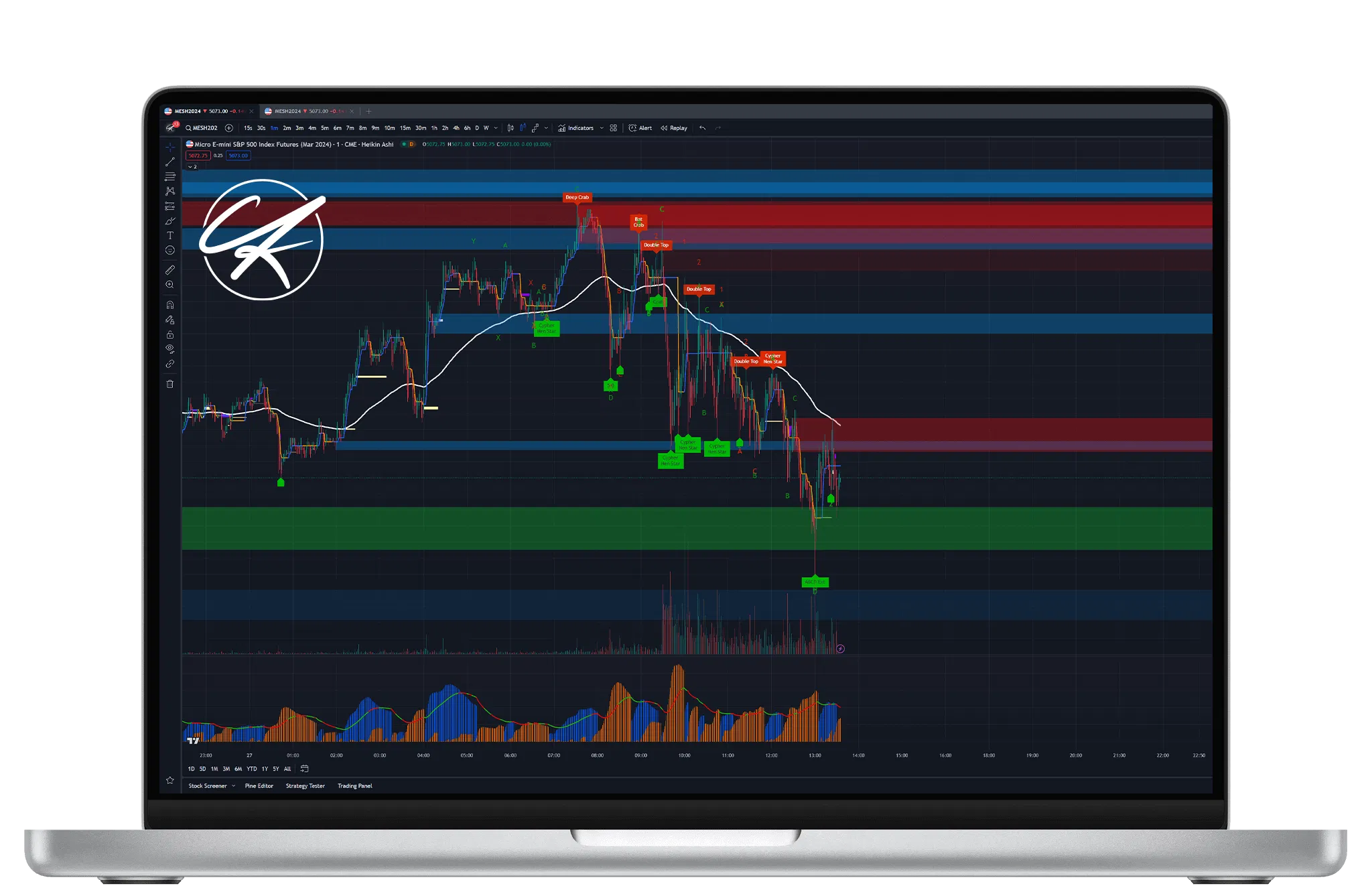
ATA TRADINGVIEW CHART

By using the ATA, our students can:

  • Eliminate Noise: Focus only on the signals that matter.
  • Reduce Bias: Let the data guide your decisions, not your emotions.
  • Master Multiple Markets: Whether it's Futures, Stocks, Currencies, or Options, the institutional edge remains the same.

Leveraging Capital: Why You Shouldn't Risk Your Own Money

One of the biggest breakthroughs our students experience is the transition to Prop Firm Trading. Why risk $2,500 of your own hard-earned money when you can leverage $250,000 of institutional capital for as little as $20?

We partner with vetted prop firms like Apex Trader Funding and Lucid Trading to help our students pass evaluations and access significant leverage.

Imagine earning thousands of dollars with just one payout in as little as 8 to 10 days. This isn't a dream; it’s the reality for traders who follow the CK Masterclass system. We teach you how to pass these evaluations by minimizing risk and maximizing your 10x potential.


SPECIAL OFFER: APEX TRADER FUNDING

If you are ready to seize your financial freedom, there is no better way to start than by leveraging professional capital. Use our exclusive affiliate link and code to get the best deal on the market.

PROMO CODE: KZRKEGJN (Get up to 90% OFF)

GET STARTED WITH APEX TRADER FUNDING NOW


PARTNER SPOTLIGHT: LUCID TRADING

We also highly recommend Lucid Trading for those looking for a robust evaluation platform. Stay tuned for more updates on how we integrate Lucid Trading into our community strategies.
[Link to Lucid Trading – Coming Soon]


Community: Your Path to Financial Sovereignty

Trading can be a lonely endeavor, but it doesn't have to be. At CK Trading Institute, you are part of a collective mission. Our expert-led community provides live trading sessions where you can watch CK analyze the markets in real-time.

"The Masterclass completely changed how I see the charts. I stopped looking for 'signals' and started looking for 'value'. Within two weeks, I passed my first 50k evaluation." : Student Testimonial

We remove the technical "clutter" and focus on technical efficiency. Our community is a "no-nonsense" environment where results are the only metric that matters.

MASTER THE MARKETS

Take Action: Seize Your Institutional Edge

The markets will always be volatile, but your results don't have to be. By combining 28 years of floor trading wisdom with AI-powered algorithms and prop firm capital, we have created the ultimate roadmap to financial freedom.

Don't spend another day guessing. Leverage the expertise of CK (George Ama) and join a community dedicated to your success.

Your Step-by-Step Path to Mastery:

  1. Enroll in the CK Masterclass: Learn the institutional secrets of clean charting and risk management.
  2. Activate the ATA: Integrate our AI-powered algorithm into your TradingView charts.
  3. Get Funded: Use code KZRKEGJN at Apex Trader Funding to start your evaluation.
  4. Join the Live Sessions: Trade alongside CK and the community to refine your skills.

The institutional edge is no longer a secret. It’s a choice. Will you seize it?

BROWSE OUR PRICING PLANS AND GET STARTED TODAY


Disclaimer: Trading involves significant risk. The information provided is for educational purposes only. Past performance is not indicative of future results.

Pre Market Futures Analysis: Trade With a Plan

The market can look calm at 8:15 a.m. and turn into a fast, one-direction move five minutes after the cash open. That is why pre market futures analysis matters. It gives you context before the noise, so you are not reacting to every candle once the bell rings.

For futures traders working toward a prop-firm evaluation or protecting a funded account, the pre-market session is not about predicting the day perfectly. It is about identifying the conditions that could help or hurt your setup, defining your risk, and arriving with a plan you can actually follow.

What Pre Market Futures Analysis Is Really For

Pre-market futures analysis is the process of reviewing overnight price action, scheduled economic events, key chart levels, and market tone before your trading window begins. For most index futures traders, that means looking at contracts such as the E-mini S&P 500, Nasdaq, Dow, or Russell before the regular US stock market opens at 9:30 a.m. Eastern.

The goal is not to force a bias. A green overnight session does not automatically mean you should buy at the open. A red overnight session does not automatically mean the market will trend down all day. Futures can reverse sharply when liquidity enters, especially after major data releases or when price opens near an important level.

Your job is simpler: know where price has been, where it is sitting now, and what would need to happen for your trade idea to be valid. That small shift helps eliminate one of the biggest evaluation killers: taking an impulsive trade because the opening move feels urgent.

Start With the Overnight Range

Before you look for an entry, mark the overnight high and low. This range shows where futures found resistance and support while the US cash market was closed. It is not magic, but it gives you clean reference points that many active traders watch.

If price is approaching the overnight high before the open, ask whether it is accepting above that area or repeatedly rejecting it. Acceptance may create a continuation opportunity if your system confirms it. Rejection may signal that buyers are losing control. The same thinking applies at the overnight low.

Then look at where price sits inside that range. Near the middle, there is often less clarity. Near an extreme, there may be a meaningful decision point. This does not mean you blindly fade highs or buy lows. It means you wait for evidence instead of treating every level as an automatic trade.

For prop traders, this matters because mid-range chop can quietly drain your daily loss limit. A disciplined trader does not need action every minute. Sometimes the best pre-market conclusion is that conditions are unclear and patience is the trade.

Add Prior-Day Levels to the Chart

Overnight levels are only one piece of the map. Mark the prior day high, prior day low, prior day close, and any obvious areas where price consolidated or rejected with force. These zones often matter because they represent unfinished business from the previous session.

When the overnight high aligns with the prior day high, that level deserves more attention. When futures gap above a prior-day range and hold there, the market may be showing strength. But if price quickly falls back into that range, the gap can become a trap for late buyers.

Keep the chart clean. Five meaningful levels are more useful than 25 lines that create hesitation. CK Trader Pro traders are working to execute a repeatable process, not prove they can identify every possible support and resistance zone.

Check the Economic Calendar Before You Trade

A technically clean setup can fail when major economic data hits. CPI, PPI, jobs data, FOMC announcements, Fed speeches, GDP, retail sales, and consumer sentiment can all change volatility in seconds. On those mornings, the question is not just where price is trading. It is when the information is due.

If high-impact data is scheduled at 8:30 a.m. Eastern, expect the market to react before the stock market opens. The first move may be real, or it may be a fast liquidity sweep that reverses once traders digest the report. If you are not experienced trading news volatility, there is no prize for being in a position when the number drops.

This is especially important in a prop evaluation. A large candle can look like a fast path to the profit target, but it can also create slippage, widen your effective risk, and push you into emotional recovery mode. Reduce size, wait for the reaction to settle, or sit out. It depends on your tested strategy and the rules of your account.

Build a Bias, Then Build an Alternative

A good trading plan has a primary scenario and an invalidation point. For example, if futures are holding above the overnight high, above a key prior-day level, and your charting tools show momentum confirmation, your primary idea may be to look for long entries on controlled pullbacks.

But the plan cannot stop there. You also need to write the opposite scenario: if price fails back below the overnight high, loses the opening range, and cannot reclaim it, the long thesis is no longer valid. That does not mean you instantly flip short. It means your original trade is off the table until a new setup develops.

This is how professionals avoid attachment to a directional opinion. The market does not owe you confirmation because you spent 30 minutes analyzing it. Your plan should make it easy to say, “That was my idea. It did not trigger. I am done with it.”

Use Opening Price Action as Confirmation

The cash open brings volume and emotion. Rather than jumping into the first candle, let the market reveal whether it can hold the pre-market levels you marked. An opening range, a retest, or a clear break-and-hold pattern can offer better information than chasing the initial burst.

There is a trade-off. Waiting for confirmation can mean missing a portion of a strong move. But for traders who have blown evaluations by entering too early, that trade-off is often worth it. You are not paid for catching the exact high or low. You are paid for managing risk and stacking quality execution.

Use your TradingView layout and your preferred indicators as a decision framework, not as a reason to override common sense. A signal near a major resistance level ahead of a news release is different from the same signal in a stable, trending environment.

Turn Your Analysis Into Risk Rules

Pre-market preparation only helps if it changes what you do after the open. Before your session starts, decide your maximum risk per trade, your maximum number of attempts, and the daily loss point that ends your trading.

For example, if you know the market is opening inside a tight overnight range with a major report later in the morning, you may choose smaller size and fewer trades. If the market is trending cleanly and your A-plus setup appears at a level you planned in advance, your rules may allow normal size. The point is to make the decision before the emotion arrives.

Your prop-firm drawdown is business capital. Treat it that way. Do not use a losing morning as an excuse to double size, ignore your stop, or hunt for a miracle trade. Passing an evaluation is usually less about one huge day and more about refusing to turn a manageable red day into a blown account.

A Pre-Market Routine You Can Repeat

A useful routine can be completed in 15 to 30 focused minutes. First, review the economic calendar and identify any event that could affect your trading window. Next, mark the overnight high and low, prior-day levels, and the clearest nearby support and resistance areas.

Then assess the broader structure. Is price trending, balancing, gapping, or trapped inside a prior range? Write one bullish scenario, one bearish scenario, and the price behavior that would keep you out. Finally, set your risk limits before placing a single order.

Keep a journal after the session. Did price respect the levels? Did you follow the plan? Did you trade because your setup appeared, or because you were bored, frustrated, or afraid of missing out? The journal is where pre-market analysis becomes a skill instead of a morning ritual.

The Edge Is Preparation, Not Prediction

No trader can know exactly what futures will do after the bell. Anyone promising certainty is selling a story, not a process. Your advantage comes from seeing the important levels early, respecting scheduled volatility, and knowing exactly how much you can lose before the first trade is placed.

A strong pre-market routine gives you room to trade with purpose instead of pressure. Show up prepared, wait for your setup, protect the account, and let disciplined repetition build the confidence that one lucky trade never will.

How to Read Trendlines Without Forcing Trades

A trendline is not a prediction tool. It is a visual record of where buyers or sellers have repeatedly defended price. Once you understand how to read trendlines, you stop drawing random diagonal lines across a chart and start using market structure to make cleaner, more disciplined futures trading decisions.

That matters when you are trading a prop firm evaluation. You do not need to catch every move in the Nasdaq, S&P 500, or crude oil. You need a repeatable process that helps you identify direction, wait for confirmation, define risk, and avoid the oversized trades that can wreck an account in minutes.

What a Trendline Is Actually Telling You

An uptrend line connects a series of higher lows. It shows that buyers are stepping in at progressively higher prices. A downtrend line connects lower highs, showing that sellers are willing to enter the market sooner as price rallies.

The line itself is not support or resistance because a drawing says so. It represents an area where order flow has repeatedly shifted. Think of it as a guide to market behavior, not a magic wall. Price can touch it, pierce it briefly, or break it completely. Your job is to read the response around that area.

This is where newer traders get trapped. They see price approach an uptrend line and immediately buy. But a trendline touch is an area to pay attention, not an automatic long entry. If momentum is weak, the market is at a major resistance level, or the session is choppy, that touch may fail.

A good trader asks a better question: Are buyers still defending this trend, or is the structure beginning to change?

How to Read Trendlines From Left to Right

Start with the larger chart before dropping into your entry timeframe. If you trade intraday futures, use a 15-minute or 5-minute chart to understand the session structure, then use a smaller timeframe only when you need entry precision.

For an uptrend line, locate two clear swing lows where price pushed down, found buyers, and moved higher. Connect those lows and extend the line to the right. For a downtrend line, connect two obvious swing highs where rallies failed and price moved lower.

Two points create a line. The third touch gives that line more credibility. Every additional clean reaction may make it more relevant, but do not assume that five touches make a trendline unbreakable. In fact, repeated tests can weaken a level because buyers or sellers may be getting absorbed each time price returns.

Keep your drawing simple. Use the most visible swing points that other traders are likely to see. If you have to force the line through every wick on the chart, it is probably not a useful trendline. Markets are not perfectly neat. A line can still be valid when a few wicks slightly overshoot it.

Use Wicks and Candle Bodies With Context

There is no universal rule that says trendlines must connect candle wicks or candle bodies. It depends on how price is trading.

Wicks often show rejection. If several lower wicks appear at a similar rising angle during an uptrend, connecting them can reveal where buyers repeatedly defended price. Candle bodies can be more useful when the market closes cleanly around a level and the wicks are unusually volatile.

The key is consistency. Pick the points that best show the actual swing structure. Then stop adjusting the line every time the market gets close. Constantly redrawing a trendline to fit your trade idea is not analysis. It is justification.

Read the Strength of the Trend, Not Just the Line

A trendline works best when it agrees with the rest of the chart. Before planning a trade, look at how price is moving between touches.

In a healthy uptrend, you want to see strong pushes upward, controlled pullbacks, and higher lows. In a healthy downtrend, you want decisive selloffs, weak bounces, and lower highs. The trendline should support what market structure is already telling you.

Watch the angle as well. A gentle, steady trendline is often more sustainable than a nearly vertical one. When price runs straight up or straight down, the move can be powerful, but it is also vulnerable to a sharp pullback. Chasing a steep trendline late in the move is one of the fastest ways to buy the high or sell the low.

Volume and momentum can add useful context, but they should not replace price action. If price reaches an uptrend line and immediately prints strong bullish candles after rejecting lower prices, that is different from price slowly bleeding through the line with small, weak bounces. The first scenario suggests defense. The second suggests buyers may be losing control.

The Three Trendline Reactions That Matter

When price reaches a trendline, focus on the reaction. Most trade decisions come down to one of three outcomes: respect, break, or break and retest.

A respect happens when price reaches the line, rejects it, and resumes the existing trend. In an uptrend, price may dip into the line, leave a lower wick, then close back above it with momentum. That can offer a continuation setup, especially when the broader structure remains bullish.

A break occurs when price closes decisively through the trendline. One quick wick through the line is not enough. Look for a meaningful close beyond it, followed by a failure to recover. A broken uptrend line does not automatically mean you should short. It means the prior pace of buying has changed, and you need to see whether lower highs and lower lows begin to form.

The break-and-retest is often the cleaner opportunity. Price breaks below an uptrend line, rallies back into that former support area, and then sellers reject the retest. That gives you more confirmation than trying to catch the initial break. The trade-off is that you may miss the fastest part of the move. That is fine. Prop trading rewards controlled execution, not hero entries.

Build an Entry Plan Around Confirmation

Trendlines can help you locate a setup, but they should not be your entire setup. Define what must happen before you enter.

For a long near an uptrend line, you might wait for price to reject the line, form a higher low on your entry timeframe, and break above a nearby swing high. For a short near a downtrend line, you might wait for rejection, a lower high, and a break below a recent swing low.

This approach can feel slower than entering on the first touch. It is also more selective. You will occasionally watch a move leave without you, but you will avoid many low-quality trades where price slices through the line and keeps going.

Your stop should sit where the trade idea is proven wrong, not at a random dollar amount. On a long trade, that may be below the swing low that formed at the trendline. On a short, it may be above the rejection high. Position size then needs to match that stop distance and your account rules.

If your stop requires more risk than your daily plan allows, skip the trade or reduce size. Never widen a stop because you want the trendline to hold. The market does not care where you entered, and a prop firm drawdown rule will not give you extra room because the setup looked good.

Trendlines and Prop Firm Risk Management

For funded-account traders and evaluation traders, trendlines are valuable because they create structure before the trade starts. They help you decide where you are interested, where you are wrong, and where price may react. That clarity reduces the urge to chase candles or revenge trade after a loss.

But trendlines cannot fix poor risk control. A clean trendline setup can still lose. News can create volatility, lunchtime price action can turn slow and unpredictable, and major support or resistance can overpower an intraday trend. That is why your process needs a daily loss limit, a maximum number of attempts, and a rule for stepping away when the market is not giving clean structure.

Treat each trade as one execution inside a larger business plan. A small, controlled loss at a broken trendline is normal. Blowing an evaluation because you doubled size to win it back is a decision, not bad luck.

Common Trendline Mistakes to Avoid

The biggest mistake is drawing too many lines. When every minor pullback has its own trendline, your chart becomes cluttered and every direction looks possible. Prioritize the lines connected to meaningful swings and the current session structure.

Another mistake is trading against the higher-timeframe trend just because price touched a small trendline. A one-minute downtrend line may break upward while the 15-minute chart is still pushing lower into resistance. Context matters more than a single diagonal line.

Finally, do not confuse a trendline break with a complete trend reversal. A break can lead to consolidation, a deeper pullback, or a full reversal. Wait for structure to confirm the story. Lower lows and lower highs after an uptrend break carry more weight than the break alone.

The next time you open your chart, draw fewer lines and watch price more closely. Let the market prove whether buyers or sellers still control the area, then take the trade only when your risk plan gives you permission to act.

Automated Success: Integrating the ATA Algorithm via the CK Masterclass

The world of day trading is often painted as a chaotic storm of flashing lights, confusing indicators, and high-stress decision-making. For many, the dream of financial sovereignty is crushed by the weight of "market noise": that relentless stream of data that cloud judgment and lead to costly emotional errors. If you’ve ever felt like the market is moving against you the moment you click "Buy," you aren’t alone. Most traders fail not because they lack ambition, but because they lack a disciplined, institutional-grade framework.

At the CK TRADING INSTITUTE OF TECHNOLOGY LLC., we’ve spent decades perfecting a solution that removes the guesswork. By combining the raw, battle-tested wisdom of a 28-year floor trader with the precision of AI-powered technology, we’ve created a path to mastery that is both accessible and highly profitable. This is the CK Masterclass, and at its heart lies the Automated Trade Assistant (ATA) Algorithm.

THE MIND BEHIND THE MACHINE: 28 YEARS OF FLOOR TRADING WISDOM

Before algorithms ruled the markets, trading was done in the "pits": a high-stakes environment where only the fastest and most disciplined survived. CK (George Ama), our lead instructor and founder, spent 28 years as a Floor Trader, navigating every market cycle imaginable. This isn't just "YouTube experience"; this is institutional-level expertise forged in the fires of real-world volatility.

When you join the CK Masterclass, you aren't just buying software. You are gaining access to the mental models and strategies that CK used on the floor. Most retail indicators are "lagging," meaning they tell you what already happened. CK teaches you how to read Macro and Micro trends to anticipate where the market is going next.

chartAnalysis
Precision charting: Identifying institutional supply and demand zones with the ATA system.

INSIDE THE ATA ALGORITHM: AI MEETS INSTINCT

In today's fast-paced environment, even the best human trader can be slowed down by emotion or hesitation. That’s where the Automated Trade Assistant (ATA) comes in. Coded specifically for TradingView, the ATA is the crown jewel of our educational ecosystem.

What makes the ATA different?

  • Noise Removal: The algorithm filters out the "clutter" that leads to overtrading. It focuses on high-probability setups that align with institutional flow.
  • Clean Charting: Unlike traditional "spaghetti charts" filled with 20 different moving averages, the ATA provides a clean, visual roadmap.
  • Risk Management: The ATA is designed to help you maintain a low-risk approach, ensuring you never risk more than is necessary to achieve your target payouts.
  • Adaptability: Whether you are trading futures, stocks, currencies, or options, the ATA adjusts to current market conditions, providing signals for both trending and ranging markets.

The ATA isn't a "black box" that you turn on and walk away from. In the CK Masterclass, we teach you the why behind the signals. We believe that a trader with an elite tool is good, but a trader who understands the mechanics of that tool is unstoppable.

THE CK MASTERCLASS: YOUR BLUEPRINT FOR FINANCIAL SOVEREIGNTY

We’ve structured our curriculum using a direct Problem-Solution-Action framework.

The Problem: You have the drive to trade, but you don't have the capital to see significant returns without risking your life savings.
The Solution: Master the skills through the CK Masterclass and leverage AI-powered tools to pass prop firm evaluations.
The Action: Sign up, learn the "Clean Charting" method, and seize professional-level capital.

Our Masterclass covers everything from beginner basics to advanced algorithmic integration. We don't just throw videos at you; we provide a comprehensive, expert-led community where you can participate in live trading sessions. This is where the theory meets the tape. Seeing CK apply the ATA algorithm in real-time is the "lightbulb moment" for many of our students.

precisionTrading
Leveraging AI signals to capture sharp market movements with institutional precision.

LEVERAGING PROP FIRM CAPITAL: THE $20 STRATEGY

The biggest barrier to entry for most traders is capital. Risking thousands of your own hard-earned dollars is a recipe for emotional disaster. This is why we focus on Prop Firm Trading.

Imagine being able to trade with $50,000, $150,000, or even $300,000 of someone else's money. By passing a simple evaluation: which our Masterclass and ATA algorithm are specifically designed to help you do: you can access significant leverage.

The Value Proposition:

  • Risk: As little as $20 for an evaluation.
  • Reward: Payouts of thousands in as little as 8-10 days.
  • Freedom: No more "daily job" grind once you've mastered the institutional flow.

We have vetted and partnered with top-tier firms like Apex Trader Funding and TakeProfitTrader to ensure our students have the best possible environment for success.


🚀 SEIZE YOUR FUNDED FUTURE WITH APEX TRADER FUNDING

Ready to stop risking your own capital and start trading with the pros? Apex Trader Funding provides the leverage you need to scale your trading to heights you never thought possible.

ACT NOW AND SAVE:
Use the link below and apply affiliate code KZRKEGJN at checkout to receive up to 90% OFF your evaluation!

GET STARTED WITH APEX TRADER FUNDING NOW


INTEGRATING THE LUCID TRADING EDGE

While Apex offers incredible opportunities, we also encourage our students to diversify their prop firm exposure. This is where our upcoming integration with Lucid Trading comes into play. By utilizing multiple firms, you minimize "platform risk" and maximize your potential payout cycles.

(Stay tuned for our exclusive Lucid Trading affiliate link and specialized Masterclass modules tailored for Lucid's unique evaluation parameters!)

tradingSuccess
Professionalism, discipline, and technology: The three pillars of a CK Masterclass trader.

WHY WAIT? THE PATH TO MASTERY STARTS HERE

Financial freedom isn't a gift; it's a skill that is earned. The markets are moving right now, and institutional traders are reaping the rewards while retail traders are left guessing.

The CK Masterclass is more than just a course: it’s a transformation. You will learn to:

  1. Amplify your returns by removing emotional bias.
  2. Leverage institutional-grade AI via the ATA Algorithm.
  3. Seize control of your financial future by trading with prop firm capital.
  4. Master the clean charting techniques that have sustained CK for nearly three decades.

We’ve removed the "clutter" of traditional trading education. No fluff, no noise: just the technical efficiency you need to succeed. Whether you are a complete beginner or an experienced trader looking to scale, our community is ready to support your journey.

sovereignty
A clear path to financial sovereignty through disciplined, data-driven education.

FINAL CALL TO ACTION: YOUR SEAT IS WAITING

Don't let another market cycle pass you by while you sit on the sidelines. Join the hundreds of traders who have already revolutionized their approach with the CK TRADING INSTITUTE OF TECHNOLOGY LLC.

Step 1: Explore our Pricing Plans and select the Masterclass tier that fits your goals.
Step 2: Download the ATA Algorithm and start cleaning up your charts.
Step 3: Use our Apex Affiliate Link (Code: KZRKEGJN) to secure your evaluation at a massive discount.
Step 4: Attend the live sessions, follow the macro trends, and claim your first payout.

JOIN THE CK MASTERCLASS TODAY

The market doesn't care about your excuses: it only cares about your execution. Let’s get to work.


CK TRADING INSTITUTE OF TECHNOLOGY LLC. provides educational resources and trading tools. Trading involves significant risk. Ensure you understand the risks involved before trading with real or prop firm capital.

7 Best TradingView Indicators for Futures

A futures chart can give you 20 signals before the opening range is even set. That is exactly why most traders do not need more tools – they need a tighter process. The best TradingView indicators for futures are the ones that help you identify direction, confirm momentum, define risk, and stay out of low-quality trades.

For prop-firm traders, this matters even more. An evaluation is not won by catching every move in NQ, ES, or crude oil. It is won by protecting your drawdown, taking planned setups, and stacking disciplined green days. Indicators should support that mission, not turn your screen into a confusing collection of colored lines.

The 7 Best TradingView Indicators for Futures

No indicator predicts the next candle. Every tool has lag, false signals, and conditions where it works better or worse. But used with price action and clear risk rules, these seven indicators can give futures traders a practical framework.

1. VWAP for the intraday battleground

Volume Weighted Average Price, or VWAP, is one of the most useful reference points on an intraday futures chart. It shows the average price traded during the session, weighted by volume. Institutional traders watch it, day traders watch it, and price often reacts around it.

For ES and NQ traders, VWAP can help answer a simple question: are buyers or sellers controlling the session? When price holds above a rising VWAP, long setups generally have more support. When price stays below a falling VWAP, short setups deserve more attention.

The mistake is treating every VWAP touch as an automatic entry. A touch in a choppy, low-volume market is not the same as a pullback that holds VWAP after a strong opening drive. Use the level alongside market structure, candle confirmation, and your planned stop.

2. 9 and 21 EMA for trend and pullbacks

The 9-period and 21-period Exponential Moving Averages are simple, fast, and effective for tracking short-term momentum. They work particularly well when a futures market is trending cleanly after the open.

When the 9 EMA is above the 21 EMA and both are angled upward, you have a bullish short-term environment. Rather than chasing a breakout candle, wait for price to pull back toward the averages, then look for buyers to step back in. Reverse that logic in a bearish trend.

EMAs lose value in sideways price action. If the lines are flat, crossing repeatedly, and price is cutting through both of them, the market is telling you there is no clean directional edge. That can be your signal to reduce size, wait for confirmation, or simply preserve capital for the next setup.

3. Volume Profile for high-interest price zones

Volume Profile shows where the market has done the most business at different prices. For futures traders, it can reveal key areas such as the Point of Control, high-volume nodes, and low-volume nodes.

A high-volume node often acts like a magnet. It is an area where buyers and sellers previously agreed on value, so price may rotate or stall there. A low-volume node can behave differently. If price accepts above or below it, the market may move quickly because there was little prior trading interest in that range.

This makes Volume Profile especially valuable for planning targets and avoiding entries directly into trouble. If you are long from a support level but a major high-volume node sits only a few points overhead, you need a realistic plan. Do not expect a huge runner just because your indicator flashed green.

4. Opening Range for the first-hour setup

The opening range marks the high and low established during a set period after the cash session begins. Many traders use the first 5, 15, or 30 minutes. There is no magic setting – the right one depends on the product and your trading style.

The opening range gives structure to the most active part of the session. A breakout above the range can signal strength, while a rejection back inside the range may point to a failed move. On NQ, where volatility can expand quickly, this creates a clean way to define a breakout level and an invalidation point.

Do not trade every opening-range break. Watch for volume, a retest, and the broader location. A breakout into prior-day resistance is very different from one that clears a major level with room to run. Your job is not to be first. Your job is to take the better-probability trade.

5. RSI for momentum confirmation, not blind reversals

The Relative Strength Index is commonly used to identify overbought and oversold conditions. It can be useful, but it is also one of the easiest indicators to misuse. An RSI above 70 does not mean you should short immediately. In a strong trend, it can remain elevated while price keeps pushing higher.

A smarter use of RSI is confirmation. If price makes a new high but RSI fails to make a new high, momentum may be weakening. That divergence can matter near a key resistance level, especially if price then breaks short-term structure.

Think of RSI as a supporting witness, not the judge. It should add confidence to a trade idea built around price, levels, and risk. It should not create the idea by itself.

6. ATR for position risk and realistic targets

Average True Range, or ATR, measures recent volatility. It does not tell you whether to buy or sell. It tells you how much a market has been moving, which is critical information when you are managing an evaluation drawdown.

If your stop is smaller than normal candle noise, you may get stopped out even when your directional read is right. If your target requires three times the market’s typical move during your trading window, you may be holding for a fantasy instead of following a plan.

Use ATR to put your stops and targets in context. A trader on a volatile NQ morning may need fewer contracts or a wider technical stop than on a quiet ES afternoon. Contract size must fit your risk limit, not your excitement level.

7. Prior Day High, Low, and Close for decision points

Prior Day High, Prior Day Low, and Prior Day Close are not flashy indicators, but they are some of the most valuable levels on a futures chart. They provide clear references for liquidity, breakouts, reversals, and targets.

Price often reacts when it reaches a previous session extreme because stops and orders can cluster around those areas. If NQ sweeps the prior day high, fails to hold, and breaks back below VWAP, that tells a far more useful story than a random oscillator signal.

Mark these levels before the session begins. Then watch what price does when it gets there. Acceptance, rejection, and retests are where the information is.

How to Build a Futures Indicator Stack That Makes Sense

The goal is not to run all seven indicators on every chart. A strong chart setup usually has one tool for direction, one for location, and one for risk.

For example, a simple intraday stack could include VWAP and the 9/21 EMA for trend context, prior-day levels and Volume Profile for key locations, and ATR for stop placement. That is enough information to build a complete trade plan without freezing when the market starts moving.

A trader looking for an opening breakout might use an Opening Range indicator, VWAP, and volume. A trader focused on pullbacks may prefer EMAs, prior-day levels, and RSI divergence. The best setup is the one you can follow consistently, review honestly, and repeat without making emotional changes after every loss.

A Prop-Firm Rule: Indicators Cannot Fix Bad Risk

This is where many traders get stuck. They search for a better signal after blowing an account, when the real problem was oversizing, revenge trading, or taking five marginal setups in a row.

Before you enter a trade, know three things: where your setup is invalid, how much you are willing to lose, and what price action would justify taking profits. If you cannot answer those questions before clicking buy or sell, no TradingView indicator will save the trade.

At CK Trader Pro, the focus is on building a process that fits real prop-firm rules: protect the account first, wait for your A-plus setup, and let consistency create the opportunity for passes and payouts. A single controlled red trade is part of the business. A large, emotional loss does not have to be.

Start with two or three indicators this week. Screenshot every trade, record why you took it, and review whether the tools actually improved your execution. The chart will always offer another opportunity. Your capital and confidence are worth protecting while you wait for it.

Risk Management for Futures Trading That Works

A futures evaluation can disappear in one emotional trade. You may be one good session away from your profit target, then give back days of progress because you doubled size, moved a stop, or kept trading after your setup was gone. That is why risk management for futures trading is not a side skill. For prop traders, it is the skill that keeps an account alive long enough for your edge to pay.

The goal is not to avoid losses. Losses are part of trading. The goal is to make every loss small enough that you can stay calm, follow your plan, and show up tomorrow with opportunity still on the table.

Prop Firm Risk Is Different From Personal Trading

When you trade a prop-firm evaluation, you are not just managing a chart. You are managing rules: drawdown limits, daily loss limits, minimum trading days, consistency requirements, and the pressure that comes from knowing a funded account can be lost.

That changes the game. A trade that might be survivable in a personal account can violate a trailing drawdown rule in an evaluation. A strong green day can create trouble too if you try to repeat it by forcing trades the next morning. The account does not care how confident you felt. It only records your realized and unrealized loss.

This is good news if you treat it correctly. Prop firms give retail traders a path to larger buying power without putting a large personal savings account directly in the market. But access to capital only helps when your risk is controlled. The trader who protects a $50,000 evaluation with patience is building a real professional habit. The trader who swings for the finish line is usually buying another evaluation.

Start With the Account Rules, Not the Trade

Before the market opens, know the exact numbers that govern the account you are trading. Do not rely on memory. Write them down where you can see them: the maximum trailing drawdown, the daily loss limit, the profit target, and any rules that apply after funding.

Then create your own limits inside those firm limits. If a firm allows a $1,000 daily loss, that does not mean you should use all $1,000. Your personal daily stop might be $250, $300, or another amount that fits your account size, setup quality, and experience level. The firm’s limit is the guardrail at the edge of the road. Your daily stop is the line you choose not to cross.

A practical approach is to decide three numbers before trading: your risk per trade, your maximum loss for the day, and your maximum number of attempts. This removes decision-making when emotions are highest.

For example, a trader may risk $100 per trade, stop at $300 down for the day, and allow no more than three valid setups. That trader can take a loss without feeling personally attacked by the market. They already know what happens next: wait for another qualified setup or shut it down.

Size Positions From the Stop Loss Backward

Many traders choose contract size first, then figure out where the stop should go. That is backwards.

Start with the chart. Where is the trade idea clearly invalid? On the E-mini S&P 500, that may be below a defined support level. On Nasdaq futures, it might be beyond the swing high or low that proves your entry was wrong. Your stop should be based on market structure, not on the dollar amount you wish to lose.

Once the stop distance is clear, calculate the number of contracts that keeps the loss within your preset risk. If a proper stop on one micro contract risks $40 and your planned trade risk is $80, two micros may fit. If a standard contract risks $250 and your limit is $100, the answer is not to tighten the stop randomly. The answer is to use smaller size, trade micros, or skip that setup.

Smaller size can feel slow, especially when you see traders posting big green days. But small size gives you the ability to execute cleanly. Clean execution creates data. Data builds confidence. Confidence earned through repetition is far more valuable than confidence built on one oversized win.

Your Daily Stop Must Be Non-Negotiable

The most expensive phrase in futures trading is, “I can make it back.” That thought turns a normal red day into a blown evaluation.

A daily stop protects you from more than market movement. It protects you from revenge trading, fatigue, boredom, and the urge to trade low-quality setups just because you want to end green. Once you hit the limit, your job changes. You are no longer a trader for that session. You are a reviewer.

Close the platform or switch to simulation. Review screenshots of the trades. Ask whether you followed the plan, entered early, chased a move, or ignored a major level. A losing day with disciplined execution is useful feedback. A losing day spent breaking rules teaches the wrong habits.

There is also a trade-off here. A very tight daily stop can end your session before a valid later opportunity appears. A loose stop can give you enough room to spiral. The right number depends on your strategy’s normal drawdown and the volatility of the product. What matters is that the number is chosen before the first trade, not negotiated after two losses.

Avoid the Trap of Trading for the Target

Profit targets can quietly damage execution. When you are $200 away from passing, every candle starts to look like a setup. You may increase contracts, take a trade outside your trading window, or hold past your planned target because you want to finish today.

That is when traders give back accounts.

Trade the same process when you are near the target as you do on day one. If your plan calls for one or two setups, take one or two setups. If your best trading window has passed, let it pass. An evaluation is not a race against other traders. Running your own race is how you reach funded status with habits that can survive after the evaluation.

A useful rule is to reduce size when you are close to a major account milestone. You do not need a hero trade to cross the line. You need to avoid making an emotional mistake that resets the entire process.

Risk Management for Futures Trading Includes Time

Not every risk comes from contract size. Time risk is real.

Trading through major economic reports without a tested plan can produce slippage and volatility that makes normal stops meaningless. Holding a position through lunch when your strategy performs best during the open can turn a focused trade into a slow, uncertain hope trade. Continuing after a long workday may put you on the chart when your attention is no longer sharp.

Know when your setups work. If you are strongest during the first 90 minutes of the cash session, build your routine around that window. If you trade news intentionally, use reduced size and rules designed for that volatility. If you do not trade news, stay flat. There is no prize for participating in every move.

This is where a structured community and live coaching can help. At CK Trader Pro, traders are encouraged to build repeatable routines around levels, trend context, and defined entries rather than reacting to every tick. The chart does not need more opinions from you. It needs a clear plan.

Track Rule-Following, Not Just P&L

A trader can make money while taking bad risk. That is dangerous because it rewards behavior that will eventually cause a major loss.

At the end of each session, record whether you honored your entry criteria, stop loss, position size, daily stop, and trading window. Keep a screenshot before and after the trade. Over time, patterns become obvious. Maybe your first trade is consistently your best trade. Maybe you lose most often after 11:00 a.m. Maybe your losses expand only when you move stops.

That information is power. You cannot improve what you refuse to measure.

Your journal does not need to be complicated. A short note with the setup, planned risk, result, and one execution grade is enough to expose whether the problem is your strategy or your discipline. Most traders do not need a brand-new system after every red week. They need to stop breaking the system they already tested.

Build a Routine That Protects the Account

Before the open, mark key levels, check scheduled news, confirm your account limits, and decide what qualifies as an A-level setup. During the session, use preset stops and targets whenever possible. After the session, review without judgment, then step away.

The process may not look exciting from the outside. That is the point. Consistency is usually quiet. It is one well-sized trade, one respected stop, one disciplined decision to stop for the day.

Your next evaluation does not need more aggression. It needs a risk plan you can follow when the market is fast, the account is near its limit, and your emotions are telling you to do the opposite. Protect the downside first. The payouts have room to follow.

Futures Trading for Beginners Starts With Control

A futures chart can move fast enough to make a new trader feel like they missed the opportunity before they even placed a trade. That pressure is exactly why futures trading for beginners should not start with chasing big moves, copying random entries, or buying a pile of indicators. It starts with control: control of risk, control of your routine, and control of the number of decisions you make when real money is on the line.

The goal is not to become a market genius by Friday. The goal is to build a repeatable process that can survive losing trades, fit prop-firm rules, and give you a legitimate path toward funded capital. Small, disciplined wins beat one emotional home run followed by a blown evaluation.

Why Futures Appeal to New Traders

Futures allow traders to take positions in markets such as stock indexes, crude oil, gold, currencies, and Treasury products. Many newer day traders focus on index futures, including the E-mini and Micro E-mini contracts tied to the S&P 500, Nasdaq, and Dow.

The appeal is straightforward. Futures markets have scheduled trading hours, deep liquidity in popular contracts, and the ability to trade both upward and downward moves. More importantly for many retail traders, proprietary trading firms can provide a route to larger buying power through an evaluation. Rather than depositing thousands of dollars into a personal brokerage account, a trader may pay for an evaluation and work to meet profit and risk requirements.

That does not make trading low effort or risk-free. Evaluation fees, resets, data fees, and payout rules all matter. Each firm has its own terms, and rules can change. But a prop-firm model can reduce the amount of personal capital exposed to market losses while giving disciplined traders a structured performance target.

Futures Trading for Beginners: Know What You Are Trading

Before you place a trade, understand the contract. A futures contract has a tick size, a tick value, margin requirements, and a point value. Those details determine how much you gain or lose when price moves.

For example, a Micro E-mini S&P 500 contract, often called MES, moves in 0.25-point ticks. Each tick is worth $1.25 per contract. A four-tick move equals one point, or $5 per MES contract. That smaller size makes it easier for a new trader to practice risk control than jumping straight into a larger E-mini contract.

Contract selection is not about proving confidence. It is about matching your position size to your stop loss and your account rules. If your planned stop is 10 points on MES, the risk is $50 per contract. On a larger contract, that same chart idea can carry dramatically more dollar risk. The chart may look identical. The pressure on your account is not.

Start by learning these four numbers for every market you trade:

  • Tick size
  • Tick value
  • Dollar value of a one-point move
  • Maximum loss allowed by your evaluation or funded account

If you cannot calculate the dollar risk before clicking Buy or Sell, you are not ready to take the trade. That one habit protects more accounts than any entry signal.

Treat the Evaluation Like a Business Rulebook

A prop-firm evaluation is not simply a profit target. It is a risk-management test. Traders often fail because they focus on how much they need to make while ignoring how little room they have left in the drawdown.

Read the rules before day one. Know whether the drawdown is trailing or end-of-day, whether there is a daily loss limit, whether minimum trading days apply, and how contract scaling works. Also understand what changes after you pass. Funded-account rules, payout thresholds, and consistency requirements may differ from evaluation rules.

A common mistake is trying to pass in one or two oversized trades. You might hit the target, but the same approach can violate drawdown limits before the market gives you another chance. A better approach is to set a daily goal that is modest relative to your total target and stop trading when your plan is complete.

For example, if your setup produces a clean win early in the session, there is no prize for staying online until you give it back. Protecting a green day is part of passing. The market will open again tomorrow.

Build a Simple Trading Routine Before the Open

New traders usually do not need more information. They need a repeatable way to filter information. A solid routine keeps you from forming a new strategy every time price moves.

Start with your charting platform and mark the levels that matter: the prior day’s high and low, overnight high and low, major support and resistance, and key opening levels. Then check the economic calendar. High-impact reports can create fast, erratic moves that do not respect a beginner’s normal stop loss.

Next, decide what you are waiting to see. Maybe your plan is a trend continuation after a pullback. Maybe it is a rejection at a major level with confirmation from price action and volume. The exact setup depends on your system, but the decision should be made before the trade, not invented after you enter.

Write down three things before the session begins: your maximum daily loss, your maximum number of trades, and the market condition you want to trade. If the market is choppy and your plan is designed for trends, sitting out is a professional decision.

At CK Trader Pro, that structure is reinforced through live guidance, charting tools, and accountability. The purpose is not to hand traders a magic button. It is to help them execute a defined process when the screen gets loud.

Risk Management Is Your First Strategy

A profitable setup can still hurt your account if you use too much size. That is why risk management comes before entries, indicators, or market predictions.

Set a hard dollar amount you are willing to lose per trade. Then choose your stop location based on the chart, not on the amount you wish to risk. Finally, adjust your contract size so the chart-based stop fits your dollar limit. This order matters.

Suppose your trade idea requires a 12-point stop on MES. One MES contract risks $60. If your per-trade risk limit is $120, two contracts fit the plan. If you want to trade more contracts, you do not move the stop closer just to make the math work. You either reduce size or skip the trade.

Daily limits matter just as much. A practical beginner rule is to stop after two or three losing trades, especially if those losses came from breaking your process. Continuing to trade while frustrated turns a manageable red day into a damaged account.

You also need a rule for winning days. If you hit your daily target, consider stepping away. Many traders can identify a decent setup but struggle to stop once they are green. Overtrading is not ambition. It is often a lack of discipline wearing an ambitious costume.

Learn to Read Context, Not Just Candles

One candle rarely tells the whole story. A green candle at support may be a good signal, or it may be a brief bounce inside a larger downtrend. Context helps you tell the difference.

Ask where price is trading relative to the day’s range. Is it above or below a major level? Is the market making higher highs and higher lows, or lower highs and lower lows? Did price break a level with momentum, then hold it on a retest? These questions turn a chart from a collection of candles into a decision framework.

Keep your tools focused. A clean chart with price levels, volume, and one or two tools you understand is more useful than six indicators sending conflicting signals. TradingView-based algorithms can help highlight conditions and structure, but they should support your plan, not replace your judgment.

Use replay, simulation, or a small-size environment to collect examples of your setup. Save screenshots of trades that followed your rules and trades that did not. After 20 to 30 examples, patterns in your execution will become much clearer than they ever will from watching social media clips.

Measure Execution Before You Measure Income

Beginners often judge every session by profit and loss. Profit matters, but it is a lagging result. Your execution is what you can control today.

Track whether you traded your planned setup, respected your stop, used proper size, and stopped when your daily rules told you to stop. A disciplined losing trade can be a better result than a reckless winning trade because it strengthens the behavior that keeps you in the game.

Your journal does not need to be complicated. Record the market, setup, entry, stop, target, result, and a short note about your decision-making. Review it weekly. If most losses occur during a specific time window or after your second trade, you have found something useful to fix.

The trader who builds consistency one controlled session at a time has a far better chance of reaching funded status than the trader searching for a shortcut. Show up prepared, trade small enough to think clearly, and let discipline earn the right to scale.

Futures Trading for Beginners: How to Pass Prop Firm Evaluations and Succeed with Funded Trader Programs

Do you dream of financial sovereignty but feel paralyzed by the thought of risking your life savings? You aren’t alone. Thousands of aspiring traders are stuck on the sidelines, watching markets move while they wait for the "perfect" amount of capital to get started.

The hard truth is that most traditional trading advice tells you to save up $25,000 or $50,000 before you even think about day trading. But what if you could flip that script? What if you could leverage professional-level capital while risking as little as $20 of your own money?

Welcome to the world of futures trading for beginners and funded trader programs. At CK TRADING INSTITUTE OF TECHNOLOGY LLC., we’ve seen students transform their lives by stopping the "retail" struggle and starting their journey with prop firm capital. Led by 28-year floor trader CK (George Ama), our mission is to provide you with the exact AI-powered tools and clean charting strategies needed to pass evaluations and keep your payouts.


What is Futures Trading? (The Beginner’s Foundation)

Before you can master a funded trader program, you must understand the vehicle you're driving. Futures trading involves buying or selling a contract for a specific asset (like the S&P 500, Gold, or Oil) at a set price on a future date.

For beginners, the most attractive markets are Index Futures like the E-mini S&P 500 (ES) or the Nasdaq 100 (NQ). These markets offer:

  • High Liquidity: You can enter and exit trades instantly.
  • Leverage: Control a large amount of value with a small margin.
  • 24/5 Access: Trade around your own schedule, day or night.
  • Tax Advantages: In the US, futures often benefit from the 60/40 tax rule (Section 1256 contracts).

But here is the catch: with great leverage comes great responsibility. Most beginners blow their accounts because they don't have a mentor or a system. This is where the "CK Way" comes in: removing the noise and focusing on macro and micro trends with surgical precision.

A professional TradingView chart setup showing CK Trading's custom AI-powered indicators and clean price action analysis.


The Revolution of Funded Trader Programs

A "Prop Firm" or funded trader program is a company that provides capital to traders who can prove they have a working strategy. Instead of risking $2,500 to trade one E-mini contract, you pay a small fee (often as low as $20 with the right discount) to take an "evaluation."

If you pass the evaluation by hitting a profit target while staying within the risk limits, the firm gives you a "funded account." You keep the majority of the profits (usually 80-90%), while the firm takes all the downside risk.

The Problem: Why 90% of Traders Fail Evaluations

Most traders treat evaluations like a lottery ticket. They "over-leverage," meaning they trade too many contracts, hoping for one big win. When the market moves slightly against them, they hit their "trailing drawdown" and fail.

The Solution: The CK Mentorship Framework

To succeed, you need to stop guessing. Instructor CK (George Ama) teaches a no-nonsense approach that prioritizes technical efficiency. By using our Automated Trade Assistant (ATA): an AI-powered algorithm coded in TradingView: our students can identify high-probability setups without the emotional "clutter" that plagues most beginners.


Step-by-Step: How to Pass Your Prop Firm Evaluation

Passing an evaluation isn't about being "right" about every trade; it's about following a process. Here is the framework our community uses to secure funded status:

1. Master One Market

Don't jump between Gold, Oil, and Bitcoin. Pick one: like the Nasdaq (NQ) or S&P 500 (ES): and learn its personality. CK emphasizes watching price action, correlations, and how news affects your chosen market before you ever place a live trade.

2. Use the Right Tools (ATA & AI)

Our AI-powered tools are designed to filter out market noise. Instead of staring at dozens of indicators, our students use clean charting that highlights supply and demand zones. Maximize your results by letting technology handle the heavy lifting of trend identification.

A trader focused on multiple monitors, illustrating the professional environment cultivated by CK Trading Institute.

3. Manage the Trailing Drawdown

The trailing drawdown is the #1 "eval killer." It moves up as your account balance grows.

  • Action: Take partial profits early.
  • Action: Never risk more than 1-2% of your allowed drawdown on a single trade.
  • Action: If you are up for the day, seize the win and walk away. Don't give it back to the market.

4. Leverage the Best Partnerships

We only work with vetted prop firms that actually pay out their traders. Apex Trader Funding is one of the industry leaders, known for their reliability and frequent massive discounts.

PRO TIP: You can start an evaluation today for a fraction of the cost. Use the code KZRKEGJN to get up to 90% OFF your Apex evaluation.


Why Mentorship with CK is Your Secret Weapon

Trading is a lonely business, and the markets are designed to take money from the uninformed. CK (George Ama) brings 28 years of floor trading experience to the table. This isn't just about "charts"; it's about the psychology of winning.

When you join the CK Trading Institute, you aren't just getting a course; you’re joining a community of like-minded individuals seeking financial freedom. We focus on:

  • Low-Risk Entry Points: Learning to trade with $20 instead of thousands.
  • 10x Potential: Turning a small evaluation fee into a payout of thousands in as little as 8-10 days.
  • Clean Charting: Removing the indicators that don't work and focusing on what does.

A detailed candlestick chart showing algorithm-driven buy/sell signals, representing the precision of the ATA tool.


Stop Waiting, Start Scaling

The path to financial sovereignty is open, but it requires action. You can continue to "paper trade" forever, or you can take a low-risk step toward a funded account. Imagine what one payout could do for your life: replacing your daily job income, paying off debt, or building real wealth.

Seize this opportunity now.

Exclusive Offer for New Traders

We’ve partnered with Apex Trader Funding to give you the best possible start.

CLICK HERE TO JOIN APEX TRADER FUNDING

Use Coupon Code: KZRKEGJN
GET UP TO 90% OFF YOUR EVALUATION!

READY TO BECOME A FUNDED TRADER?

Don’t risk your own savings. Use professional capital and scale your trading career today.

Affiliate Link: Get Started with Apex Trader Funding

USE CODE: KZRKEGJN (UP TO 90% OFF)


Authentic Community Validation

Don't just take our word for it. Our community is filled with real traders hitting real milestones.

"I was struggling with my own capital, constantly stressed about every tick. Switching to the CK methodology and using Apex changed everything. I passed my first 50k eval in 10 days using the ATA signals. The risk is so low, I finally feel free to trade my plan!" : Sarah M., Community Member

"CK’s floor trader experience is unmatched. He doesn't just show you where to click; he shows you how to think. The clean charting approach removed all the noise from my screens." : David R., Funded Trader

A conceptual illustration of a prop firm dashboard and financial growth tools used by CK Trading students.


Frequently Asked Questions (FAQ)

What is the minimum I need to start?

With our community and the Apex discount, you can often start an evaluation for as little as $20. We recommend having a small cushion for your monthly platform fees, but the capital risk is minimal compared to traditional trading.

How long does it take to get a payout?

Most firms require a minimum of 7-10 trading days to pass an evaluation. Once you are funded, you can request your first payout following the firm's specific withdrawal schedule.

Do I need to be a math genius?

Absolutely not. Our AI-powered algorithms and the Automated Trade Assistant (ATA) do the complex calculations for you. If you can follow a set of rules and stay disciplined, you can succeed.

Is futures trading better than Forex or Stocks?

Futures offer centralized exchanges, massive leverage, and better tax treatment for many traders. For futures trading for beginners, the index markets (ES/NQ) provide the most consistent volatility for day trading success.


Embark on your path to mastery today. Let CK (George Ama) guide you through the noise and into the profit zone.

Claim Your 90% Discount with Code KZRKEGJN at Apex Trader Funding