

Futures Order Types Explained: Market, Limit, Stop, Stop-Limit and Brackets
Education only, not financial advice. Trading futures involves substantial risk of loss and is not suitable for everyone.
Many traders don't pass prop evaluations, and evaluation fees can be lost entirely. Rules, costs and payout terms vary by firm and change often, so check the firm's current terms.
By CK · Futures trader since 1998
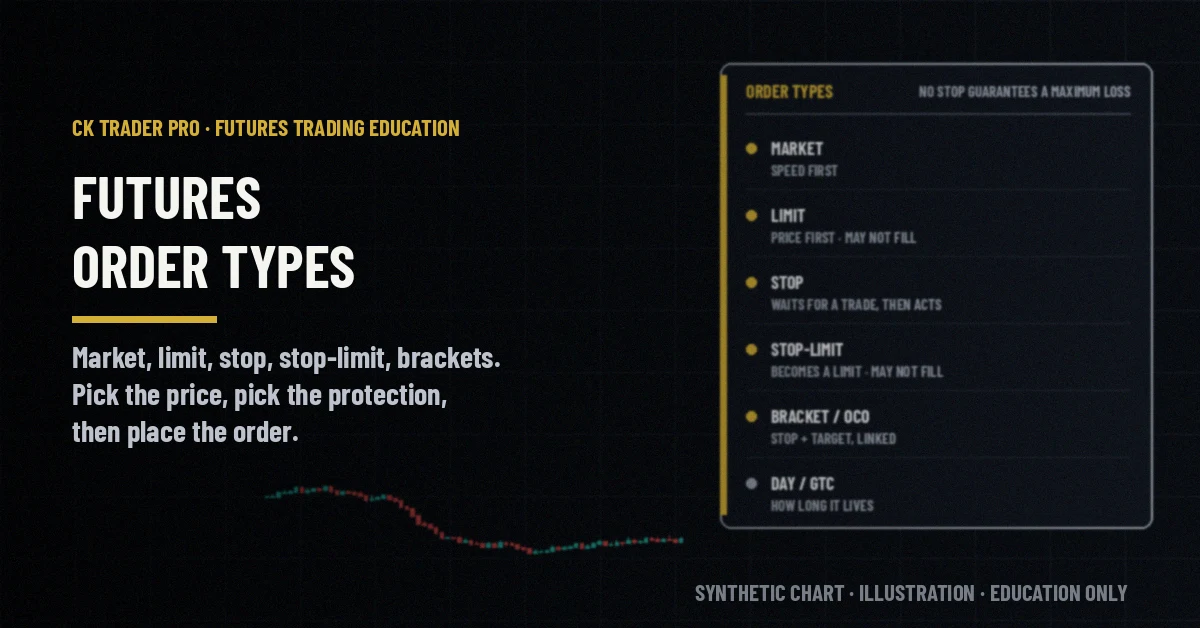
Short answer: Futures order types tell the exchange how, and at what price, your order can fill. A market order takes the best price available now. A limit order can’t fill worse than your price, but may not fill at all. A stop order waits for a trade at your trigger price, then enters the book as a market-type order (stop with protection) or a limit order (stop-limit). A bracket pairs a stop and a target, linked as OCO, one-cancels-other. Each one trades speed for price, or price for a fill. No stop guarantees a maximum loss.
Education only. Futures trading involves substantial risk of loss. Not financial advice.
Some retail futures prop programs use simulated evaluations and simulated funded accounts; some also offer a separate live-funded stage. Verify your specific account type. CK Trader Pro and NQ Live Trading aren’t owned, run or endorsed by any prop firm.
The order is part of the trade
I’ve been trading futures since 1998. In my experience, traders spend hours on where to get in and seconds on how. But the button is a decision. It decides whether you get filled, and at what price.
Have you ever noticed this about traders?
How many traders can describe their setup in detail, but not the difference between a stop and a stop-limit?
How many place a limit order, watch price touch it, and wonder why they weren’t filled?
And how many set a stop and treat that price as the most they could lose?
None of that is a chart problem. It’s an order problem, and it can be learned before the open.
Here’s the point
Every order type trades one risk for another.
A market order trades price for speed. A limit order trades a sure fill for control of price. A stop waits, then acts.
Market orders: speed first
A market order asks to be filled right away at the best available price. CME Group describes two forms on its markets: a market-limit order, which fills at the best available price and, if only partly filled, becomes a limit order for the remaining quantity at that fill price, and a market order with protection, which fills only inside a pre-set “protected range” to prevent fills at extreme prices (sources: CME Group, Futures Order Types; CME Group Client Systems Wiki, Order Types for Futures and Options).
CME also notes the catch: in a market with a wide bid-ask spread and low volume, a buyer “might find their order gets filled for a higher price,” and a seller for a lower one (same source). That gap is slippage; for NQ examples, see NQ slippage on nqlivetrading.com.
Limit orders: price first
A limit order sets the maximum price you’ll pay to buy or the minimum price you’ll accept to sell. CME puts it plainly: a limit order “cannot be filled worse than the limit price but can be filled better” (source: CME Group, Futures Order Types).
The trade-off is the fill. CME notes that “in a fast-moving market, the order may not be filled because the price keeps moving away from the price of their order.” Price touching your level doesn’t mean you were filled. On CME Globex, FIFO matching fills resting orders at the same price in the order they arrived, earliest first, so other orders at that price can be ahead of yours (source: CME Group Client Systems Wiki, CME Globex Matching Algorithm Steps).
Stop orders: wait, then act
A stop order doesn’t sit in the book like a limit. CME says a stop “does not immediately go on the book, but must be triggered by a trade in the market at the price level submitted with the order” (source: CME Group, Futures Order Types). Stops are used to exit a losing position or to enter on a break of a level.
On CME Globex there are two kinds of stop:
- Stop with protection. When triggered, it enters the book as a market order that can fill only within a protection range around the trigger price; any quantity not filled in that range rests at the protection price limit (source: CME Group Client Systems Wiki, Order Types for Futures and Options). So it can fill worse than your stop price, and in an extreme move part of it can be left unfilled.
- Stop-limit. When triggered, it becomes a limit order at your limit price. It can fill between the trigger and the limit; anything unfilled rests at the limit (same source). If price jumps past your limit, a stop-limit may not fill at all, and you’re still in the position.
Platform labels may not match the exchange’s names, so check your platform’s order-type help. No stop guarantees a maximum loss. A stop is an instruction about when to act, not a promise about price.
Brackets and OCO: stop and target together
A bracket is a stop on one side of a position and a target, usually a limit, on the other. The link that cancels the leftover order is called one-cancels-other. CME Group’s help for its CME Direct front end describes OCO orders as “two or more separate (though linked) orders, in which a full fill of one order in the group results in all other linked orders being canceled or held,” and notes that “a partial fill will not cancel linked orders” (source: CME Group, One Cancels Other). The same page shows this behavior can be configured, so platforms differ.
Bracket and OCO aren’t on CME Globex’s list of futures order types, which is limit, market order with protection, market-limit, stop-limit and stop order with protection (CME Group Client Systems Wiki). The link is typically held by your platform or broker. A bracket carries every risk of the stop inside it. For how we set one before entry in the live room, see bracket orders on NQ.
How long an order lives
Price isn’t the only condition. CME notes that futures orders are typically submitted as day orders, active only until the end of that day’s session, while Good Till Cancel (GTC) orders stay active until you cancel them or they fill (source: CME Group, Futures Order Types). In my experience, a forgotten GTC order is one of the quietest risks on a screen.
Putting it in ticks
NQ moves in minimum ticks of 0.25 index points (source: CME Group E-mini Nasdaq-100 contract specs). A stop 10 points away is 40 ticks. Use the NQ tick value calculator to turn ticks into dollars for your size. Illustration only, not a recommendation.
The order type belongs in the plan, next to the level; see how to plan trade entries.
A five-question order check
- Do I need the fill or the price? That’s market vs limit.
- Is my stop a stop with protection or a stop-limit?
- If my stop-limit doesn’t fill, what’s my next step?
- Are my stop and target linked as OCO, and what happens on a partial fill?
- Is this a day order or GTC?
Where we fit
Is CK Trader Pro a prop firm? No. We teach futures and prop firm education. We don’t sell evaluations or funded accounts, and we don’t route or execute anyone’s orders.
CK has affiliate relationships with some prop firms, including Apex Trader Funding and Lucid Trading, and may earn a commission from sign-ups through his links. Knowing order types doesn’t promise you’ll pass anything or make money. It means the button won’t be the thing that surprises you. For the bigger picture, start with our futures trading education and day trading education guides.
The noise skips the order
Here’s what gets in a new trader’s way, and it isn’t the trader. It’s the noise. Feeds show the entry and the exit, never the order behind them. Nobody posts “my stop-limit didn’t fill.” The order looks like a detail. It isn’t.
Remember this
Pick the price, pick the protection, then place the order.
So here’s my question: for the last trade you took, could you say which order type you used, and what it would have done in a fast market?
If you’d like to watch orders get planned and talked through in real time, there’s a free live NQ session on weekdays from 9:30 to 10:30 AM ET at nqlivetrading.com/live, run by the same company. Registration is required. Adults 21+. Sessions are education, not signals.
Join the Academy
Know your order before the open. CK Trader Pro is futures and prop firm education: step-by-step lessons, live sessions and risk planning, built for traders who want their entries, stops and order types written down and understood before the bell. It’s the CK Trader Pro Membership, which includes:
- Members-only educational lessons on prop-firm rules, drawdown, daily loss limits, position sizing and NQ and MNQ contract basics
- War Room: CK’s live pre-market planning session, weekdays 8:30–9:30 AM ET, where the day’s levels, news times and risk get written down before the open
- CK’s chart setup, shown and explained live in every session
- Economic news calendar
Education only. No trade signals or personal advice. No results promised.
Billed monthly until you cancel. See pricing at cktraderpro.com.
FAQ
What are the main futures order types?
On CME Globex, the futures order types are limit, market order with protection, market-limit, stop-limit and stop order with protection. Brackets and OCO links are typically managed by your platform or broker, which sends those individual orders to the exchange.
What’s the difference between a market, limit and stop order in futures?
A market order fills at the best available price now. A limit order sets the worst price you’ll accept and can’t fill worse, but may not fill. A stop order waits for the market to trade at your trigger price, then enters the book as a market-type or limit order.
Can a futures stop order fill worse than my stop price?
Yes. Once triggered, a stop with protection can fill at prices past your stop, within its protection range. No stop guarantees a maximum loss, so many traders plan for the fill being worse than the stop price.
Why didn’t my stop-limit order fill?
A stop-limit becomes a limit order when it triggers. If price moves past your limit price, the order can’t fill worse than that limit, so it may not fill at all and you may still be in the position.
What is a bracket order in futures?
It’s a stop and a target placed around a position and linked as one-cancels-other (OCO), so a full fill of one cancels or holds the other. How partial fills are handled depends on your platform, so check its help.
Is CK Trader Pro a prop firm?
No. CK Trader Pro is futures and prop firm education. It doesn’t sell evaluations or funded accounts, and it isn’t owned, run or endorsed by any prop firm.
Trading futures involves substantial risk of loss and is not suitable for everyone. Past performance is not indicative of future results. Education only, not financial advice. Example numbers are illustrations, not recommendations. No stop guarantees a maximum loss. Order types and their labels vary by platform and broker; check your platform’s current order-type help. Prop-firm rules vary by firm and change often; check each firm’s current rules. Some retail futures prop programs use simulated evaluations and simulated funded accounts; some also offer a separate live-funded stage. Verify your specific account type. CK Trader Pro and NQ Live Trading aren’t owned, run or endorsed by any prop firm. See our Risk Disclosure and Disclosures. CK Trader Pro is operated by CK TRADING INSTITUTE OF TECHNOLOGY LLC.
About this article. This is general education from CK Trader Pro. It isn't investment advice, a recommendation to buy or sell, or a trade signal, and it doesn't take your situation into account. Dollar figures and examples are illustrations, not results. Prop-firm rules, costs and payout terms vary by firm and change often; check the firm's current terms before you buy anything. We have paid referral relationships with some prop firms (see Disclosures). We are not owned, run, employed or endorsed by these firms. Mentioning a firm or its evaluations is not a recommendation that you trade. Trading futures involves substantial risk of loss and is not suitable for everyone.