

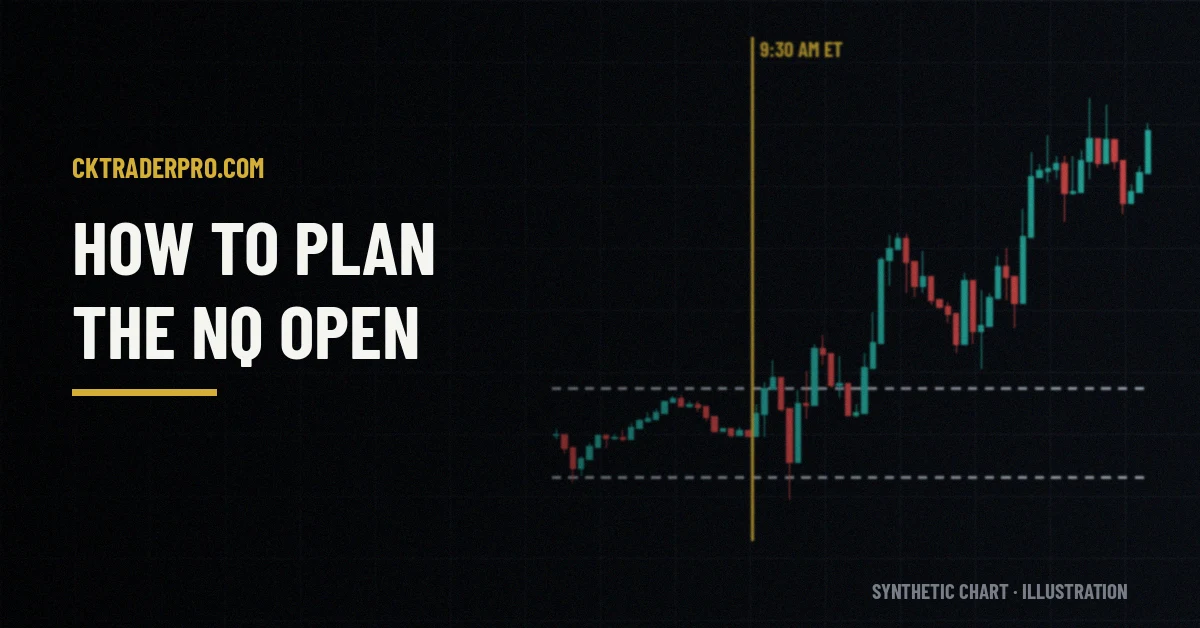
How to Plan the NQ Open
Education only, not financial advice. Trading futures involves substantial risk of loss and is not suitable for everyone.
Many traders don't pass prop evaluations, and evaluation fees can be lost entirely. Rules, costs and payout terms vary by firm and change often, so check the firm's current terms.
By CK · Futures trader since 1998
Short answer: Planning the NQ open means writing a premarket plan before 9:30 AM ET: the levels you’ll watch, the most you’ll risk, your position size and the conditions that mean you don’t trade. The plan is set before price moves, so decisions at the open follow rules instead of reactions.
Education only. Futures trading involves substantial risk of loss.
Prop-firm evaluations and funded accounts are typically simulated. CK Trader Pro and NQ Live Trading aren’t owned, run or endorsed by any prop firm.
Affiliate disclosure: some links are affiliate links; we may earn a commission at no extra cost to you.
What does “planning the NQ open” mean?
Planning the NQ open means writing down, before 9:30 AM ET, the price levels you care about, your maximum risk for the session, your position size and your no-trade rules. It turns the open from a guessing game into a checklist. The plan decides what you’re allowed to do before the market moves.
A complete plan has four parts:
| Part | Question it answers |
|---|---|
| Levels | Where might price react? |
| Max risk | What’s the most I’ll lose today before I stop? |
| Size | How many contracts fit that risk at my stop distance? |
| No-trade rules | What conditions mean I sit out? |
Many traders skip the last two parts. They mark levels, then decide size and risk in the moment, which is when decisions are hardest to make well. Writing all four parts down first is what makes the plan a plan. That’s what I teach.
When is the NQ open?
For most planning purposes, “the NQ open” means 9:30 AM ET, the U.S. stock market open on Nasdaq and the NYSE. NQ futures themselves trade on CME Globex Sunday–Friday, 6:00 PM to 5:00 PM ET, with a daily 5:00–6:00 PM ET break. So futures are already trading before the stock market opens.
Sources: CME Group E-mini Nasdaq-100 (NQ) contract specifications for futures hours; Nasdaq market hours and holiday schedule for the 9:30 AM to 4:00 PM ET regular stock session.
That matters for your plan in two ways:
- The overnight session leaves levels behind. The high and low traded since the prior evening are already on your chart at 9:30.
- Economic data can land before the stock open. Many U.S. releases, including the Employment Situation report, CPI, PPI, retail sales and jobless claims, come out at 8:30 AM ET, an hour before the stock market opens, while NQ futures are already trading.
Which premarket levels matter?
The premarket levels many traders mark are the overnight high and low, the prior day’s high, low and close, and the times of any scheduled economic releases. These give you reference points where price has turned before, plus a clear warning of when volatility may jump on news.
A simple premarket level list:
- Overnight high (ONH) and overnight low (ONL). The range traded on Globex since the prior evening.
- Prior day high, low and close. Where the previous regular session went and where it settled.
- Economic calendar. Check for releases such as the jobs report and CPI, typically 8:30 AM ET (BLS); see the BLS release calendar. Separately, note FOMC decisions at 2:00 PM ET on the Federal Reserve FOMC calendar.
Keep the list short. Three to five levels you understand beat fifteen you don’t. A level isn’t a signal. It’s a place to watch how price behaves and to compare with your plan.
How much should I risk on the open?
Decide your dollar risk first, then size from your stop distance using tick value. NQ moves in 0.25-point ticks worth $5 each, so NQ is $20 per point. MNQ ticks are worth $0.50, so MNQ is $2 per point (source: CME Group). Size equals dollar risk divided by stop distance times point value. Run your numbers in the NQ tick value calculator.
Sources: CME Group NQ contract specifications and MNQ contract specifications.
Illustration only. Say you’ll risk $200 on a trade and your stop is 20 points away:
| Contract | Point value | Risk per contract at a 20-point stop | Contracts that fit $200 |
|---|---|---|---|
| NQ | $20 | $400 | 0 (doesn’t fit) |
| MNQ | $2 | $40 | 5 |
In this example, one NQ contract is double the risk budget, so the plan says MNQ or no trade. That’s the point of sizing before the open: the math says no before your emotions get a vote.
Two reminders:
- A stop doesn’t guarantee a maximum loss. In fast markets, orders can fill past your stop, so leave a margin in your plan.
- Set a session limit, not just a trade limit. Decide how many losing trades or how many dollars end your day.
Our prop firm drawdown calculator helps you see how your size compares with the room you have left.
How do prop-firm daily loss limits change the plan?
If you trade a prop firm evaluation, your daily loss limit and drawdown floor set a hard ceiling on risk, so your session limit should sit well inside them. Rules vary by firm and change often, so check your firm’s current rules before you build the plan. Plan around the room left, not the account size.
How to fold firm rules into your plan:
- Write down your room today. Daily loss limit remaining and distance to the drawdown floor. The smaller of the two is your real ceiling.
- Set your session limit below it. Leave a buffer for slippage, because a stop isn’t a guaranteed fill.
- Know how your floor moves. An intraday trailing floor can rise with open profit. See trailing vs end-of-day drawdown.
- Run the numbers. Use the prop firm drawdown calculator and read our prop firm information hub. Then check your firm’s current rules, word for word.
Prop-firm evaluations and funded accounts are typically simulated. Treat the rules as real constraints anyway, because breaking them usually ends the account.
When should I not trade the open?
Don’t trade the open when a major release is due and your plan doesn’t cover it, when you can’t state your levels, risk and size in one sentence, or when you’re already near your daily loss limit. Sitting out is a valid plan, and writing these rules down ahead of time makes them easier to follow.
A no-trade checklist:
- News risk. A big release such as CPI, the jobs report or an FOMC decision is scheduled and your plan doesn’t account for it.
- Unclear plan. You can’t say where you’d enter, where your stop goes and how many contracts you’d trade.
- Near the threshold. You’re close to a daily loss limit or drawdown floor, and one normal stop could breach it.
- State of mind. You’re tired, rushed or trying to win back a loss.
If any box is checked, the plan is to watch. Many traders find that the open still teaches them a lot when they aren’t in a trade.
Where can I watch the open being planned live?
You can watch the NQ open being planned and read live in the free room every weekday from 9:30 to 10:30 AM ET. It walks through levels, risk, size and no-trade rules in real time. Registration is required. Adults 21+. It’s education only, with no signals and no promised results.
CK (George Ama) is a futures trader since 1998 and the founder of CK Trader Pro. He began as a quant analyst and started trading in the pits in 2000 before moving to the screen. Today he teaches risk-first futures education in a free live room every weekday at 9:30 AM ET.
Join CK Trader Pro. Free room. Paid membership also available. Billed monthly until you cancel. See pricing at cktraderpro.com.
Premarket checklist (copy this)
- ☐ Overnight high and low marked
- ☐ Prior day high, low and close marked
- ☐ 8:30 AM ET BLS releases checked; FOMC day noted (2:00 PM ET)
- ☐ Max session loss written down
- ☐ Size calculated from stop distance and point value (NQ $20/pt, MNQ $2/pt)
- ☐ Firm’s daily loss limit and floor checked (check your firm’s current rules)
- ☐ No-trade conditions reviewed
FAQ
What time is the NQ open?
Planning usually centers on 9:30 AM ET, the U.S. stock market open on Nasdaq and the NYSE. NQ futures trade on CME Globex Sunday–Friday, 6:00 PM to 5:00 PM ET, with a daily 5:00–6:00 PM ET break.
What levels should I mark before the NQ open?
Many traders mark the overnight high and low, the prior day’s high, low and close, and the times of scheduled economic releases.
How much is a point on NQ and MNQ?
NQ is $20 per point ($5 per 0.25-point tick). MNQ is $2 per point ($0.50 per tick), per CME Group contract specifications.
Does a stop limit my loss on the open?
A stop helps manage risk, but it doesn’t guarantee a maximum loss. In fast markets orders can fill past the stop.
How do prop firm rules affect my opening plan?
Your daily loss limit and drawdown floor cap your risk, so set your session limit below them. Rules vary, so check your firm’s current rules.
Education only. Futures trading involves substantial risk of loss and isn’t suitable for every investor. Past performance isn’t indicative of future results. Prop-firm evaluations and funded accounts are typically simulated. CK Trader Pro and NQ Live Trading aren’t owned, run or endorsed by any prop firm. Affiliate disclosure: some links are affiliate links; we may earn a commission at no extra cost to you.
About this article. This is general education from CK Trader Pro. It isn't investment advice, a recommendation to buy or sell, or a trade signal, and it doesn't take your situation into account. Dollar figures and examples are illustrations, not results. Prop-firm rules, costs and payout terms vary by firm and change often; check the firm's current terms before you buy anything. We have paid referral relationships with some prop firms (see Disclosures). We are not owned, run, employed or endorsed by these firms. Mentioning a firm or its evaluations is not a recommendation that you trade. Trading futures involves substantial risk of loss and is not suitable for everyone.