

Paper Trading vs Live Futures: How to Practice With Purpose
Education only, not financial advice. Trading futures involves substantial risk of loss and is not suitable for everyone.
Many traders don't pass prop evaluations, and evaluation fees can be lost entirely. Rules, costs and payout terms vary by firm and change often, so check the firm's current terms.
By CK · Futures trader since 1998
How to practice futures trading in plain English: what paper trading (a simulator) can teach you, what it can’t, why a live account feels different, and how to turn sim time into practice with a purpose. Education only. Futures trading involves substantial risk of loss. Not financial advice.
Prop-firm evaluations and funded accounts are typically simulated. CK Trader Pro and NQ Live Trading aren’t owned, run or endorsed by any prop firm.
The account that didn’t feel real
In my experience, the first simulator account a trader opens teaches them something nobody warned them about: it doesn’t feel real.
You click buy. The fill comes back instantly. You take a loss, shrug, and click again. You size up because, honestly, why not? It’s not your money.
Then one day the money is real, or the rules are, and the same click feels completely different. Your hand hesitates. You move a stop you swore you’d never move. And the screen hasn’t changed at all. You have.
Have you ever noticed this about traders who practice?
How many traders spend months on a simulator and never write down a single rule they’re testing?
How many take trades in sim they’d never take with real risk on, then wonder why the results don’t carry over?
And how many measure practice by the account balance, instead of by whether they did what they planned?
None of that is about the platform. It’s about what you’re practicing. A simulator only builds the habits you bring to it.
What paper trading is
Paper trading, sim trading or a demo account all mean the same basic thing: you place orders on a platform that tracks them against market prices, but no real order reaches the exchange and no real money is at risk. Many futures platforms offer one, and many prop-firm evaluations are run on simulated accounts too.
If some of the vocabulary is new, our futures trading glossary covers the core terms in plain English.
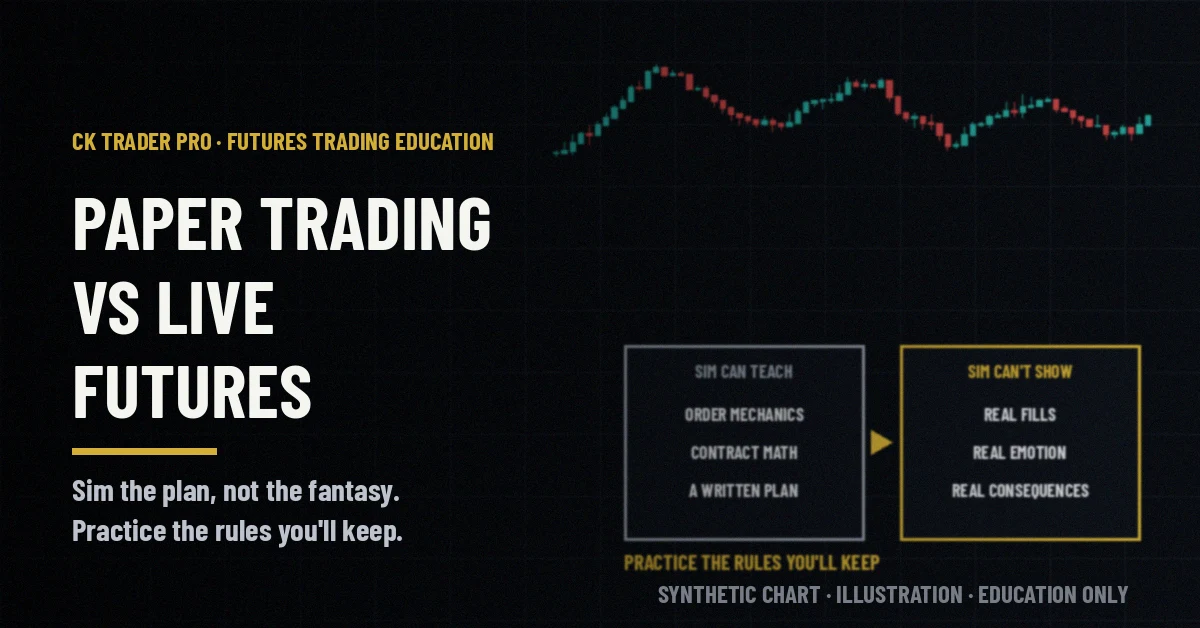
What a simulator can teach you
Used well, a simulator is one of the cheapest teachers in trading. It’s good for:
- Platform mechanics. Placing, moving and cancelling orders. Knowing where the flatten button is before you need it.
- Order types. How a market, limit and stop order behave, and what a bracket order does.
- Contract math. Feeling what a point means on NQ ($20 per point) and MNQ ($2 per point), per CME Group’s E-mini Nasdaq-100 and Micro E-mini Nasdaq-100 specifications.
- Following a written plan. Repeating the same routine until it’s boring.
- Seeing the open. Watching how fast the market can move around the 9:30 AM ET open and scheduled news, without paying for the lesson.
What a simulator can’t teach you
Here’s the honest part. A simulator leaves some things out, and those things matter.
- Real fills. In sim, your limit order may fill the moment price touches it. In a live market, you’re in a queue, and you may not get filled at all. Stops can also fill worse than the price you set, especially in fast markets. No stop guarantees a maximum loss.
- Real emotion. Fear and hope show up differently when the loss is real. Many traders find their rules get harder to follow the moment something real is at stake.
- Real consequences. A blown sim account resets with a click. A blown live account, or a breached prop-firm rule, doesn’t.
Regulators say this plainly about simulated results. The CFTC’s required disclaimer for simulated performance reads: “Unlike the results shown in an actual performance record, these results do not represent actual trading. Also, because these trades have not actually been executed, these results may have under-or over-compensated for the impact, if any, of certain market factors, such as lack of liquidity” (source: 17 CFR § 4.41(b)(1)(i)). That’s written for advertised performance, but the lesson applies to your own sim results too.
Here’s the point
Practice isn’t about the account. It’s about the rules you repeat.
A great sim balance built on oversized trades and moved stops teaches you the wrong habits very efficiently. A flat sim balance built on a written plan, followed every day, teaches you the right ones.
How to practice futures trading with a purpose
In my experience, purposeful practice looks a lot like real trading, just without the money. Here’s the routine I’d use:
- Practice at the size you’d actually trade. If you’d trade one MNQ contract live, trade one in sim. Practicing at a size you’ll never use teaches you nothing about your real risk.
- Write your risk before the open. Dollar risk per trade, maximum losses per day, and the contract count that math gives you. Our walkthrough on how to size NQ and MNQ trades from your stop shows the method.
- Pick one skill per week. Entries at your planned level, holding your stop, or stopping after your daily limit. One thing at a time.
- Use a pre-market plan. Key levels and news times, written down before 9:30. Our guide to pre-market futures analysis walks through it.
- Keep a daily stop in sim too. If you’d stop for the day live, stop in sim.
- Journal every trade. Did you follow the plan? Yes or no. That’s the score that matters. See how to journal futures trades.
Illustration only, not a recommendation. Say your plan risks $100 per trade on MNQ. With a 20-point stop, that’s $40 per contract (20 × $2), so the math gives you 2 contracts ($80) and not 3 ($120). Practicing that exact calculation every morning in sim is the habit. Fills can be worse than planned, especially around the open and news. No stop guarantees a maximum loss.
When are you ready to move on from sim?
There’s no date on the calendar that makes you ready, and moving to live trading or a prop-firm evaluation doesn’t promise any result. But in my experience, these are better signals than a sim balance:
- You’ve followed your written plan on nearly every trade for weeks, and your journal shows it.
- You stop at your daily limit without arguing with yourself.
- You can explain your risk on any trade before you take it.
- You know the rules of the account you’re moving to, word for word.
If you’re heading toward a prop-firm evaluation, remember it’s typically simulated too, with rules that can end the account. Our prop firm education learning path covers what to learn first.
The noise says practice doesn’t count
Here’s what gets in a lot of traders’ way, and it isn’t you. It’s the noise. It says sim is a waste of time and you have to “get in the real game” to learn. Or it flips the other way and treats a big sim balance like proof you’re ready.
Both skip the real lesson. The CFTC urges people “to be skeptical when promoters… claim that their products and services will earn high profits with minimal risks” (source: CFTC Fraud Advisory). Practice is how you learn the process. It isn’t a shortcut to profit.
CK has affiliate relationships with some prop firms, including Apex Trader Funding and Lucid Trading, and may earn a commission from sign-ups through his links. That doesn’t change what we teach.
Remember this
Sim the plan, not the fantasy. Practice the rules you’ll keep.
Where to learn it step by step
Can practicing in a simulator make you profitable? There’s no guarantee of that. Plenty of traders do well in sim and struggle live. What education can do is help you practice the right things, in the right order, with a plan you can check yourself against. That’s what I teach. For the bigger picture, start with our day trading education guide and the futures trading education starting point.
So here’s my question: if you looked at your last ten practice trades, how many followed a plan you wrote down before the open?
If you’d like to watch first, there’s a free live NQ session on weekdays from 9:30 to 10:30 AM ET at nqlivetrading.com/live, run by the same company. Registration is required. Adults 21+. Sessions are education, not signals.
Join the Academy
Practice with a plan, not a guess. CK Trader Pro is prop firm education for futures traders: step-by-step lessons, live sessions and risk planning. It’s the CK Trader Pro Membership, which includes:
- Members-only educational lessons on prop-firm rules, risk and charting
- War Room: CK’s live pre-market planning session, weekdays 8:30–9:30 AM ET, where the day’s risk and news times get written down before the open
- CK’s chart setup, shown and explained live in every session
- Economic news calendar
Education only. No trade signals or personal advice. No results promised.
Billed monthly until you cancel. See pricing at cktraderpro.com.
FAQ
What’s the difference between paper trading and live futures trading?
Paper trading tracks your orders against market prices without sending them to the exchange or risking real money. Live trading uses real orders and real money, so fills, slippage and your own emotions can all behave differently.
Is a futures trading simulator worth using?
It can be useful for learning platform mechanics, order types, contract math and following a written plan. It can’t fully show real fills, real emotion or real consequences, so sim results don’t predict live results.
How should I practice futures trading?
Practice at the size you’d actually trade, write your risk before the open, focus on one skill at a time, keep a daily stop, and journal whether each trade followed your plan.
Why do sim results often differ from live results?
Simulated fills can be more generous than real ones, especially for limit orders and in fast markets, and many traders follow their rules less closely when real money is at stake. No stop guarantees a maximum loss.
When should I stop paper trading?
There’s no set date. Better signals than a sim balance are following your written plan consistently, stopping at your daily limit, and knowing the rules of the account you’re moving to. Moving on doesn’t promise any result.
Trading futures involves substantial risk of loss and is not suitable for everyone. Past performance is not indicative of future results. Simulated results have inherent limitations and do not represent actual trading. Education only, not financial advice. All numbers in this article are illustrations, not results or recommendations. No stop guarantees a maximum loss. Prop-firm evaluations and funded accounts are typically simulated. Fees are generally non-refundable, and rules vary by firm and change often. CK Trader Pro and NQ Live Trading aren’t owned, run or endorsed by any prop firm. See our Risk Disclosure and Disclosures. CK Trader Pro is operated by CK TRADING INSTITUTE OF TECHNOLOGY LLC.
About this article. This is general education from CK Trader Pro. It isn't investment advice, a recommendation to buy or sell, or a trade signal, and it doesn't take your situation into account. Dollar figures and examples are illustrations, not results. Prop-firm rules, costs and payout terms vary by firm and change often; check the firm's current terms before you buy anything. We have paid referral relationships with some prop firms (see Disclosures). We are not owned, run, employed or endorsed by these firms. Mentioning a firm or its evaluations is not a recommendation that you trade. Trading futures involves substantial risk of loss and is not suitable for everyone.