

Prop Firm Consistency Rules, Explained
Education only, not financial advice. Trading futures involves substantial risk of loss and is not suitable for everyone.
Many traders don't pass prop evaluations, and evaluation fees can be lost entirely. Rules, costs and payout terms vary by firm and change often, so check the firm's current terms.
By CK · Futures trader since 1998
A prop firm consistency rule, explained in plain English: what it is, how the percentage is usually worked out, how it differs between an evaluation and a payout request, and how it collides with your drawdown. Education only. Futures trading involves substantial risk of loss. Not financial advice.
Prop-firm evaluations and funded accounts are typically simulated. CK Trader Pro and NQ Live Trading aren’t owned, run or endorsed by any prop firm.
The rule that shows up after the good day
In my experience, the consistency rule is the one traders read last. They learn the profit target, they learn the drawdown, and then one strong session puts them near the target and they find a line they skimmed past: no single day can make up more than a set share of the total.
Nothing was breached. The account is fine. But the finish line just moved.
Have you ever wondered this about prop traders?
How many traders hit a big day and think they’re almost done, without checking whether that day is now too big?
How many plan their sessions around the profit target and never once around the best-day limit?
And how many push harder on the next few days to “dilute” that big day, right when their drawdown has the least room for mistakes?
If that sounds familiar, you’re not alone. None of those questions is about a better entry. They’re about reading the rules before the market tests them.
What a consistency rule is
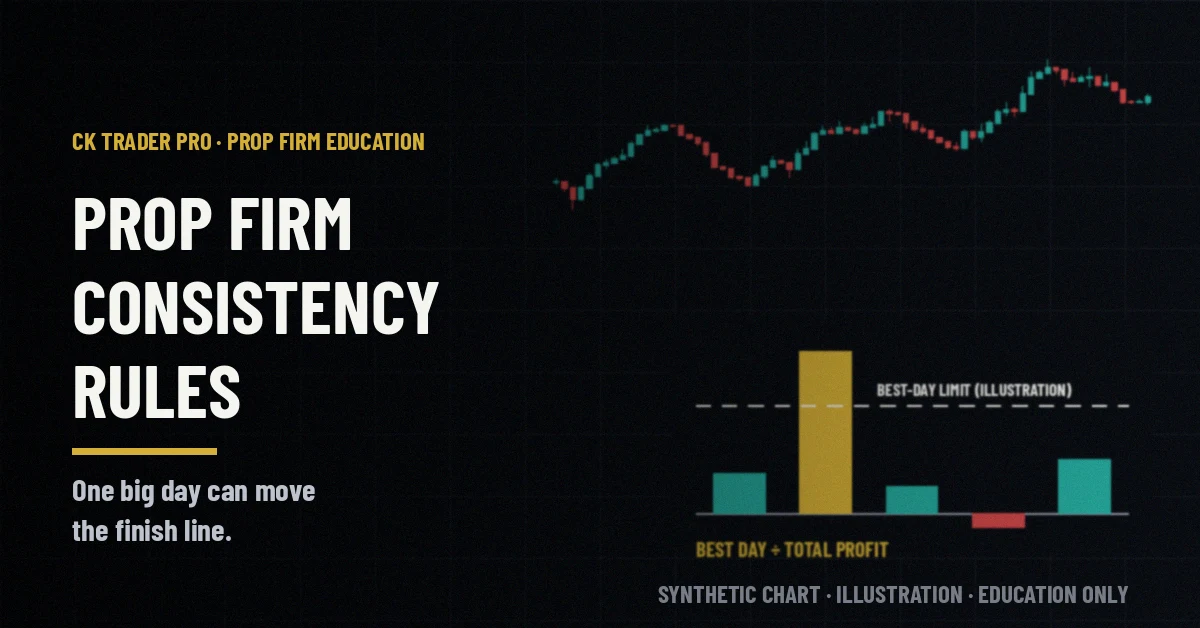
A consistency rule limits how much of your total profit can come from one trading day. Firms use it to see that results come from repeatable trading over several sessions rather than one outsized day. Some firms call it a “best day rule,” and some apply it only when you ask for a payout.
Not every firm has one, and the ones that do don’t all calculate it the same way. Rules vary by firm and change often, so check your firm’s current rules, word for word. For the bigger picture of how evaluations work, start with our prop firm information hub.
How the percentage is usually calculated
The most common version compares your single best day to your total profit:
Best day ÷ total profit = your consistency percentage.
If that number is above the firm’s limit, you haven’t met the rule yet. You usually don’t fail; you just need more total profit (or more trading days) before the rule is satisfied.
Illustration only, not any firm’s real numbers. Say the limit is 40% and you trade 2 MNQ, which is $4 per point (MNQ is $2 per point; source: CME Group Micro E-mini Nasdaq-100 contract specifications).
| Day | Result | Running total | Best day | Best day ÷ total |
|---|---|---|---|---|
| 1 | +$300 (75 pts) | $300 | $300 | 100% |
| 2 | +$1,200 (300 pts) | $1,500 | $1,200 | 80% |
| 3 | +$200 (50 pts) | $1,700 | $1,200 | 71% |
| 4 | −$100 (−25 pts) | $1,600 | $1,200 | 75% |
| 5 | +$400 (100 pts) | $2,000 | $1,200 | 60% |
With a $1,200 best day and a 40% limit, total profit has to reach $1,200 ÷ 0.40 = $3,000 before the rule is met. That’s $1,000 more, and the losing day on Day 4 pushed the percentage back up.
Some firms measure the best day against the profit target instead of total profit, some count only winning days, and some cap the day itself rather than its share. Same idea, different math. Check which one your firm uses.
Evaluation vs payout consistency rules
Some firms apply a consistency rule during the evaluation, so it affects when you pass. Others drop it in the evaluation and apply it to funded accounts when you request a payout, so it affects when you can withdraw. A few use both, with different limits.
That difference matters for planning. The same big day can be harmless in one phase and hold up a payout request in another. Our guide to prop firm payout requirements covers the other conditions that usually sit next to this one, such as minimum trading days.
How it interacts with drawdown
Here’s where the rule gets expensive. A big day doesn’t only raise your consistency percentage. On a trailing account, it can also raise your floor.
Using the illustration above with an end-of-day trailing drawdown of $2,000: if the $1,200 day closes at a new account high, the floor can rise by the same $1,200 (until it reaches any level where your firm stops trailing it). Your room stays about $2,000 below your best end-of-day balance, so the profit you’ve banked doesn’t add any extra cushion. And after the Day 4 loss, you have less room than you did on Day 1. Now you need another $1,000 of profit to satisfy the rule, with no more room to work with than you had at the start. If you get impatient and size up to “fix” the percentage faster, one bad trade can hit the floor. On intraday trailing, the open profit during that big trade can move the floor even further. See trailing vs end-of-day drawdown for how each one moves.
Stops can fill worse than the price you set, especially around the 9:30 AM ET open and scheduled news. That’s slippage. No stop guarantees a maximum loss.
Here’s the point
The consistency rule doesn’t punish losing. It punishes lopsided winning, and that pushes traders to take risks they wouldn’t otherwise take.
Planning sessions around the rule
In my experience, the answer is a plan you write before the session, not a reaction after a big day.
- Know the math before day one. Multiply the profit target by the limit to see the largest single day that still fits if you finish right at the target. With a $3,000 target and a 40% limit (illustration), that’s $1,200.
- Set a personal daily profit cap below it. Some traders stop for the day once they reach it. That’s a rule you set, not a firm requirement.
- Size from your room, not the target. Contracts = risk in dollars ÷ (stop points × dollars per point). The NQ tick value calculator turns points into dollars, and how to size NQ and MNQ trades from your stop walks through it.
- Track the floor every day. The free prop firm drawdown calculator shows how much room is left from the numbers you enter.
- Keep a daily stop well inside any daily loss limit. More in our daily loss limit strategy.
Read your firm’s exact terms (checklist)
Before you buy or trade an evaluation, find the answer to each of these on the firm’s current rules page, or ask the firm in writing:
- Is there a consistency rule? In the evaluation, on payouts, or both?
- What’s the limit, and what is the best day measured against: total profit, the profit target, or something else?
- Do losing days count in the total?
- What happens if you exceed it: more days, more profit, or something else?
- Does it reset after a payout?
- Which drawdown type does the account use, and does the floor stop trailing?
The noise sells you the target
Here’s what gets in a lot of traders’ way, and it isn’t you. It’s the noise. It shows the profit target in big letters and the consistency rule in small ones. It celebrates the one huge day and skips the rule that day just triggered.
The CFTC urges people “to be skeptical when promoters… claim that their products and services will earn high profits with minimal risks” (source: CFTC Fraud Advisory). Read the rules page before the sales page. An evaluation is a paid test, usually in a simulated account, and the fee is generally non-refundable.
CK has affiliate relationships with some prop firms, including Apex Trader Funding and Lucid Trading, and may earn a commission from sign-ups through his links. That doesn’t change what we teach.
Remember this
Plan the day, not the payday.
Where to learn it step by step
Can understanding the consistency rule make you profitable? There’s no guarantee of that. Plenty of traders understand every rule and still lose money or fail evaluations. What education can do is help you know how the rules work together, and what they cost when you ignore them, before money is on the line. That’s what I teach.
So here’s my question: before your next session, could you write down your firm’s consistency limit, the biggest day that fits inside it, and where your drawdown floor sits right now?
If you’d like to watch first, there’s a free live NQ session on weekdays from 9:30 to 10:30 AM ET at nqlivetrading.com/live, run by the same company. Registration is required. Adults 21+. Sessions are education, not signals.
Join the Academy
Know the rule before it costs you. CK Trader Pro is prop firm education for futures traders: step-by-step lessons, live sessions and risk planning. It’s the CK Trader Pro Membership, which includes:
- Members-only educational lessons on prop-firm rules, risk and charting
- War Room: CK’s live pre-market planning session, weekdays 8:30–9:30 AM ET, where the day’s risk and news times get written down before the open
- CK’s chart setup, shown and explained live in every session
- Economic news calendar
Education only. No trade signals or personal advice. No results promised.
Billed monthly until you cancel. See pricing at cktraderpro.com.
FAQ
What is a consistency rule at a prop firm?
It’s a rule that limits how much of your total profit can come from a single trading day. Not every firm has one, and the details vary, so check your firm’s current rules.
How is the consistency percentage calculated?
The most common version divides your best day by your total profit. Some firms measure the best day against the profit target instead, or cap the day itself. Check which method your firm uses.
Do I fail if I break the consistency rule?
Usually it means the rule isn’t met yet, so you may need more profit or more trading days before you pass or request a payout. Some firms handle it differently, so read your firm’s current terms.
Is the consistency rule for the evaluation or the payout?
It depends on the firm. Some apply it during the evaluation, some only to payout requests on funded accounts, and some to both.
How does a consistency rule interact with trailing drawdown?
A big day can raise both your consistency percentage and, on a trailing account, your drawdown floor. Pushing size to fix the percentage can put the account closer to the floor. No rule or plan makes passing likely or certain.
Trading futures involves substantial risk of loss and is not suitable for everyone. Past performance is not indicative of future results. Education only, not financial advice. All numbers in this article are illustrations, not results or recommendations. No stop guarantees a maximum loss. Prop-firm evaluations and funded accounts are typically simulated. Fees are generally non-refundable, and rules vary by firm and change often. CK Trader Pro and NQ Live Trading aren’t owned, run or endorsed by any prop firm. See our Risk Disclosure and Disclosures. CK Trader Pro is operated by CK TRADING INSTITUTE OF TECHNOLOGY LLC.
About this article. This is general education from CK Trader Pro. It isn't investment advice, a recommendation to buy or sell, or a trade signal, and it doesn't take your situation into account. Dollar figures and examples are illustrations, not results. Prop-firm rules, costs and payout terms vary by firm and change often; check the firm's current terms before you buy anything. We have paid referral relationships with some prop firms (see Disclosures). We are not owned, run, employed or endorsed by these firms. Mentioning a firm or its evaluations is not a recommendation that you trade. Trading futures involves substantial risk of loss and is not suitable for everyone.