

VWAP for Futures Day Traders: What It Is and What It Isn’t
Education only, not financial advice. Trading futures involves substantial risk of loss and is not suitable for everyone.
Many traders don't pass prop evaluations, and evaluation fees can be lost entirely. Rules, costs and payout terms vary by firm and change often, so check the firm's current terms.
By CK · Futures trader since 1998
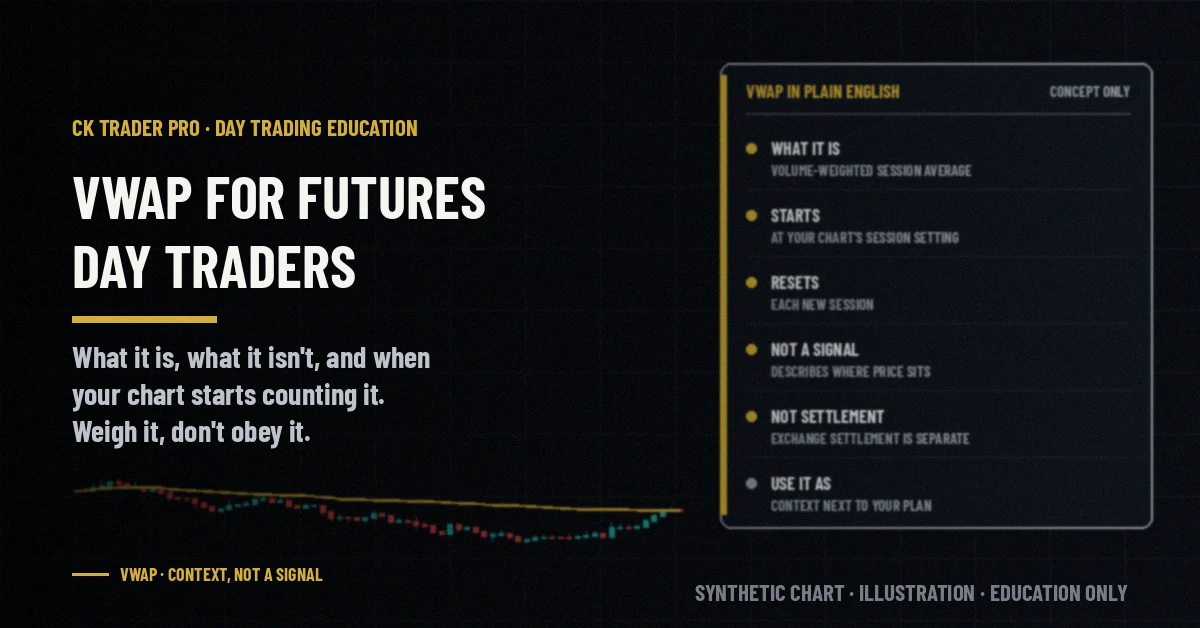
Short answer: VWAP, the volume-weighted average price, is the average price a market has traded at during a session, weighted by how much volume traded at each price. It resets when a new session starts. For a futures day trader, it’s a reference line that shows where the session’s trading has been concentrated so far. It isn’t a buy or sell signal, it isn’t a forecast, and it isn’t the exchange’s settlement price.
Education only. Futures trading involves substantial risk of loss. Not financial advice.
Some retail futures prop programs use simulated evaluations and simulated funded accounts; some also offer a separate live-funded stage. Verify your specific account type. CK Trader Pro and NQ Live Trading aren’t owned, run or endorsed by any prop firm.
I learned to ask what a line is made of
I’ve been trading futures since 1998. In my experience, the lines that cause the trouble aren’t the complicated ones. They’re the simple ones a trader puts on the chart without knowing what goes into them.
VWAP is one of those lines. So before I let it on my screen, I want to know what it measures, when it starts counting, and what it can’t tell me.
Have you ever noticed this about traders?
How many traders say “price is above VWAP” but couldn’t tell you when their VWAP started counting?
How many treat a VWAP cross as a reason to act, without asking how much volume the line is built on yet?
And how many have two charts open with two different VWAPs, and never noticed?
None of that is a market problem. It’s a definition problem, and a definition is something you can learn before the open.
Here’s the point
VWAP tells you where trading has happened. It doesn’t tell you where price will go.
It’s a summary of the session so far, built from past trades. That makes it useful context. It doesn’t make it a decision.
What is VWAP in futures?
VWAP is the average price a market has traded at through a session, weighted by volume. Investopedia defines it as the average price “for the day, weighted by trading volume” and notes that it “resets at the start of every new trading session” (source: Investopedia, Volume-Weighted Average Price (VWAP)).
The same source gives the full calculation: the sum of each trade’s price times its volume, divided by total volume. Because not every data feed has every trade, charting platforms usually approximate it bar by bar. For each bar they take a typical price (high plus low plus close, divided by three), multiply it by that bar’s volume, keep a running total from the session start, and divide by the running total of volume (source: Investopedia, same page).
Here’s what the weighting means in plain English. A simple average treats every price the same. VWAP doesn’t. Illustration: if ten contracts trade at one price and one contract trades at another, the volume-weighted average sits much closer to the first price, because that’s where the bulk of the volume changed hands.
Session VWAP isn’t the settlement price
Futures traders run into a second “VWAP” that’s a different thing. CME Group says that for most equity index futures, the daily settlement price for the front month “is calculated using a volume weighted average price (VWAP)” of trades in a short window near the end of the day (source: CME Group, Understanding Equity Index Daily & Final Settlement).
That settlement VWAP is set by the exchange. The VWAP line on your chart covers the whole session your platform is set to, and your platform draws it. Same three letters, different numbers, different jobs. Check the exchange’s current settlement procedure for any contract you trade.
Your chart decides when VWAP starts
Equity index futures such as NQ trade on CME Globex nearly around the clock, Sunday to Friday, 6:00 PM to 5:00 PM ET, with a daily break from 5:00 to 6:00 PM ET (source: CME Group, Trading Hours). So “the session” isn’t one fixed thing. One platform may start VWAP at the evening Globex open. Another may be set to start at the 9:30 AM ET stock market open. Some let you anchor it to any bar you choose.
Each choice gives a different line from the same trades. Before you compare notes with anyone, check your platform’s session setting and know which VWAP you’re looking at.
What VWAP isn’t
- It isn’t a buy or sell signal. Price above or below the line describes where price is versus the session average. It doesn’t tell you what to do next.
- It isn’t a forecast. Investopedia notes that VWAP is based on past values and has no built-in predictive quality (source: Investopedia, same page).
- It isn’t a level that has to hold. Price can stay away from VWAP for long stretches. Nothing pulls it back on a schedule.
- It isn’t equally useful all session. Early in a session, the average rests on only a little volume, so it can move a lot. Investopedia also notes the line lags more as the day goes on, because each new bar is a smaller share of the total.
- It isn’t a product. It’s a calculation you can understand on paper. You don’t need to buy anything to use it.
How I think about VWAP
In my experience, VWAP is context for where the session’s volume has traded so far, and which side of that volume-weighted average price is on right now: above it, below it, or sitting near it. I read it next to the other pieces I teach, the volume profile, the dealing range and cumulative volume delta, and none of them gets to make the decision alone.
My levels and my risk get written down first, as part of my pre-market futures analysis. After the open, I’d rather see how price behaves around the opening range than react to the first time it touches VWAP.
If you trade NQ or MNQ, remember that distance from VWAP is measured in points, and points are money at your size. The NQ tick value calculator turns that distance into real numbers. And if you place a stop near the line, know that no stop guarantees a maximum loss; in a fast market, an order can fill past the stop price.
Where we fit
Is CK Trader Pro a prop firm? No. We teach futures and prop firm education. We don’t sell evaluations or funded accounts, and we don’t send trade signals or setups to follow.
CK has affiliate relationships with some prop firms, including Apex Trader Funding and Lucid Trading, and may earn a commission from sign-ups through his links. Understanding VWAP doesn’t promise you’ll pass anything or make money. It means you know what the line on your chart is made of. For the bigger picture, start with our day trading education guide or the wider futures trading education path.
The noise sells the line as a trigger
Here’s what gets in a new trader’s way, and it isn’t the trader. It’s the noise. Clips call VWAP a magic line, a cross that means buy, a touch that means sell. Nobody mentions the session setting, the volume behind the average, or that the line is built from trades that already happened. When the noise defines your tools, you end up obeying a calculation you never checked.
Remember this
Weigh it, don’t obey it.
So here’s my question: the next time you say “price is above VWAP,” can you say when that VWAP started, and what it actually tells you about today?
If you’d like to watch VWAP read as context in real time, there’s a free live NQ session on weekdays from 9:30 to 10:30 AM ET at nqlivetrading.com/live, run by the same company. Registration is required. Adults 21+. Sessions are education, not signals.
Join the Academy
Know your lines before the open. CK Trader Pro is futures and prop firm education: step-by-step lessons, live sessions and risk planning, built for traders who want to understand what every line on their chart measures, and to have their levels, limits and plan written down before the bell. It’s the CK Trader Pro Membership, which includes:
- Members-only educational lessons on prop-firm rules, drawdown, daily loss limits, position sizing and NQ and MNQ contract basics
- War Room: CK’s live pre-market planning session, weekdays 8:30–9:30 AM ET, where the day’s levels, news times and risk get written down before the open
- CK’s chart setup, shown and explained live in every session
- Economic news calendar
Education only. No trade signals or personal advice. No results promised.
Billed monthly until you cancel. See pricing at cktraderpro.com.
FAQ
What is VWAP in futures?
VWAP is the volume-weighted average price: the average price a futures contract has traded at during a session, weighted by the volume at each price. It resets when a new session starts, and platforms usually approximate it bar by bar from a typical price times volume.
Is VWAP a buy or sell signal?
No. Price above or below VWAP describes where price sits versus the session’s volume-weighted average. In my experience, it’s context to read alongside your levels and plan, not a reason to act on its own.
Is session VWAP the same as the CME settlement price?
No. CME Group calculates the daily settlement price for many equity index futures, including NQ, from a VWAP over a short window near the end of the day. The VWAP on your chart covers the whole session your platform is set to, so the two are different numbers.
Why does my VWAP look different from someone else’s?
Usually because the session start is set differently. Futures trade nearly around the clock, so one chart may start VWAP at the evening Globex open and another at the 9:30 AM ET stock market open. Check your platform’s session setting.
Does a stop placed near VWAP limit my loss?
Not always. A stop is an instruction, not a promise. In a fast market, an order can fill past the stop price. No stop guarantees a maximum loss.
Is CK Trader Pro a prop firm?
No. CK Trader Pro is futures and prop firm education. It doesn’t sell evaluations or funded accounts, and it isn’t owned, run or endorsed by any prop firm.
Trading futures involves substantial risk of loss and is not suitable for everyone. Past performance is not indicative of future results. Education only, not financial advice. Example numbers are illustrations, not recommendations. No stop guarantees a maximum loss. Prop-firm rules vary by firm and change often; check each firm’s current rules. Some retail futures prop programs use simulated evaluations and simulated funded accounts; some also offer a separate live-funded stage. Verify your specific account type. CK Trader Pro and NQ Live Trading aren’t owned, run or endorsed by any prop firm. See our Risk Disclosure and Disclosures. CK Trader Pro is operated by CK TRADING INSTITUTE OF TECHNOLOGY LLC.
About this article. This is general education from CK Trader Pro. It isn't investment advice, a recommendation to buy or sell, or a trade signal, and it doesn't take your situation into account. Dollar figures and examples are illustrations, not results. Prop-firm rules, costs and payout terms vary by firm and change often; check the firm's current terms before you buy anything. We have paid referral relationships with some prop firms (see Disclosures). We are not owned, run, employed or endorsed by these firms. Mentioning a firm or its evaluations is not a recommendation that you trade. Trading futures involves substantial risk of loss and is not suitable for everyone.