

What a Prop Firm Evaluation Really Is (Before You Pay)
Education only, not financial advice. Trading futures involves substantial risk of loss and is not suitable for everyone.
Many traders don't pass prop evaluations, and evaluation fees can be lost entirely. Rules, costs and payout terms vary by firm and change often, so check the firm's current terms.
By CK · Futures trader since 1998
I’ve been trading futures since 1998
I’ve seen a lot change since 1998. Platforms got faster. Charts got busier. New ways into trading showed up.
Prop-firm evaluations are one of those ways. People ask me about them all the time, and the question is usually “Should I buy one?”
I don’t answer that for anyone, because it’s your decision and your money. What I can do is explain what a prop firm evaluation is, in plain words. That’s what this article is for.
Maybe this sounds familiar
Maybe you’ve seen the ads, with big account sizes and bright dashboards next to a checkout button.
Maybe you’ve opened a rules page and hit terms like “trailing drawdown,” “daily loss limit” and “consistency rule” without being sure what they meant.
And maybe you’ve wondered whether you’re ready, and nobody gave you a straight answer.
If so, let’s slow down and look at what you’d actually be buying.
What a prop firm evaluation is
A prop firm evaluation is a paid test. You pay a fee, and the firm gives you an account and a set of rules. If you reach the profit target without breaking a rule, you may move to the next stage.
Here’s what often gets missed:
- It’s usually simulated. Prop-firm evaluation and funded accounts are typically simulated. CK Trader Pro and NQ Live Trading aren’t owned, run or endorsed by any prop firm.
- The fee is a cost. It’s generally non-refundable. Many traders don’t pass, and evaluation fees can be lost entirely.
- Rules vary by firm and change often. Always check your firm’s current rules. What was allowed last month may not be allowed now.
- No one can promise an outcome. We can’t promise anyone passes, gets funded or gets paid.
None of this is meant to scare you. It sets the frame: an evaluation is a test under fixed rules for a set fee, so treat it like one.
The rules you’ll usually see
Each firm writes its own rules, so read your firm’s rules page word for word. Most evaluations use some version of these:
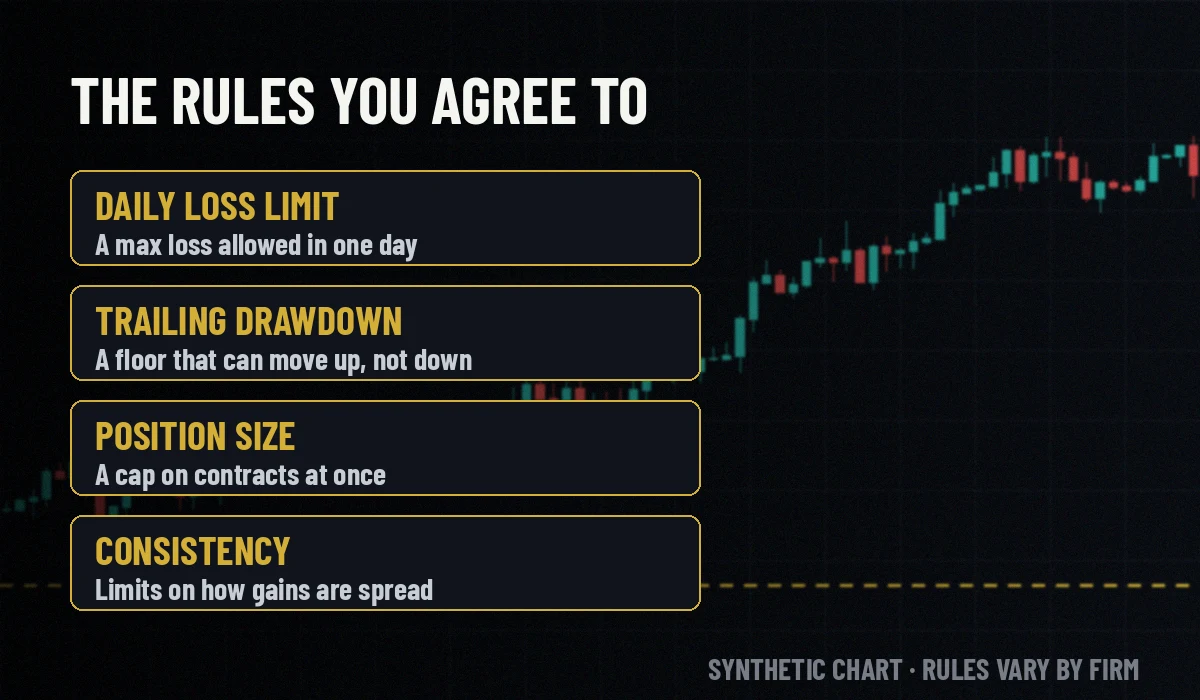
Profit target. This is the amount you need to reach to pass the stage. It’s a test requirement, not a forecast.
Daily loss limit. This caps how much you can lose in one day. Hitting it usually ends your day, and at some firms it ends the account.
Maximum drawdown. This is the floor the account can’t go below. It comes in two main types:
– Static: a fixed floor set from your starting balance.
– Trailing: a floor that follows the account’s highest balance or equity. Some firms trail at the end of the day and some trail intraday. With intraday trailing, unrealized open profit can raise the floor.
Consistency rules. Some firms cap how much of your total profit can come from a single day.
Contract limits. Firms set a maximum number of contracts, and at some it grows with the balance. Firms count micro contracts differently: some treat 10 MNQ as equal to 1 NQ toward the limit, while others count each micro on its own or set a separate micro limit. Check your firm’s rules.
News restrictions. Some firms restrict trading around major scheduled news, and some don’t. Check.
Here’s the point: it’s mostly about not breaking a rule
This is the part I wish more people heard first.
An evaluation is less about finding a great trade and more about never breaking a rule.
In my experience, trailing drawdown is one of the rules new traders misunderstand most. Picture a trade that runs well in your favor and then reverses back to flat. On an intraday trailing account, the floor may have moved up while the trade was in profit. So a trade that closes at breakeven can still put you closer to the floor, or through it. Read how your firm trails before you trade.
The other piece is leverage. NQ, the E-mini Nasdaq-100 future, moves $20 per index point. Its tick is 0.25 points, which is $5. MNQ, the Micro, is one-tenth of that: $2 per point, or $0.50 per tick.
Illustration only: a 40-point stop costs $800 on 1 NQ, or $80 on 1 MNQ.
That’s why sizing comes from your stop, not from how sure you feel:
Contracts = risk in dollars ÷ (stop in points × dollars per point)
Illustration only: say you’ve decided to risk $250 with a 25-point stop. On MNQ that’s 250 ÷ (25 × $2) = 5 MNQ. On NQ it works out to half a contract, which you can’t trade, so MNQ is the tool that fits.
One more thing about trailing accounts: measure your risk against the drawdown you have left, not against the account’s headline size. The space between your balance and the floor is your real risk capital.
Plan before the open
Most of this work happens before the bell:
- Write down your firm’s loss limits in dollars, and note how its drawdown trails.
- Choose a stop, then size from it.
- Set a daily stop for yourself, either a number of losses or a dollar amount. When you hit it, you’re done for the day.
- Check the economic calendar. CPI, PPI, jobs reports and jobless claims usually come out at 8:30 AM ET, some reports like ISM at 10:00 AM ET, and the FOMC statement at 2:00 PM ET with the press conference at 2:30. NQ can move fast around these releases, and stops can fill worse than the price you set (slippage).
- Know what the 9:30 AM ET cash open is like. It often brings the day’s highest volume and range, along with wider spreads and fast moves both ways. Many traders wait for the first minutes to settle.
That’s trading with a plan. It promises nothing. It helps you build consistency and risk control, which is the part you control.
What gets in the way
This is what we’re all up against.
The noise. Big promises, screenshots with no context, and people telling you what to buy right now. All of it makes a paid test feel like a lottery ticket. It isn’t one.
I don’t make calls. In my sessions I show my plan and my chart setup and explain my thinking. That’s education, not signals. Don’t mirror or follow anyone’s trades in real time, including mine.
The other enemy is rushing: buying an evaluation before reading the rules, or trading a size the drawdown can’t handle. Slowing down costs nothing.
Remember this
Read the rules before you risk the fee.
And on hard days: plan the trade, then trade the plan.
Can education help?
Can education help you trade NQ with discipline and maybe, one day, profitably? There’s no guarantee of that. Many people study hard and still don’t pass an evaluation. What education can do is help you understand the contract, the rules and your own risk before money is on the line. That’s what I teach.
If you’d like to watch first, there’s a free live NQ session on weekdays from 9:30 to 10:30 AM ET at nqlivetrading.com/live, run by the same company. Registration is required. Sessions are education, not signals.
Join the Academy
To go deeper, the CK Trader Pro Membership is $333 a month and includes:
- Members-only educational lessons on prop-firm rules, risk and charting
- War Room: CK’s live pre-market planning session, weekdays 8:30–9:30 AM ET
- CK’s chart setup, shown and explained live in every session
- Economic news calendar
Education only. No trade signals or personal advice.
Billed $333 (USD, plus any applicable tax) today and every month on the same date until you cancel. Cancel anytime; cancellation takes effect at the end of your current billing period. See our Refund Policy.
Trading futures involves substantial risk of loss and is not suitable for everyone. Past performance is not indicative of future results. Education only, not financial advice. All numbers in this article are illustrations, not results or recommendations. Prop-firm evaluation and funded accounts are typically simulated, fees are generally non-refundable, and rules vary by firm and change often. CK Trader Pro is a d/b/a of CK TRADING INSTITUTE OF TECHNOLOGY LLC.
About this article. This is general education from CK Trader Pro. It isn't investment advice, a recommendation to buy or sell, or a trade signal, and it doesn't take your situation into account. Dollar figures and examples are illustrations, not results. Prop-firm rules, costs and payout terms vary by firm and change often; check the firm's current terms before you buy anything. We have paid referral relationships with some prop firms (see Disclosures). We are not owned, run, employed or endorsed by these firms. Mentioning a firm or its evaluations is not a recommendation that you trade. Trading futures involves substantial risk of loss and is not suitable for everyone.