

Futures Margin vs Account Size: What Beginners Mix Up
Education only, not financial advice. Trading futures involves substantial risk of loss and is not suitable for everyone.
Many traders don't pass prop evaluations, and evaluation fees can be lost entirely. Rules, costs and payout terms vary by firm and change often, so check the firm's current terms.
By CK · Futures trader since 1998
Futures margin, explained for beginners: what initial and maintenance margin are, why margin is not the most you can lose, and how to size NQ and MNQ trades from your risk instead of from your buying power. Education only. Futures trading involves substantial risk of loss. Not financial advice.
Prop-firm evaluations and funded accounts are typically simulated. CK Trader Pro and NQ Live Trading aren’t owned, run or endorsed by any prop firm.
The number on the screen that lies to you
In my experience, a lot of new futures traders open their platform, see how many contracts their margin allows, and read it as a suggestion. The account says you can hold ten. So ten feels normal.
Then the market moves twenty points against them, and a single trade takes a chunk out of the account that a week of good trades won’t put back.
Nothing about the margin was wrong. They just asked it a question it was never built to answer.
Have you ever wondered this about new traders?
How many traders size their position by what the broker allows, instead of by what they’re willing to lose?
How many think a small margin deposit means a small risk?
And how many have never once written down, in dollars, what their stop costs before they click buy?
If any of that sounds familiar, you’re not alone. None of it is about finding a better entry. It’s about knowing what the numbers on your screen actually mean.
Margin is a deposit, not your risk
CME Group puts it plainly: futures margin “is the amount of money that you must deposit and keep on hand with your broker when you open a futures position. It is not a down payment and you do not own the underlying commodity” (source: CME Group, Margin: Know What’s Needed).
CME also notes that futures margin “generally represents a smaller percentage of the notional value of the contract, typically 3-12% per futures contract” (same source). That’s leverage. A small deposit controls a large contract value, and gains and losses are figured on the whole contract, not on the deposit.
So margin tells you what it takes to open a position. It doesn’t tell you what the position can cost you. Your loss depends on how far price moves, how many contracts you hold, and the dollars per point of the contract. It can be larger than the margin you posted.
Initial, maintenance and day-trading margin
There are three terms beginners mix up:
- Initial margin is the amount required to open a futures position. CME Clearing sets the exchange amount, and “your broker may be required to collect additional funds” (source: CME Group, Margin: Know What’s Needed).
- Maintenance margin is the minimum you have to keep in the account while the position is open. If equity drops below it, you may get a margin call to bring the account back up to initial margin, or the position may be reduced or liquidated (same source).
- Day-trading margin is a lower amount many brokers set for positions opened and closed in the same session. CME notes that brokers “require more margin to be posted for positions that are held into the next trading day, versus positions that will be opened and closed within the same trading day” (source: CME Group, Position and Risk Management). Day-trading margin is a broker policy, not an exchange number, and it varies by broker.
Margin requirements also change. CME says margins can rise when markets get more volatile and can be reduced when conditions warrant (source: Margin: Know What’s Needed). Always check your broker’s current numbers. Our older guide, understanding futures margin requirements, covers the rules in more detail.
Why account size isn’t how much you can lose per trade
Here’s the mix-up in one line: your account size tells you how much you have. It doesn’t tell you how much one trade should be allowed to take.
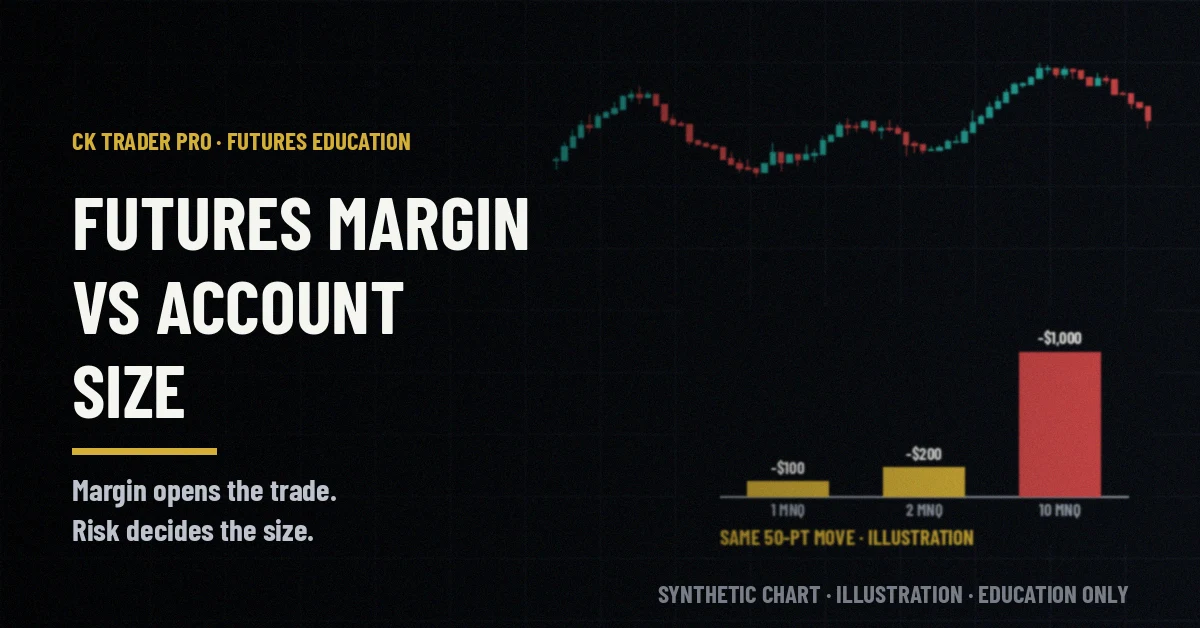
Illustration only, not a recommendation or any broker’s real margin. Say you have a $5,000 account, and your broker’s day-trading margin would let you open 10 MNQ. MNQ is $2 per point (source: CME Group Micro E-mini Nasdaq-100 contract specifications).
| Contracts | Dollars per point | 20-point stop | 50-point move against you |
|---|---|---|---|
| 1 MNQ | $2 | $40 | $100 |
| 2 MNQ | $4 | $80 | $200 |
| 10 MNQ | $20 | $400 | $1,000 |
At 10 MNQ, a 50-point move against you is $1,000, a fifth of the account, and the margin didn’t stop any of it. On NQ, a 50-point move is $1,000 per contract, since NQ is $20 per point (source: CME Group E-mini Nasdaq-100 contract specifications).
Stops can fill worse than the price you set, especially around the 9:30 AM ET open and scheduled news. That’s slippage. No stop guarantees a maximum loss.
Here’s the point
Margin decides how many contracts you’re allowed to hold. Your risk plan decides how many you should.
Size by risk, not by margin (worked MNQ example)
In my experience, the fix is a small piece of math you do before the session, not after the trade.
- Pick your dollar risk per trade. That’s a number you choose and write down. In this illustration, it’s $80.
- Find your stop distance in points from where the idea is wrong on the chart. Here, 20 points.
- Multiply by dollars per point. On MNQ, 20 points × $2 = $40 per contract.
- Divide. Contracts = risk in dollars ÷ (stop points × dollars per point) = $80 ÷ $40 = 2 MNQ.
- Then check margin. Margin is the last check, not the first. If your account can’t cover the margin for the size your risk math gives you, trade smaller or don’t trade.
Notice that the answer was 2, not 10. Same account, same broker, same margin. The only thing that changed was the question you asked. The NQ tick value calculator turns points into dollars, and how to size NQ and MNQ trades from your stop walks through the full method. If you need tick size, point value or trading hours, see NQ futures contract specs.
Prop accounts: drawdown replaces margin thinking
On a prop-firm evaluation or funded account, which is typically simulated, you usually aren’t posting your own margin at all. The limit that matters is the firm’s drawdown and any daily loss limit, plus the firm’s own contract limits.
Illustration only, not any firm’s real rules. Say the account has a $2,000 trailing drawdown. A 50-point move against 10 MNQ ($1,000) uses half of it in one trade. The same move against 2 MNQ ($200) uses a tenth. And on a trailing account, your floor can move up as your balance makes new highs, so the room you have changes day to day. See trailing vs end-of-day drawdown for how each type moves, and use the free prop firm drawdown calculator to see how much room you have from the numbers you enter.
Rules vary by firm and change often, so check your firm’s current rules, word for word. For the bigger picture, start with our prop firm information hub and the prop firm education learning path.
The noise sells you buying power
Here’s what gets in a lot of traders’ way, and it isn’t you. It’s the noise. It talks about how little it takes to “control” a big contract and skips what that contract can cost you in a few minutes. It shows the contract count your margin allows and never the dollar size of your stop.
The CFTC urges people “to be skeptical when promoters… claim that their products and services will earn high profits with minimal risks” (source: CFTC Fraud Advisory). Leverage cuts both ways. Low margin makes it easier to open a big position, not safer to hold one.
CK has affiliate relationships with some prop firms, including Apex Trader Funding and Lucid Trading, and may earn a commission from sign-ups through his links. That doesn’t change what we teach.
Remember this
Margin opens the trade. Risk decides the size.
Where to learn it step by step
Can understanding margin make you profitable? There’s no guarantee of that. Plenty of traders understand every margin rule and still lose money. What education can do is help you know what your numbers mean, and what they cost when you ignore them, before money is on the line. That’s what I teach. If you’re just getting started, our futures trading education guide lays out what to learn first.
So here’s my question: before your next session, could you write down your dollar risk per trade, your stop in points, and the contract count that math gives you, without looking at your margin first?
If you’d like to watch first, there’s a free live NQ session on weekdays from 9:30 to 10:30 AM ET at nqlivetrading.com/live, run by the same company. Registration is required. Adults 21+. Sessions are education, not signals.
Join the Academy
Know your risk before the market tells you. CK Trader Pro is prop firm education for futures traders: step-by-step lessons, live sessions and risk planning. It’s the CK Trader Pro Membership, which includes:
- Members-only educational lessons on prop-firm rules, risk and charting
- War Room: CK’s live pre-market planning session, weekdays 8:30–9:30 AM ET, where the day’s risk and news times get written down before the open
- CK’s chart setup, shown and explained live in every session
- Economic news calendar
Education only. No trade signals or personal advice. No results promised.
Billed monthly until you cancel. See pricing at cktraderpro.com.
FAQ
What is futures margin, in simple terms?
It’s a deposit your broker holds so you can open and keep a futures position. It isn’t a down payment, and it isn’t the most you can lose.
What’s the difference between initial and maintenance margin?
Initial margin is what you need to open a position. Maintenance margin is the minimum you have to keep while it’s open. If your equity falls below maintenance, you may get a margin call or the position may be reduced or liquidated.
What is day-trading margin?
It’s a lower amount many brokers set for positions opened and closed in the same session. It’s a broker policy, it varies by broker, and it can change, so check your broker’s current numbers.
Can I lose more than my margin?
Yes. Losses are based on the full contract’s price move, not on the deposit, so a loss can be larger than the margin you posted. No stop guarantees a maximum loss.
How should a beginner size MNQ trades?
Start from the dollar risk you choose, divide by your stop in points times dollars per point ($2 for MNQ), and only then check that your margin covers that size. No sizing method makes a trade or an account profitable.
Trading futures involves substantial risk of loss and is not suitable for everyone. Past performance is not indicative of future results. Education only, not financial advice. All numbers in this article are illustrations, not results or recommendations. Margin requirements are set by the exchange and your broker and can change at any time. No stop guarantees a maximum loss. Prop-firm evaluations and funded accounts are typically simulated. Fees are generally non-refundable, and rules vary by firm and change often. CK Trader Pro and NQ Live Trading aren’t owned, run or endorsed by any prop firm. See our Risk Disclosure and Disclosures. CK Trader Pro is operated by CK TRADING INSTITUTE OF TECHNOLOGY LLC.
About this article. This is general education from CK Trader Pro. It isn't investment advice, a recommendation to buy or sell, or a trade signal, and it doesn't take your situation into account. Dollar figures and examples are illustrations, not results. Prop-firm rules, costs and payout terms vary by firm and change often; check the firm's current terms before you buy anything. We have paid referral relationships with some prop firms (see Disclosures). We are not owned, run, employed or endorsed by these firms. Mentioning a firm or its evaluations is not a recommendation that you trade. Trading futures involves substantial risk of loss and is not suitable for everyone.