

NQ Futures Contract Specs: Tick Size, Point Value, Hours
Education only, not financial advice. Trading futures involves substantial risk of loss and is not suitable for everyone.
Many traders don't pass prop evaluations, and evaluation fees can be lost entirely. Rules, costs and payout terms vary by firm and change often, so check the firm's current terms.
By CK · Futures trader since 1998
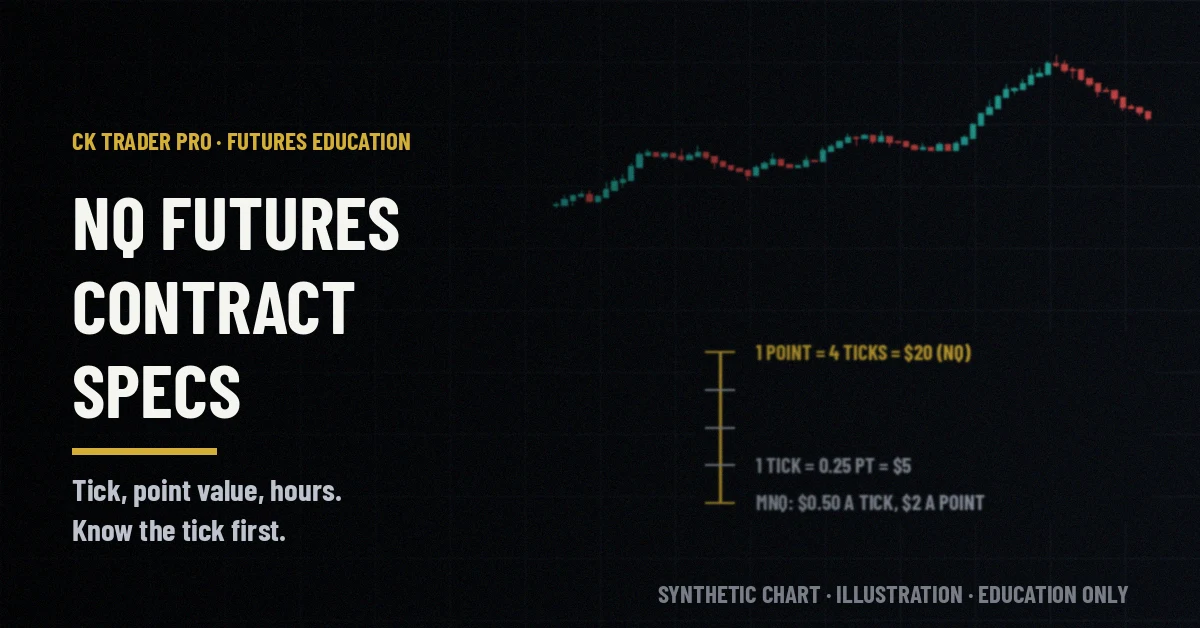
Short answer: NQ is the E-mini Nasdaq-100 futures contract on CME Group. It moves in 0.25-point ticks worth $5 each, so one point is $20. MNQ, the micro version, is one-tenth the size: $0.50 a tick and $2 a point. Both trade on CME Globex Sunday to Friday, 6:00 PM to 5:00 PM ET, with a daily break from 5:00 to 6:00 PM ET.
Education only. Futures trading involves substantial risk of loss. Not financial advice.
Prop-firm evaluations and funded accounts are typically simulated. CK Trader Pro and NQ Live Trading aren’t owned, run or endorsed by any prop firm.
The number I check before anything else
I’ve been trading futures since 1998. I started in the pits in 2000, moved to the screen, and the first thing I still check on any contract isn’t a chart. It’s what one tick is worth.
That sounds boring. It’s also the number that decides how much a normal move costs you before you’ve made a single decision.
Have you ever wondered this about new NQ traders?
How many traders open an NQ chart, see the index move 50 points, and have no idea what that move is worth in dollars?
How many pick NQ because it’s the contract everyone talks about, when the micro would fit their stop and their account far better?
And how many hold a position into 5:00 PM ET without knowing the market is about to close for an hour?
None of those are strategy problems. They’re spec problems, and every one is fixable in about ten minutes of reading.
What is NQ?
NQ is the ticker for E-mini Nasdaq-100 futures, listed by CME Group. One contract is worth $20 times the Nasdaq-100 index, and it tracks the 100 largest non-financial companies in that index (source: CME Group, E-mini Nasdaq-100 contract specs).
Because the multiplier is $20, a contract controls a large dollar value with a much smaller margin deposit. That’s leverage, and it works in both directions.
Tick size and tick value
| Spec | NQ (E-mini) | MNQ (Micro) |
|---|---|---|
| Minimum tick | 0.25 index points | 0.25 index points |
| Tick value | $5.00 | $0.50 |
| Point value | $20 | $2 |
| Size vs NQ | 1 | 1/10 |
Sources: CME Group NQ contract specs and MNQ contract specs.
Four ticks make one point. So on NQ, 4 × $5 = $20 a point. On MNQ, 4 × $0.50 = $2 a point. Turn any move into dollars with the free NQ tick value calculator.
Point value and a P&L-per-point example
Illustration only, not a result or a recommendation. Say a trader plans a 40-point stop:
| Contract | Point value | Dollars at risk on a 40-point stop |
|---|---|---|
| 1 NQ | $20 | $800 |
| 1 MNQ | $2 | $80 |
Same idea, same chart, ten times the dollars. That’s why the contract you pick is a risk decision, not a style choice. And no stop guarantees a maximum loss: in a fast market an order can fill past the stop price (slippage), so the real loss can be bigger than the plan.
To go from “how much am I willing to lose” to “how many contracts,” read how to size NQ and MNQ trades from your stop or use the position sizing calculator.
MNQ: the micro version, compared
MNQ tracks the same index, moves in the same 0.25-point ticks, and trades the same hours. The only difference is size: one MNQ is one-tenth of one NQ.
In my experience, that’s what makes MNQ the better teaching contract. It lets a trader size in small steps. Say the math says 0.5 NQ: that’s not possible, but 5 MNQ is. Many prop firms also count 10 MNQ as one NQ toward contract limits, but rules vary, so check your firm’s current rules.
Trading hours and the daily break
NQ trades on CME Globex from Sunday 6:00 PM ET to Friday 5:00 PM ET, with a one-hour break each day from 5:00 to 6:00 PM ET (source: CME Group NQ contract specs). Holiday schedules can change those hours, so check CME’s calendar around holidays.
Three times matter on a normal weekday:
- 6:00 PM ET: the new Globex session opens. Volume is usually lighter overnight, and the overnight high and low become reference levels later.
- 8:30 AM ET: many U.S. economic releases, including CPI and the jobs report, come out while NQ is already trading (source: BLS release calendar).
- 9:30 AM ET: the U.S. stock market opens, and NQ often sees some of the day’s heaviest volume and widest range. See how to plan the NQ open.
Contract months and rollover basics
NQ is listed in a quarterly cycle: March, June, September and December, coded H, M, U and Z. Each contract stops trading at 9:30 AM ET on the third Friday of its contract month (source: CME Group NQ contract specs).
Before that date, volume moves from the expiring contract to the next one. That’s the “roll.” Many traders switch their charts and orders to the new month during roll week, because that’s where the liquidity goes. If your platform shows “NQZ6” or “NQH7,” the letter is the month and the digit is the year.
Margin vs account size
Margin is a good-faith deposit your broker holds to open a position. It isn’t the most you can lose. Exchange margin is set by CME and your broker can require more, and both can change, so check your broker’s current numbers. For the details, read understanding futures margin requirements.
In a prop evaluation the number that matters is different again: it’s the room left above your drawdown floor, not the account’s headline size. Our prop firm drawdown calculator and the prop firm information hub walk through it.
The noise skips the specs
Here’s what gets in a lot of traders’ way, and it isn’t them. It’s the noise. It shows the big point move and leaves out what a point costs. It talks about the setup and never mentions the session break or the roll.
The CFTC urges people “to be skeptical when promoters… claim that their products and services will earn high profits with minimal risks” (source: CFTC Fraud Advisory). Read the contract specs before the sales page.
CK has affiliate relationships with some prop firms, including Apex Trader Funding and Lucid Trading, and may earn a commission from sign-ups through his links. That doesn’t change what we teach.
Remember this
Know the tick before you take the trade.
So here’s my question: right now, without looking, could you say what a 25-point move costs on one NQ and on one MNQ? (Illustration: $500 and $50.)
If you’d like to watch the specs used in real time, there’s a free live NQ session on weekdays from 9:30 to 10:30 AM ET at nqlivetrading.com/live, run by the same company. Registration is required. Adults 21+. Sessions are education, not signals.
For the bigger picture, start with futures trading education and prop firm education.
Join the Academy
Specs first, then strategy. CK Trader Pro is futures and prop firm education: step-by-step lessons, live sessions and risk planning. It’s the CK Trader Pro Membership, which includes:
- Members-only educational lessons on contract specs, prop-firm rules, risk and charting
- War Room: CK’s live pre-market planning session, weekdays 8:30–9:30 AM ET, where the day’s risk and news times get written down before the open
- CK’s chart setup, shown and explained live in every session
- Economic news calendar
Education only. No trade signals or personal advice. No results promised.
Billed monthly until you cancel. See pricing at cktraderpro.com.
FAQ
What is the tick size and tick value of NQ futures?
NQ moves in 0.25-point ticks, and each tick is worth $5, per CME Group contract specs.
How much is one point on NQ?
One point is $20 on NQ (four ticks at $5). On MNQ, one point is $2.
What’s the difference between NQ and MNQ?
They track the same Nasdaq-100 index with the same 0.25-point tick and the same hours. MNQ is one-tenth the size: $0.50 per tick and $2 per point.
What are NQ futures trading hours?
CME Globex, Sunday 6:00 PM ET to Friday 5:00 PM ET, with a daily break from 5:00 to 6:00 PM ET. Holiday hours can differ, so check CME’s calendar.
When do NQ contracts expire?
NQ is listed for March, June, September and December, and each contract stops trading at 9:30 AM ET on the third Friday of its month. Volume usually rolls to the next contract during the week before.
Trading futures involves substantial risk of loss and is not suitable for everyone. Past performance is not indicative of future results. Education only, not financial advice. All numbers in this article are illustrations, not results or recommendations. No stop guarantees a maximum loss. Prop-firm evaluations and funded accounts are typically simulated. Rules vary by firm and change often. CK Trader Pro and NQ Live Trading aren’t owned, run or endorsed by any prop firm. See our Risk Disclosure and Disclosures. CK Trader Pro is operated by CK TRADING INSTITUTE OF TECHNOLOGY LLC.
About this article. This is general education from CK Trader Pro. It isn't investment advice, a recommendation to buy or sell, or a trade signal, and it doesn't take your situation into account. Dollar figures and examples are illustrations, not results. Prop-firm rules, costs and payout terms vary by firm and change often; check the firm's current terms before you buy anything. We have paid referral relationships with some prop firms (see Disclosures). We are not owned, run, employed or endorsed by these firms. Mentioning a firm or its evaluations is not a recommendation that you trade. Trading futures involves substantial risk of loss and is not suitable for everyone.