

Futures vs Stocks vs Options for a New Day Trader
Education only, not financial advice. Trading futures involves substantial risk of loss and is not suitable for everyone.
Many traders don't pass prop evaluations, and evaluation fees can be lost entirely. Rules, costs and payout terms vary by firm and change often, so check the firm's current terms.
By CK · Futures trader since 1998
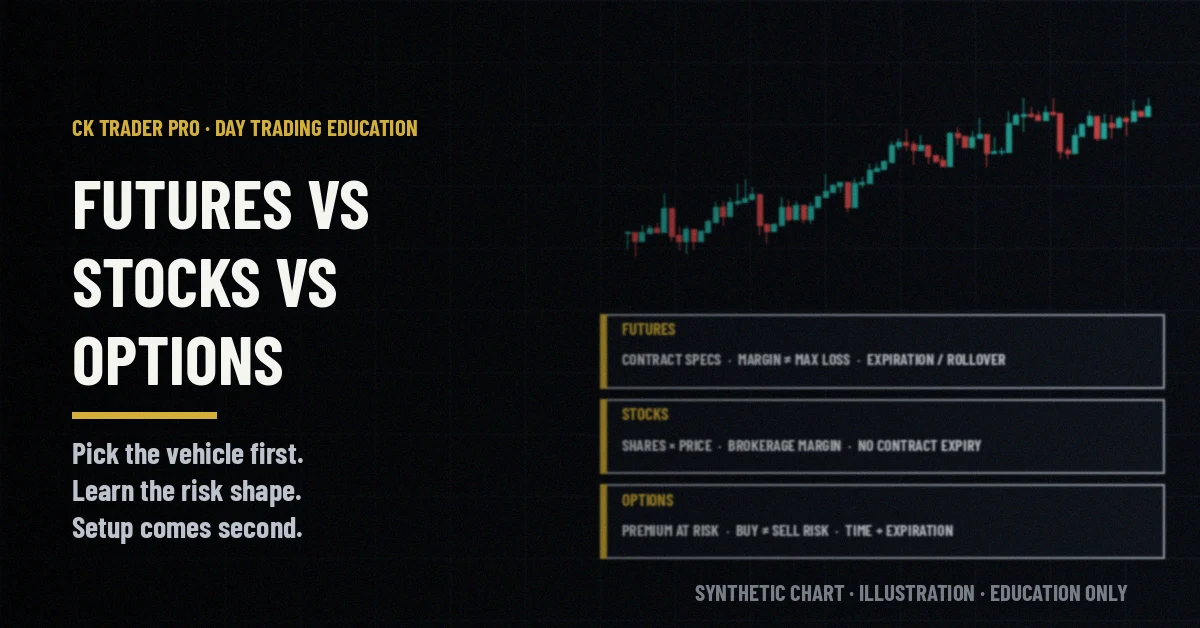
Short answer: For a new day trader, futures, stocks and options are different vehicles, not different setups. Futures use exchange margin and fixed contract dollar values (NQ $20 per point; MNQ $2 per point). Stocks are shares, with brokerage margin rules that differ from futures. Options can limit loss to the premium when you buy a contract, but selling options can leave risk open-ended. The education question isn’t which one makes money. It’s whether you understand how the vehicle can cost you money before you trade it.
Education only. Futures trading involves substantial risk of loss. Not financial advice.
Prop-firm evaluations and funded accounts are typically simulated. CK Trader Pro and NQ Live Trading aren’t owned, run or endorsed by any prop firm.
I trade futures. I still teach the other two.
I’ve been trading futures since 1998. That doesn’t mean futures are “better” for every new day trader. It means I know one vehicle cold, and I’ve watched plenty of new traders bounce between stock charts, options screenshots and futures platforms without learning what each one actually is.
In my experience, the product isn’t the problem. Shopping for a product without understanding the vehicle is.
Have you ever noticed this about traders?
How many traders ask “which market is best to day trade” before they can say what one point, one share or one option premium is worth in dollars?
How many jump from stocks to options to futures because last week’s feed showed a different product, without writing down how risk works in each?
And how many treat a new platform login as education, when education is knowing the contract, the margin and the expiration before the first click?
None of those is a strategy problem. They’re vehicle problems. And a vehicle, unlike the next setup video, has a risk shape you can study.
Here’s the point
Pick the vehicle before you pick the setup.
A setup is an idea about price. A vehicle decides what that idea costs if you’re wrong: leverage, margin, expiration, and whether your risk is defined or open. If you’re new, start with day trading education for the skills around any session, and futures trading education for the futures roadmap. This page compares the three vehicles so you stop shopping and start learning.
Side by side: what actually differs
| Topic | Futures (e.g. NQ / MNQ) | Stocks | Options |
|---|---|---|---|
| What you trade | Standardized exchange contracts | Shares of a company | Contracts on an underlying (right or obligation) |
| Dollar size | Fixed by contract (NQ $20/pt; MNQ $2/pt) | Share price × shares | Premium paid/received; assignment can change the picture |
| Margin | Performance bond to open/hold; not max loss | Brokerage margin (FINRA Rule 4210) | Buyers pay premium; writers often post margin |
| Expiration | Yes (equity-index often quarterly) | Shares don’t expire | Yes; time decay matters |
| Risk shape | Gains/losses on full contract; can exceed margin | Long stock: paid-in capital (before leverage); short stock: open | Long options: often limited to premium; short/naked: can be open-ended |
| Account world | FCM; CFTC/NFA | Broker-dealer; SEC/FINRA | Usually same brokerage world as stocks |
Rules and margin numbers change. Check your broker or FCM’s current documents. Nothing below recommends any vehicle.
Futures: fixed point values, exchange margin, expiration
Equity-index futures like the E-mini Nasdaq-100 (NQ) and Micro E-mini Nasdaq-100 (MNQ) are standardized CME contracts. NQ is $20 per index point; its minimum tick is 0.25 points, or $5. MNQ is one-tenth of NQ: $2 per point, tick $0.50 (source: CME Group E-mini Nasdaq-100 and Micro E-mini Nasdaq-100 contract specifications). Check tick and point values with the NQ tick value calculator.
Illustration only: a 40-point move against you is $800 on 1 NQ and $80 on 1 MNQ. No stop guarantees a maximum loss: in a fast market an order can fill past the stop price.
CME describes futures margin as money you deposit and keep with your broker when you open a futures position: it is not a down payment, and you do not own the underlying (source: CME Group, Margin: Know What’s Needed). Margin tells you what it takes to open a position. It does not cap what the position can cost. That distinction is the point of futures margin vs account size.
Futures also expire. Many day traders never hold to expiration, but the calendar still matters for rollover. Equity-index futures like NQ are cash-settled rather than delivered (same CME specs above).
Stocks: shares, brokerage accounts, different margin rules
A stock is an ownership share. Day trading stocks means buying and selling shares within a session. Dollar size is share price times shares. There is no fixed “point value” like NQ’s $20; the risk math and the account world are different.
U.S. stock and options day trading in a brokerage margin account sits under FINRA’s Rule 4210 margin framework. For years, many traders knew the old “pattern day trader” day-trading margin requirements, including a $25,000 minimum-equity concept for designated pattern day traders. FINRA replaced those day-trading margin requirements with new intraday margin standards, effective June 4, 2026, with a member phase-in through October 20, 2027 (source: FINRA Regulatory Notice 26-10). What your broker enforces today can still vary during that phase-in. Read the firm’s current margin disclosures.
Futures accounts are not the same world. Futures are typically carried through a futures commission merchant under CFTC/NFA oversight. That does not make futures easier or safer. It means you cannot assume stock-account rules apply to an NQ contract, or the other way around.
Options: defined risk when you buy; not when you sell
An option is a contract. When you buy a call or a put, the most you can lose on that purchase is often limited to the premium you paid (plus fees), if you let it expire worthless and you don’t hold a related position that changes the picture. That “defined risk” is why many new traders are drawn to options.
When you sell or write options, especially naked (uncovered) options, risk can be large or open-ended. Margin, assignment, early exercise and expiration all matter. Options also decay with time: the premium can change even if the underlying barely moves. Expiration is part of the vehicle, not an afterthought.
So “options have defined risk” is only half a sentence. Defined for the buyer of a simple long option. Not automatically true for every options strategy. Know which side of the contract you’re on before you click.
What a new day trader should compare (not “which pays”)
Use this as a study list, not a ranking:
- Dollar size of a wrong move. NQ/MNQ: points × dollars per point × contracts. Stocks: dollars per share × shares. Options: premium at risk, and what happens if you’re short.
- Margin vs risk. Futures margin is a deposit, not a loss limit (futures margin vs account size). Stock/options margin follows your broker’s FINRA Rule 4210 policies.
- Expiration. Futures and options expire. Shares don’t. Near the date, behavior can change.
- Defined or open risk. Long stock (unlevered) and long options often have a clearer ceiling; short stock, short options and futures can move past a casual “I thought I had a stop.”
- Vehicle literacy vs product shopping. A new login is not a plan. A written risk plan is.
If you later look at prop-firm futures evaluations, those accounts are typically simulated, and the limits that matter are the firm’s drawdown and daily loss rules, not stock day-trading folklore. Is CK Trader Pro a prop firm? No. We teach education; we don’t sell evaluations or funded accounts.
The noise sells products. It skips the vehicle.
Here’s what gets in many traders’ way, and it isn’t them. It’s the noise. Feeds and threads push the next product: this stock, that option, this micro future. They rarely start with how the vehicle can cost you money in one bad hour.
The CFTC urges people “to be skeptical when promoters… claim that their products and services will earn high profits with minimal risks” (source: CFTC Fraud Advisory). Product shopping without vehicle literacy confuses a chart pattern with a risk plan.
CK has affiliate relationships with some prop firms, including Apex Trader Funding and Lucid Trading, and may earn a commission from sign-ups through his links. That doesn’t change what we teach, and it’s one more reason to read every firm’s current rules yourself.
Remember this
Know the vehicle before you drive the setup.
So here’s my question: if someone asked you tomorrow morning what one wrong move costs in dollars on the vehicle you plan to trade, could you answer without opening a new tab?
And if you’d like to watch futures process education in real time, there’s a free live NQ session on weekdays from 9:30 to 10:30 AM ET at nqlivetrading.com/live, run by the same company. Registration is required. Adults 21+. Sessions are education, not signals.
Join the Academy
Learn the vehicle before the market teaches it the hard way. CK Trader Pro is futures and prop firm education: step-by-step lessons, live sessions and risk planning. It’s the CK Trader Pro Membership, which includes:
- Members-only educational lessons on prop-firm rules, drawdown, daily loss limits, position sizing and risk
- War Room: CK’s live pre-market planning session, weekdays 8:30–9:30 AM ET, where the day’s risk and news times get written down before the open
- CK’s chart setup, shown and explained live in every session
- Economic news calendar
Education only. No trade signals or personal advice. No results promised.
Billed monthly until you cancel. See pricing at cktraderpro.com.
FAQ
What is the difference between futures and stocks for day trading?
Futures are standardized exchange contracts with fixed dollar values per point (for example, NQ is $20 per point and MNQ is $2 per point) and futures margin that acts as a performance bond, not a max-loss cap. Stocks are shares; dollar size is price times shares, and U.S. brokerage margin accounts follow FINRA Rule 4210 frameworks that differ from futures FCM margin. Neither is “safer” by default; the risk math and account rules differ.
Are options safer than futures for beginners?
Not automatically. Buying a simple call or put often limits loss to the premium paid, which many traders call defined risk. Selling or writing options, especially uncovered, can leave risk large or open-ended. Futures gains and losses are on the full contract value and can exceed margin posted. Safety depends on the side of the trade, size, and whether you understand the vehicle.
Does the pattern day trader rule apply to futures?
The old FINRA pattern day trader day-trading margin requirements applied to securities margin accounts, not to futures accounts at an FCM. FINRA replaced those day-trading margin requirements with new intraday margin standards effective June 4, 2026, with a phase-in through October 20, 2027 (FINRA Regulatory Notice 26-10). Futures sit under a different regulatory and margin structure. Always read your broker or FCM’s current rules.
How should a new day trader choose among futures, stocks and options?
Start with education, not with a product pitch. Learn how dollar risk, margin, expiration and defined vs open risk work in the vehicle you’re considering. Write the cost of a wrong move in dollars before you trade. Use practice accounts with purpose. This is education, not a recommendation of any market.
Is CK Trader Pro a prop firm?
No. CK Trader Pro is futures and prop firm education. It doesn’t sell evaluations or funded accounts, and it isn’t owned, run or endorsed by any prop firm.
Trading futures involves substantial risk of loss and is not suitable for everyone. Past performance is not indicative of future results. Education only, not financial advice. Example numbers are illustrations, not recommendations. No stop guarantees a maximum loss. Prop-firm rules vary by firm and change often; check each firm’s current rules. Prop-firm evaluations and funded accounts are typically simulated. CK Trader Pro and NQ Live Trading aren’t owned, run or endorsed by any prop firm. See our Risk Disclosure and Disclosures. CK Trader Pro is operated by CK TRADING INSTITUTE OF TECHNOLOGY LLC.
About this article. This is general education from CK Trader Pro. It isn't investment advice, a recommendation to buy or sell, or a trade signal, and it doesn't take your situation into account. Dollar figures and examples are illustrations, not results. Prop-firm rules, costs and payout terms vary by firm and change often; check the firm's current terms before you buy anything. We have paid referral relationships with some prop firms (see Disclosures). We are not owned, run, employed or endorsed by these firms. Mentioning a firm or its evaluations is not a recommendation that you trade. Trading futures involves substantial risk of loss and is not suitable for everyone.