

How Much Is One Point on NQ and MNQ?
Education only, not financial advice. Trading futures involves substantial risk of loss and is not suitable for everyone.
Many traders don't pass prop evaluations, and evaluation fees can be lost entirely. Rules, costs and payout terms vary by firm and change often, so check the firm's current terms.
By CK · Futures trader since 1998
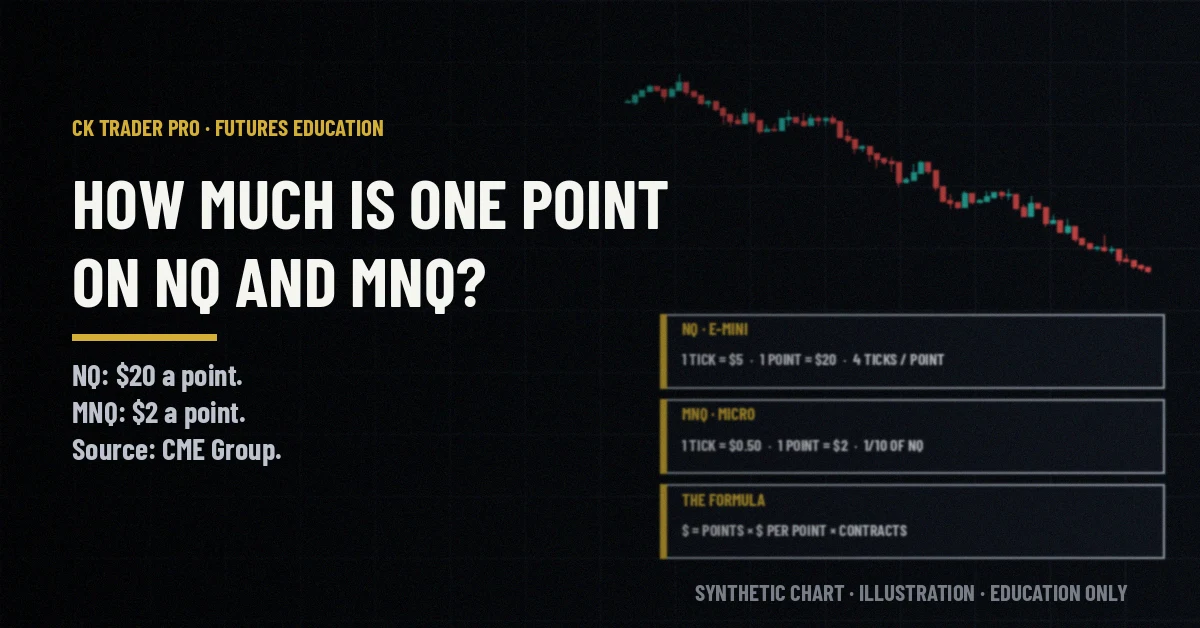
Short answer: One point on NQ (E-mini Nasdaq-100) is $20 per contract. One point on MNQ (Micro E-mini Nasdaq-100) is $2 per contract, one-tenth the size. Both move in ticks of 0.25 points, so one NQ tick is $5 and one MNQ tick is $0.50, and there are four ticks in a point (source: CME Group E-mini Nasdaq-100 and Micro E-mini Nasdaq-100 contract specifications). To run any number of points through the math, use the NQ tick value calculator.
| Contract | One tick (0.25 pt) | One point | Ticks per point |
|---|---|---|---|
| NQ (E-mini Nasdaq-100) | $5.00 | $20 | 4 |
| MNQ (Micro E-mini Nasdaq-100) | $0.50 | $2 | 4 |
Per contract, before commissions and fees. Source: CME Group contract specifications.
Education only. Futures trading involves substantial risk of loss. Not financial advice.
Some retail futures prop programs use simulated evaluations and simulated funded accounts; some also offer a separate live-funded stage. Verify your specific account type. CK Trader Pro and NQ Live Trading aren’t owned, run or endorsed by any prop firm.
Why I start every new trader here
I’ve been trading futures since 1998. In my experience, the first question a new trader should be able to answer isn’t “where do I get in?” It’s “what does one point cost me?”
It sounds basic. But if you don’t know that number cold, every stop, every target and every daily limit you write is a guess. And the market is very good at punishing guesses.
Have you ever noticed this about traders?
How many traders can tell you exactly where they want to enter, but not what a 20-point stop costs on the contract they’re trading?
How many say “it’s only a few points,” without turning those points into dollars first?
And how many switch from MNQ to NQ, keep the same stop, and don’t notice they just made every point ten times bigger?
That’s not a lack of talent. It’s a missing number. Many traders learn the chart before they learn the contract. In my experience, it goes better the other way around.
Here’s the point
Points are what the chart shows you. Dollars are what your account feels.
The chart doesn’t care whether you’re trading one MNQ or five NQ. The same 10-point move looks identical on screen. On your account, it can be $20 or $1,000. Knowing your point value is how you connect the two.
Points to dollars: a quick reference
Illustration only. Simple multiplication from the CME figures above, per contract, before commissions and fees:
| Move | NQ (1 contract) | MNQ (1 contract) |
|---|---|---|
| 1 tick (0.25 pt) | $5 | $0.50 |
| 1 point | $20 | $2 |
| 5 points | $100 | $10 |
| 10 points | $200 | $20 |
| 25 points | $500 | $50 |
| 50 points | $1,000 | $100 |
| 100 points | $2,000 | $200 |
Multiply by the number of contracts. Two MNQ on a 10-point move is $40. Two NQ on the same move is $400.
The formula behind every row is the same:
Dollars = points × dollars per point × contracts
For NQ, dollars per point is 20. For MNQ, it’s 2. If you’d rather count in ticks: dollars = ticks × tick value × contracts, with $5 per tick on NQ and $0.50 per tick on MNQ.
How much is MNQ per point, and why does that matter?
MNQ is $2 per point. It tracks the same Nasdaq-100 index as NQ, at one-tenth the size (source: CME Group Micro E-mini Nasdaq-100 contract specifications).
That one-tenth is the whole reason micros matter to a learning trader. It doesn’t make the market slower or safer. NQ and MNQ move the same number of points. It makes your steps smaller, so you can size closer to the risk you actually planned.
Illustration only: say your plan risks $200 on a trade with a 20-point stop. On MNQ, that’s 200 ÷ (20 × $2) = 5 contracts. On NQ, the same math gives 0.5 contracts, which you can’t trade, so one NQ would put $400 at risk, double your plan, before commissions and fees.
And a stop is an instruction, not a promise. No stop guarantees a maximum loss; in a fast market, an order can fill past the stop price. Size from the stop, and leave room for slippage. The full walkthrough is in how to size NQ and MNQ trades from your stop.
Three mistakes I see with point value
1. Forgetting the multiplier when switching contracts
A trader practices on MNQ, then moves to NQ with the same 30-point stop. On MNQ that stop was $60 a contract. On NQ it’s $600. Same chart, same stop, ten times the dollars. Before you switch, rewrite your plan in dollars.
2. Mixing up ticks and points
NQ quotes move in 0.25-point ticks. “Ten ticks” is 2.5 points, not 10. On NQ, that’s $50, not $200. When you write a stop or target, pick one unit, points or ticks, and stick with it.
3. Counting the move and forgetting the costs
The dollars in the table above are the gross move. Commissions and exchange, clearing and NFA fees are charged per contract, per side, and they come off every trade. Check your own broker’s or firm’s fee schedule so your plan uses real numbers.
Where the calculator fits
This page gives you the answer. The NQ tick value calculator lets you plug in your own points, ticks and contract count, so you can check a stop or a daily limit before the session instead of during it. For the rest of the contract sheet (trading hours, contract months and rollover), see NQ futures contract specs. If you’re just getting started, the futures trading education guide shows where this fits in the bigger picture.
Where prop firms come in
Many new NQ traders first use these numbers inside a prop firm evaluation, where drawdown and daily loss limits are written in dollars and your chart is in points. Knowing that one NQ point is $20 is how you turn a firm’s dollar limit into a number of points you can actually see on screen.
And if you’ve wondered where we fit: Is CK Trader Pro a prop firm? No. We teach futures and prop firm education. We don’t sell evaluations or funded accounts.
CK has affiliate relationships with some prop firms, including Apex Trader Funding and Lucid Trading, and may earn a commission from sign-ups through his links. Whichever firm you trade with, its current written rules are the only version that counts. Knowing your point value doesn’t promise you’ll pass anything or make money. It gives you a plan written in real numbers.
The noise talks in points. Your account pays in dollars.
Here’s what gets in a new trader’s way, and it isn’t the trader. It’s the noise. Feeds brag about “50 points on NQ” and never say how many contracts, or what the stop was. Fifty points can be $100 on one micro or $5,000 on five minis. When all you hear is points, it’s easy to forget there’s a multiplier behind every one of them.
Remember this
Know the point before you take the trade.
So here’s my question: right now, without looking it up, could you say what your usual stop costs in dollars on the contract you trade?
If you’d like to watch a trading day get planned in points and dollars in real time, there’s a free live NQ session on weekdays from 9:30 to 10:30 AM ET at nqlivetrading.com/live, run by the same company. Registration is required. Adults 21+. Sessions are education, not signals.
Join the Academy
Learn the contract before you trade the chart. CK Trader Pro is futures and prop firm education: step-by-step lessons, live sessions and risk planning, built for traders who want to know exactly what every point means before they click. It’s the CK Trader Pro Membership, which includes:
- Members-only educational lessons on NQ and MNQ contract basics, position sizing, drawdown, daily loss limits and prop-firm rules
- War Room: CK’s live pre-market planning session, weekdays 8:30–9:30 AM ET, where the day’s levels, news times and risk get written down before the open
- CK’s chart setup, shown and explained live in every session
- Economic news calendar
Education only. No trade signals or personal advice. No results promised.
Billed monthly until you cancel. See pricing at cktraderpro.com.
FAQ
How much is one point on NQ?
One point on NQ (E-mini Nasdaq-100) is $20 per contract, according to CME Group’s contract specifications. A 10-point move is $200 per contract, before commissions and fees.
How much is MNQ per point?
MNQ (Micro E-mini Nasdaq-100) is $2 per point per contract, one-tenth of NQ, according to CME Group’s contract specifications.
What is the MNQ tick value?
MNQ moves in ticks of 0.25 points, and each tick is worth $0.50 per contract. Four ticks make one point.
What is the NQ tick value?
NQ moves in ticks of 0.25 points, and each tick is worth $5 per contract. Four ticks make one $20 point.
How do I convert NQ points to dollars?
Dollars = points × dollars per point × contracts. Use 20 for NQ and 2 for MNQ, or check any number with the NQ tick value calculator at cktraderpro.com.
Does a stop limit my loss to the points I set?
A stop is an instruction, not a promise. No stop guarantees a maximum loss; in a fast market, an order can fill past the stop price.
Is CK Trader Pro a prop firm?
No. CK Trader Pro is futures and prop firm education. It doesn’t sell evaluations or funded accounts, and it isn’t owned, run or endorsed by any prop firm.
Trading futures involves substantial risk of loss and is not suitable for everyone. Past performance is not indicative of future results. Education only, not financial advice. Example numbers are illustrations, not recommendations. No stop guarantees a maximum loss. Prop-firm rules vary by firm and change often; check each firm’s current rules. Some retail futures prop programs use simulated evaluations and simulated funded accounts; some also offer a separate live-funded stage. Verify your specific account type. CK Trader Pro and NQ Live Trading aren’t owned, run or endorsed by any prop firm. See our Risk Disclosure and Disclosures. CK Trader Pro is operated by CK TRADING INSTITUTE OF TECHNOLOGY LLC.
About this article. This is general education from CK Trader Pro. It isn't investment advice, a recommendation to buy or sell, or a trade signal, and it doesn't take your situation into account. Dollar figures and examples are illustrations, not results. Prop-firm rules, costs and payout terms vary by firm and change often; check the firm's current terms before you buy anything. We have paid referral relationships with some prop firms (see Disclosures). We are not owned, run, employed or endorsed by these firms. Mentioning a firm or its evaluations is not a recommendation that you trade. Trading futures involves substantial risk of loss and is not suitable for everyone.