

Intraday vs End-of-Day Prop Firms: How the Rule Sets Differ
Education only, not financial advice. Trading futures involves substantial risk of loss and is not suitable for everyone.
Many traders don't pass prop evaluations, and evaluation fees can be lost entirely. Rules, costs and payout terms vary by firm and change often, so check the firm's current terms.
By CK · Futures trader since 1998
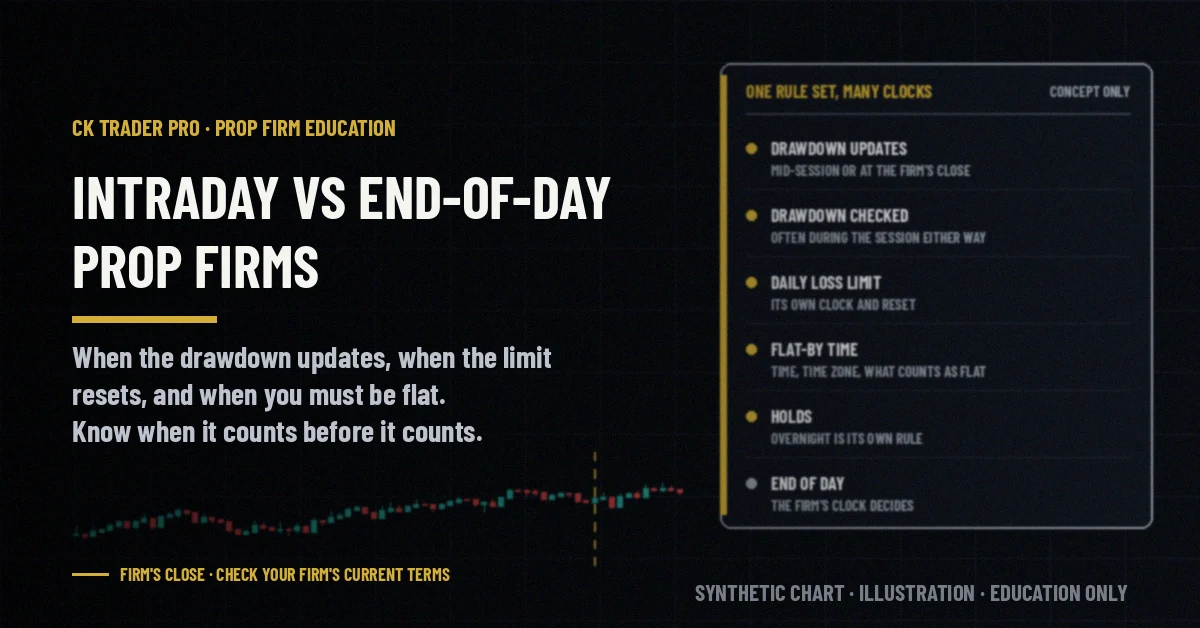
Short answer: “Intraday” and “end-of-day” describe when a prop firm measures a rule, not how much room you get. An intraday-style account can move the drawdown during the session, including open trades. An end-of-day-style account updates it from your balance at the firm’s close. But the drawdown is one rule. The daily loss limit, the flat-by time, overnight holds and the firm’s definition of “end of day” each run on their own clock, so read each one in your firm’s current terms.
Education only. Futures trading involves substantial risk of loss. Not financial advice.
Some retail futures prop programs use simulated evaluations and simulated funded accounts; some also offer a separate live-funded stage. Verify your specific account type. CK Trader Pro and NQ Live Trading aren’t owned, run or endorsed by any prop firm.
I learned that “end of day” is a time, not a feeling
I’ve been trading futures since 1998. In my experience, the costly word isn’t in the rule. It’s the one traders assume.
“End of day” sounds like “after I’m done trading.” It isn’t. It’s a time on the firm’s clock, not mine. So I read every rule as “measured when, and reset when.”
Have you ever noticed this about traders?
How many traders pick an account because it says “end-of-day,” without ever finding the time the firm’s day actually ends?
How many think an end-of-day drawdown means nothing during the session can hurt them, while a daily loss limit is still watching every tick?
And how many could tell you their entry setup in detail, but not whether they’re allowed to hold a position past the close?
None of that is a chart problem. It’s a reading problem.
Here’s the point
“Intraday” and “end-of-day” tell you when a rule is measured. They don’t tell you how much room you have.
Two accounts can show the same drawdown number and behave very differently.
What the two labels usually describe
When a firm calls an account “intraday” or “end-of-day,” it’s usually describing the drawdown. An intraday trailing floor can follow your highest account value in real time, including unrealized gains on an open trade. An end-of-day trailing floor updates from your balance at the close. The mechanics, with a worked example, are in trailing vs end-of-day drawdown.
This page covers everything around that rule. A firm that updates the drawdown at the close can still check it mid-session, run a real-time daily loss limit and require you flat before the close. The label is a starting point, not the rule set.
The rule set, side by side
Concept only. These are common styles, not any firm’s rules. Firms mix and match, and terms change.
| Rule | Intraday-style | End-of-day-style | What to find in the terms |
|---|---|---|---|
| Drawdown update | Can move mid-session, open trades included | From the balance at the firm’s close | “Intraday” or “end-of-day” next to the drawdown |
| Drawdown check | During the session | At many firms, also during the session | Can the floor be breached mid-session? |
| Daily loss limit | Can be measured in real time | Can be measured in real time | Do open trades count? When does it reset? |
| Flat-by time | May apply | May apply | Time, time zone, what happens if you’re not flat |
| Overnight and weekend holds | Depends on the account | Depends on the account | Allowed, and on which account types? |
| “End of day” | Sets the daily reset | Sets the drawdown update and daily reset | The firm’s clock and time zone |
The styles really differ in one row. The other rows are where traders get caught.
1. When the drawdown updates, and when it’s checked
“Updates” is when the floor can move. “Checked” is when touching it counts. At many firms, an end-of-day floor moves only at the close but can still be breached during the session. Managing the room above it is covered in prop firm drawdown management.
2. When the daily loss limit is measured and resets
A daily loss limit is separate from the drawdown. Some firms count open trades against it in real time; some count only closed trades. It resets on the firm’s trading day, so “today” ends when the firm says it does. Keep your own daily stop inside it: daily loss limit strategy for prop traders.
3. Flat-by time and the session close
A flat-by time is when a firm requires positions closed and working orders cancelled, under either style. Write down the time, the time zone, what “flat” includes and what happens if you’re still in a trade. The full checklist is in prop firm trading hours and session rules.
4. Overnight and weekend holds
An end-of-day drawdown doesn’t mean you can hold overnight. Holding is its own rule, allowed on some account types and not others. If it’s allowed, find out how an open position is measured at the firm’s close.
5. How the firm’s clock defines “end of day”
Futures sessions don’t end at midnight. CME’s rulebook for NQ says a trading day “generally shall coincide with the start of the CME Globex trading session at 5:00 p.m.” Chicago time, which is 6:00 PM ET (source: CME Rulebook, Chapter 359). Globex runs Sunday to Friday, 6:00 PM to 5:00 PM ET, with a daily break from 5:00 to 6:00 PM ET (source: CME Group, Trading Hours).
A firm may use that boundary or set its own, and its definition decides when an end-of-day drawdown updates and a daily limit resets. It’s Thanksgiving week, and holiday sessions can change the clock, so check the exchange’s holiday schedule and your firm’s announcements first.
Where to find each rule in a firm’s current terms
- The rules or FAQ page for your account type: the drawdown wording, then the daily loss limit.
- The terms and conditions: often the flat-by time, holding rules and time zone.
- The firm’s announcements: holiday hours and recent changes.
- Your dashboard, if it shows the floor or daily limit, to compare with what you read.
Date what you read. How to re-check it is in prop firm rule changes: how to check a firm’s current terms.
How I think about it
In my experience, the better question isn’t “intraday or end-of-day?” It’s “which clock is each rule on, and do my trades fit inside all of them?” I write all five rules above on one sheet before the session.
If you trade NQ or MNQ, limits are often written in dollars while your chart moves in points. The NQ tick value calculator converts one into the other at your size. And if you set a stop near a limit or the flat-by time, know that no stop guarantees a maximum loss; in a fast market, an order can fill past the stop price.
Where we fit
Is CK Trader Pro a prop firm? No. We teach futures and prop firm education. We don’t sell evaluations or funded accounts, and we don’t send trade signals or setups to follow.
CK has affiliate relationships with some prop firms, including Apex Trader Funding and Lucid Trading, and may earn a commission from sign-ups through his links. Understanding which clock your rules run on doesn’t promise you’ll pass anything or make money. It means you know when each rule counts. For the bigger picture, start with our prop firm education guide or the prop firm information hub.
The noise sells the label
Here’s what gets in a new trader’s way, and it isn’t the trader. It’s the noise. It puts “end-of-day” in big letters and leaves the daily limit, the flat-by time and the holding rule in the fine print. When the noise picks your account, you end up trading one rule while another one ends your day.
Remember this
Know when it counts before it counts.
So here’s my question: before your next session, could you write down when your firm’s day ends, and which of your rules are measured before then?
If you’d like to watch a plan read before the trade, there’s a free live NQ session on weekdays from 9:30 to 10:30 AM ET at nqlivetrading.com/live, run by the same company. Registration is required. Adults 21+. Sessions are education, not signals.
Join the Academy
Know your firm’s clock before the open. CK Trader Pro is futures and prop firm education: step-by-step lessons, live sessions and risk planning, built for traders who want every rule, limit and cutoff written down before the bell. It’s the CK Trader Pro Membership, which includes:
- Members-only educational lessons on prop-firm rules, drawdown, daily loss limits, position sizing and NQ and MNQ contract basics
- War Room: CK’s live pre-market planning session, weekdays 8:30–9:30 AM ET, where the day’s levels, news times and risk get written down before the open
- CK’s chart setup, shown and explained live in every session
- Economic news calendar
Education only. No trade signals or personal advice. No results promised.
Billed monthly until you cancel. See pricing at cktraderpro.com.
FAQ
What’s the difference between an intraday and an end-of-day prop firm?
The labels usually describe the drawdown. An intraday-style account can move the floor during the session, including open trades; an end-of-day-style account updates it from the balance at the firm’s close. The daily loss limit, flat-by time and holding rules are separate, so check each one in the firm’s current terms.
Can I breach an end-of-day account during the session?
At many firms, yes. “End-of-day” usually describes when the floor moves, not when it’s checked, and a daily loss limit can be measured in real time. Read your firm’s current rules.
When does “end of day” happen at a prop firm?
When the firm’s terms say it does. CME’s trading day for NQ generally starts at 5:00 p.m. Chicago time, which is 6:00 PM ET, and a firm may use that boundary or its own. Write down the time and the time zone.
Can I hold trades overnight on an end-of-day account?
Not necessarily. Holding is a separate rule. Some account types allow overnight or weekend holds and others require you to be flat by a set time. Check the firm’s current terms for your account type.
Does a stop keep me inside my daily loss limit?
A stop is an instruction, not a promise. No stop guarantees a maximum loss; in a fast market, an order can fill past the stop price, so many traders keep their own daily stop well inside the firm’s limit.
Is CK Trader Pro a prop firm?
No. CK Trader Pro is futures and prop firm education. It doesn’t sell evaluations or funded accounts, and it isn’t owned, run or endorsed by any prop firm.
Trading futures involves substantial risk of loss and is not suitable for everyone. Past performance is not indicative of future results. Education only, not financial advice. Example numbers are illustrations, not recommendations. No stop guarantees a maximum loss. Prop-firm rules vary by firm and change often; check each firm’s current rules. Some retail futures prop programs use simulated evaluations and simulated funded accounts; some also offer a separate live-funded stage. Verify your specific account type. CK Trader Pro and NQ Live Trading aren’t owned, run or endorsed by any prop firm. See our Risk Disclosure and Disclosures. CK Trader Pro is operated by CK TRADING INSTITUTE OF TECHNOLOGY LLC.
About this article. This is general education from CK Trader Pro. It isn't investment advice, a recommendation to buy or sell, or a trade signal, and it doesn't take your situation into account. Dollar figures and examples are illustrations, not results. Prop-firm rules, costs and payout terms vary by firm and change often; check the firm's current terms before you buy anything. We have paid referral relationships with some prop firms (see Disclosures). We are not owned, run, employed or endorsed by these firms. Mentioning a firm or its evaluations is not a recommendation that you trade. Trading futures involves substantial risk of loss and is not suitable for everyone.