

Prop Firm Rule Changes: How to Check a Firm’s Current Terms Before You Trade
Education only, not financial advice. Trading futures involves substantial risk of loss and is not suitable for everyone.
Many traders don't pass prop evaluations, and evaluation fees can be lost entirely. Rules, costs and payout terms vary by firm and change often, so check the firm's current terms.
By CK · Futures trader since 1998
Short answer: Prop firm rule changes happen, and the version that counts is the one on the firm’s own site today, not the one you remember or saw in a video. Before each session, open the firm’s official rules page, help center and announcements, note the date you read them, compare them with your rule sheet, and write down anything that changed. If a rule is unclear, ask support in writing before you trade.
Education only. Futures trading involves substantial risk of loss. Not financial advice.
Some retail futures prop programs use simulated evaluations and simulated funded accounts; some also offer a separate live-funded stage. Verify your specific account type. CK Trader Pro and NQ Live Trading aren’t owned, run or endorsed by any prop firm.
I read the rules on the day I trade them
I’ve been trading futures since 1998, and the habit I trust is a boring one. In my experience, the rule that catches a trader off guard is rarely the one they never read. It’s the one they read once, months ago, and stopped checking.
So the rules get the same treatment as the economic calendar. I look at them before the session, not after something goes wrong.
Have you ever noticed this about traders?
How many traders can quote a firm’s daily limit from memory, but can’t say when they last checked it?
How many learned the rules from a video or a screenshot instead of the firm’s own pages?
And how many find out a rule changed only after it ends their day?
None of that is a trading problem. It’s a reading problem, and reading is something you can finish before the open.
Here’s the point
The rules you trade under are the ones on the firm’s site today, not the ones in your head.
A prop firm writes its own terms, and it can update them. Your job isn’t to argue with the rules or look for gaps in them. It’s to know the current version and follow it.
Why prop firm rule changes matter
A firm’s rules are its terms. They can cover drawdown, daily limits, consistency rules, news restrictions, contract limits, hours and more. Our futures prop firm rules checklist walks through each category, so I won’t repeat it here.
What matters on this page is that any of those lines can be reworded, added or removed. Sometimes a change applies only to new accounts; sometimes it applies to existing ones too. The firm’s wording decides which, so read it rather than guess.
Where to find a firm’s current terms
Use official sources only. In rough order:
- The firm’s rules page. The main page that lists each rule for each account type.
- The help center. Articles there often explain how a rule is measured, with the edge cases.
- The terms and conditions or user agreement. The legal document you accepted. It usually says how and when the firm can change its rules.
- Your account dashboard. Some firms show the rules that apply to your specific account.
- Announcements. Emails, a news page or a changelog where updates are posted.
Not on that list: forums, chat groups, videos, screenshots and other people’s summaries, including ours. They can be a starting point for questions. They aren’t the rules.
How to date what you read
A rule without a date is a guess. Every time you read a firm’s rules, write down:
- The date and time you read them, with the time zone.
- The page’s own “last updated” date, if it shows one. Not every page does.
- The exact URL of the page you read.
- The account type and stage the rule applies to, since rules often differ between them.
- The wording itself, copied, not paraphrased, for any rule that can end the day or the account.
In my experience, keeping your own dated copy of the page helps when you compare later. It’s for your records, not a substitute for the live page.
A re-check before each session
This takes a few minutes, and I do it before I look at a chart:
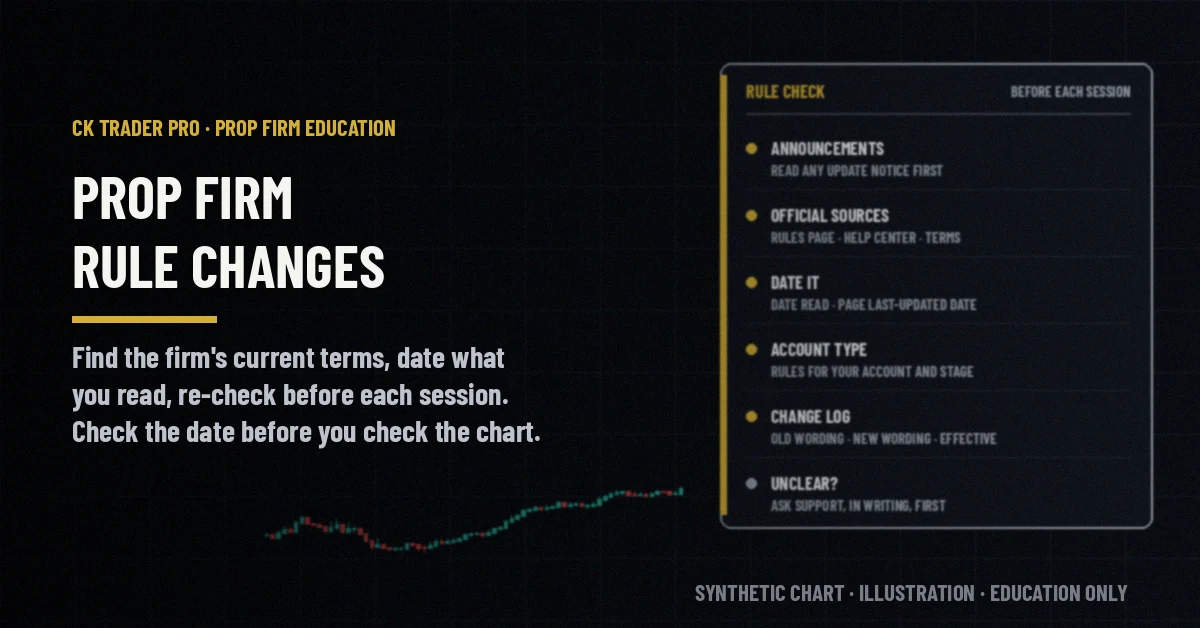
- Open the announcements first. If there’s a “rules updated” notice, read it fully before anything else.
- Compare dates. Check the “last updated” dates on the rules page and help center against the dates on your sheet.
- Confirm your account type. Make sure you’re reading the rules for your account and stage, not a different plan.
- Update the sheet. If anything changed, start a fresh sheet or log the change (see below). The prop firm rule sheet template has the blank lines.
- Re-check your own limits. Your personal daily stop should still sit inside the firm’s current limit. If a dollar rule changed, redo the points conversion; for NQ or MNQ, the NQ tick value calculator does the math at your size.
- If something is unclear, ask first. Send the question to support and keep the answer in writing. Until you have it, not trading that account is a valid plan.
What to note on your rule sheet when a rule changes
Add a change log under your rule sheet. Copy this block:
RULE CHANGE LOG
Date and time checked (with time zone): ________
Source (rules page / help center / terms / dashboard / announcement): ________
URL: ________
Page "last updated" date, if shown: ________
Account type and stage: ________
Rule category: ________
Old wording: ________
New wording: ________
Applies to (new accounts / existing accounts / all): ________
Effective from: ________
Support's answer, in writing, if I asked: ________
What I changed in my own plan: ________
Keep the old entries. When a session goes wrong, the log shows which version of the rules you were trading under. When the firm’s pages disagree with each other, the log shows what each one said, so your question to support can be specific.
What this isn’t
This isn’t a way to find loopholes. You read the rules to follow them. If a rule seems unclear, don’t test it on the account to see what happens; ask the firm, and trade inside the stricter reading until you have an answer.
And a stop doesn’t make a rule safe to sit next to. No stop guarantees a maximum loss; in a fast market, an order can fill past the stop price. In my experience, a buffer between your own limit and the firm’s limit is part of the plan.
Where we fit
Is CK Trader Pro a prop firm? No. We teach futures and prop firm education. We don’t sell evaluations or funded accounts, and we don’t set or change anyone’s rules.
CK has affiliate relationships with some prop firms, including Apex Trader Funding and Lucid Trading, and may earn a commission from sign-ups through his links. Whichever firm you trade with, its current written rules are the only version that counts. Checking them doesn’t promise you’ll pass anything or make money. It means you won’t learn about a change from the account itself. For the bigger picture, start with our prop firm education path.
The noise repeats old rules
Here’s what gets in a new trader’s way, and it isn’t the trader. It’s the noise. Clips and threads keep repeating rules long after they’ve changed, and nobody adds a date. When the noise is your rulebook, you’re trading under terms that may not exist anymore.
Remember this
Check the date before you check the chart.
So here’s my question: when did you last read your firm’s rules on the firm’s own site, and could you show the date you read them?
If you’d like to watch a trading day get planned around written rules in real time, there’s a free live NQ session on weekdays from 9:30 to 10:30 AM ET at nqlivetrading.com/live, run by the same company. Registration is required. Adults 21+. Sessions are education, not signals.
Join the Academy
Know the rules before the bell. CK Trader Pro is futures and prop firm education: step-by-step lessons, live sessions and risk planning, built for traders who want their firm’s current rules, their own limits and their plan written down and understood before the open. It’s the CK Trader Pro Membership, which includes:
- Members-only educational lessons on prop-firm rules, drawdown, daily loss limits, position sizing and NQ and MNQ contract basics
- War Room: CK’s live pre-market planning session, weekdays 8:30–9:30 AM ET, where the day’s levels, news times and risk get written down before the open
- CK’s chart setup, shown and explained live in every session
- Economic news calendar
Education only. No trade signals or personal advice. No results promised.
Billed monthly until you cancel. See pricing at cktraderpro.com.
FAQ
What are prop firm rule changes?
They’re updates a prop firm makes to its own terms, such as rewording, adding or removing a rule on drawdown, daily limits, consistency, news, contract limits or hours. The firm’s current written version is the one that applies, and its wording says whether a change covers existing accounts, new accounts or all accounts.
How do I find a prop firm’s current terms and conditions?
Use the firm’s official sources: its rules page, help center, terms and conditions or user agreement, your account dashboard, and its announcements. Forums, videos, screenshots and other people’s summaries aren’t the rules.
How often should I check for prop firm rule updates?
In my experience, before each session. Check the announcements and the “last updated” dates on the rules page and help center, compare them with your rule sheet, and log anything that changed.
What should I do if a firm’s pages disagree?
Write down what each page says, with the URL and the date you read it, and ask support in writing which one applies to your account. Until you have an answer, trade inside the stricter reading or don’t trade that account.
Does a stop keep me inside my firm’s loss limit?
Not always. A stop is an instruction, not a promise. In a fast market, an order can fill past the stop price. No stop guarantees a maximum loss, so keep a buffer between your own limit and the firm’s.
Is CK Trader Pro a prop firm?
No. CK Trader Pro is futures and prop firm education. It doesn’t sell evaluations or funded accounts, and it isn’t owned, run or endorsed by any prop firm.
Trading futures involves substantial risk of loss and is not suitable for everyone. Past performance is not indicative of future results. Education only, not financial advice. No stop guarantees a maximum loss. Prop-firm rules vary by firm and change often; check each firm’s current rules. Some retail futures prop programs use simulated evaluations and simulated funded accounts; some also offer a separate live-funded stage. Verify your specific account type. CK Trader Pro and NQ Live Trading aren’t owned, run or endorsed by any prop firm. See our Risk Disclosure and Disclosures. CK Trader Pro is operated by CK TRADING INSTITUTE OF TECHNOLOGY LLC.
About this article. This is general education from CK Trader Pro. It isn't investment advice, a recommendation to buy or sell, or a trade signal, and it doesn't take your situation into account. Dollar figures and examples are illustrations, not results. Prop-firm rules, costs and payout terms vary by firm and change often; check the firm's current terms before you buy anything. We have paid referral relationships with some prop firms (see Disclosures). We are not owned, run, employed or endorsed by these firms. Mentioning a firm or its evaluations is not a recommendation that you trade. Trading futures involves substantial risk of loss and is not suitable for everyone.