

Futures Prop Firm Rules: A Plain-English Checklist
Education only, not financial advice. Trading futures involves substantial risk of loss and is not suitable for everyone.
Many traders don't pass prop evaluations, and evaluation fees can be lost entirely. Rules, costs and payout terms vary by firm and change often, so check the firm's current terms.
By CK · Futures trader since 1998
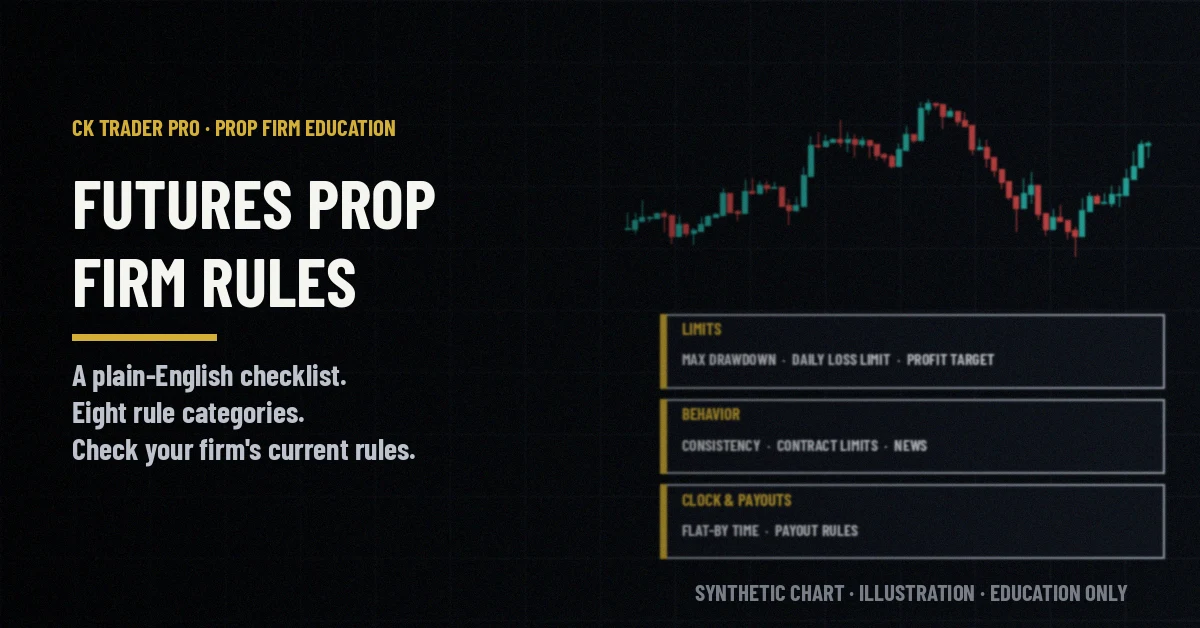
Short answer: Futures prop firm rules usually fall into eight categories: the profit target, the maximum drawdown (and how it’s measured), the daily loss limit, consistency rules, contract limits and scaling, news restrictions, trading hours and flat-by times, and payout rules. Not every firm uses all eight, and the details differ by firm, by account type and by stage. They also change. This checklist tells you what to look for in each category; your firm’s current written rules tell you the actual numbers.
Education only. Futures trading involves substantial risk of loss. Not financial advice.
Some retail futures prop programs use simulated evaluations and simulated funded accounts; some also offer a separate live-funded stage. Verify your specific account type. CK Trader Pro and NQ Live Trading aren’t owned, run or endorsed by any prop firm.
The page I read before I read a chart
I’ve been trading futures since 1998. In my experience, the fastest way to understand any trading account is to ask one question first: what ends it?
Not “how do I make money in it.” What ends it. Which number, which time, which behavior closes the door. A prop firm’s rulebook answers that question in writing, and in my experience, the traders who read it like a contract tend to trade it differently from the ones who skim it like terms and conditions.
Have you ever noticed this about traders?
How many traders can draw a perfect level on the NQ chart, but can’t tell you whether their drawdown trails intraday or at the end of the day?
How many learn their firm has a news rule from an email, after the trade?
And how many study the profit target for an hour and the daily loss limit for a minute?
None of that is a talent problem. It’s an attention problem. Entries are exciting. Rulebooks aren’t. But the rulebook decides which trades count, and which one is your last.
Here’s the point
Your strategy works inside the rules, or it doesn’t work at all.
A prop account isn’t the open market. It’s the market plus a set of boundaries. The best entry in the world can still break an account if it breaks a rule. So before you ask “is this a good trade?”, ask “is this trade legal in this account, today, at this size, at this time?”
The checklist: eight rule categories
Use this list every time you open a new account, change account types or see a “rules updated” notice. For the due-diligence checklist before you pick a firm, see how to choose a prop firm. For each line, find the firm’s exact wording and write it down in your own words.
1. Profit target
The amount an evaluation asks you to reach before you can move to the next stage. Check whether it’s measured on closed trades or on account balance, and whether other rules (like consistency or minimum trading days) must also be met at the same time.
2. Maximum drawdown, and how it’s measured
The floor your account can’t go below. This is the rule I’d read three times. Some rule sets use a static floor set from the starting balance. Others use a trailing floor that follows your highest balance or equity, either intraday (open profit can move it) or at the end of day. On an intraday trailing rule, a trade that runs up and then comes back can raise your floor even if it closes flat. The deeper explanation is in prop firm drawdown management, and the two trailing types are compared in trailing vs end-of-day drawdown.
3. Daily loss limit
The maximum loss allowed in one trading day. Depending on the firm, hitting it can end your day or end the account. Check when “the day” starts and ends, and whether open losses count toward it. For a planning approach, see daily loss limit strategy for prop traders.
4. Consistency rules
Some firms cap how much of your total profit can come from a single day, or require a minimum number of trading days. These rules can matter more than you’d expect after one big day. The details are in prop firm consistency rules.
5. Contract limits and scaling
The maximum number of contracts you can hold, which at some firms grows as the account balance grows. Check how micros count against the limit; at some firms, 10 MNQ count as 1 NQ, while others count micros separately, so verify yours. See prop firm scaling plans and contract limits.
6. News restrictions
Some firms restrict trading around major scheduled releases, and some don’t. Where a rule exists, check which releases count, how many minutes the window covers, and whether it applies to new trades, open trades or both. The full walkthrough: prop firm news trading rules.
7. Trading hours and flat-by times
Many rule sets require you to be flat by a set time each day and may restrict holding through the daily break, weekends or holidays. Check the exact time, the time zone it’s written in and what happens to a position still open at that time. For the exchange schedule itself, see NQ futures trading hours and rollover.
8. Payout rules
If an account reaches a payout stage, there are usually conditions: minimum days, buffers, request windows and caps. Payout rules describe a process; they don’t promise one. Read them before you trade the account, not after. See prop firm payout requirements.
Turning a dollar rule into points on the chart
Rules are written in dollars. Your chart is in points. NQ is $20 per point and MNQ is $2 per point (source: CME Group E-mini Nasdaq-100 and Micro E-mini Nasdaq-100 contract specifications).
Illustration only, hypothetical numbers, not any firm’s rule: say a rule set has a $1,000 daily loss limit. On 1 NQ, that’s 50 points. On 1 MNQ, it’s 500 points. On 5 MNQ, it’s 100 points. Same rule, very different room on the chart, before commissions and fees. Check your own numbers with the NQ tick value calculator.
And remember, a stop is an instruction, not a promise. No stop guarantees a maximum loss; in a fast market, an order can fill past the stop price. If your stop sits right at the edge of a rule, slippage can carry you over it. In my experience, it’s wiser to leave a buffer between your planned loss and the firm’s limit.
How I read a rule sheet
- Get the current version. Use the firm’s own rules page or help center, and note the date you read it.
- Write each rule in your own words next to the eight categories above. If you can’t explain it simply, you don’t know it yet.
- Convert every dollar rule into points for the contract you trade.
- Mark the rules that can end the account versus the ones that only pause the day.
- Ask support about anything unclear before you trade, and keep the answer in writing.
If any of these terms are new, the prop firm glossary defines them, and the prop firm education path shows where rule literacy fits in the bigger picture. For a broader look at how evaluations and accounts work, start with prop firm information.
Where we fit
Is CK Trader Pro a prop firm? No. We teach futures and prop firm education. We don’t sell evaluations or funded accounts, and we don’t set anyone’s rules.
CK has affiliate relationships with some prop firms, including Apex Trader Funding and Lucid Trading, and may earn a commission from sign-ups through his links. Whichever firm you trade with, its current written rules are the only version that counts. Knowing the rules doesn’t promise you’ll pass anything or make money. It means you won’t be surprised by the rule that ends an account.
The noise skips the fine print
Here’s what gets in a new trader’s way, and it isn’t the trader. It’s the noise. Feeds show the screenshot and skip the rulebook. You see the entry, the target and the excitement. You don’t see the drawdown type, the daily limit or the flat-by time that shaped every decision. When all you hear is the trade, it’s easy to forget the rules were in the room too.
Remember this
Read the rules before you risk the run.
So here’s my question: without opening your firm’s website, could you name your drawdown type, your daily loss limit and your flat-by time right now?
If you’d like to watch a trading day get planned around written rules in real time, there’s a free live NQ session on weekdays from 9:30 to 10:30 AM ET at nqlivetrading.com/live, run by the same company. Registration is required. Adults 21+. Sessions are education, not signals.
Join the Academy
Learn the rules before you trade the account. CK Trader Pro is futures and prop firm education: step-by-step lessons, live sessions and risk planning, built for traders who want to understand exactly which rules shape every trade. It’s the CK Trader Pro Membership, which includes:
- Members-only educational lessons on prop-firm rules, drawdown, daily loss limits, position sizing and NQ and MNQ contract basics
- War Room: CK’s live pre-market planning session, weekdays 8:30–9:30 AM ET, where the day’s levels, news times and risk get written down before the open
- CK’s chart setup, shown and explained live in every session
- Economic news calendar
Education only. No trade signals or personal advice. No results promised.
Billed monthly until you cancel. See pricing at cktraderpro.com.
FAQ
What are the main futures prop firm rules?
Futures prop firm rules usually cover the profit target, maximum drawdown, daily loss limit, consistency, contract limits and scaling, news restrictions, trading hours and flat-by times, and payouts. Not every firm uses all of them, and details change, so check your firm’s current rules.
What is the difference between static and trailing drawdown?
A static drawdown sets a fixed floor from the starting balance. A trailing drawdown moves up with your highest balance or equity, either intraday or at the end of the day, depending on the firm’s rules.
Does hitting the daily loss limit end a prop account?
It depends on the firm. At some firms, hitting the daily loss limit ends the trading day; at others, it can end the account. Read your firm’s current wording.
Do prop firms restrict trading around news?
Some do and some don’t. Where a news rule exists, check which releases count, how long the window is, and whether it applies to new trades, open trades or both.
How do I turn a dollar rule into NQ points?
Multiply the dollars per point by your number of contracts, then divide the dollar rule by that figure. NQ is $20 per point and MNQ is $2 per point, according to CME Group’s contract specifications.
Does a stop keep me inside my firm’s loss limit?
A stop is an instruction, not a promise. No stop guarantees a maximum loss; in a fast market, an order can fill past the stop price, so many traders leave a buffer before the limit.
Is CK Trader Pro a prop firm?
No. CK Trader Pro is futures and prop firm education. It doesn’t sell evaluations or funded accounts, and it isn’t owned, run or endorsed by any prop firm.
Trading futures involves substantial risk of loss and is not suitable for everyone. Past performance is not indicative of future results. Education only, not financial advice. Example numbers are illustrations, not recommendations. No stop guarantees a maximum loss. Prop-firm rules vary by firm and change often; check each firm’s current rules. Some retail futures prop programs use simulated evaluations and simulated funded accounts; some also offer a separate live-funded stage. Verify your specific account type. CK Trader Pro and NQ Live Trading aren’t owned, run or endorsed by any prop firm. See our Risk Disclosure and Disclosures. CK Trader Pro is operated by CK TRADING INSTITUTE OF TECHNOLOGY LLC.
About this article. This is general education from CK Trader Pro. It isn't investment advice, a recommendation to buy or sell, or a trade signal, and it doesn't take your situation into account. Dollar figures and examples are illustrations, not results. Prop-firm rules, costs and payout terms vary by firm and change often; check the firm's current terms before you buy anything. We have paid referral relationships with some prop firms (see Disclosures). We are not owned, run, employed or endorsed by these firms. Mentioning a firm or its evaluations is not a recommendation that you trade. Trading futures involves substantial risk of loss and is not suitable for everyone.