

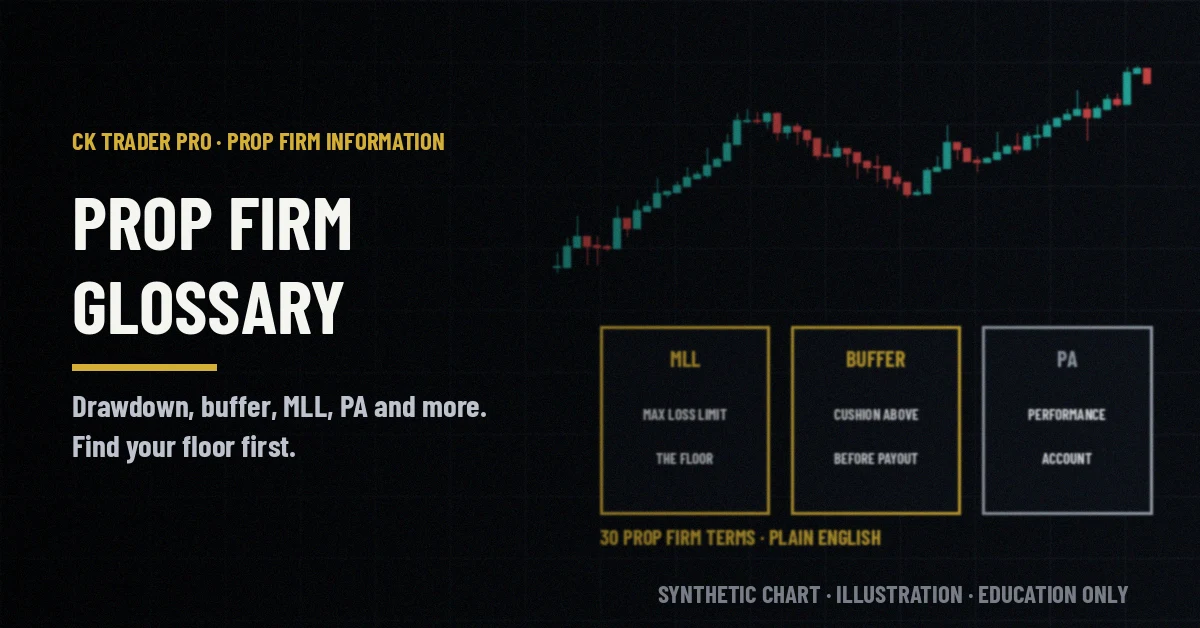
Prop Firm Glossary: Drawdown, Buffer, MLL, PA and More
Education only, not financial advice. Trading futures involves substantial risk of loss and is not suitable for everyone.
Many traders don't pass prop evaluations, and evaluation fees can be lost entirely. Rules, costs and payout terms vary by firm and change often, so check the firm's current terms.
By CK · Futures trader since 1998
Prop firm terms, explained in plain English: 30 words you’ll meet in a futures prop firm’s rulebook, from max drawdown and MLL to buffer, PA accounts, consistency and payout rules. Education only. Futures trading involves substantial risk of loss. Not financial advice.
Prop-firm evaluations and funded accounts are typically simulated. CK Trader Pro and NQ Live Trading aren’t owned, run or endorsed by any prop firm.
I learned the rules before I learned the screen
I’ve been trading futures since 1998. I started as a quant analyst, went into the pits in 2000, and later moved to the screen. On the floor, nobody handed you a glossary. You learned what the rules meant by watching what happened to traders who didn’t.
Prop firms put their rules in writing, which is better. But the writing comes in shorthand. MLL. PA. Buffer. Trailing threshold. Consistency. And every firm uses those words a little differently.
Have you ever noticed this about new prop traders?
How many traders buy an evaluation, read “max drawdown” in the rules, and assume it means the same thing at every firm?
How many find out what “intraday trailing” means only after a winning trade turns around and their floor has already moved up?
And how many reach a profit target, ask for a payout, and only then read the words “buffer” and “consistency”?
None of that is about the setup. It’s vocabulary. And unlike the market, vocabulary is something you can learn completely before you place a trade.
How to use this glossary
This is a reference page. Here’s how I’d use it:
- Start with the drawdown section. In my experience, it’s the part of a prop rulebook new traders misread most often, and every other rule sits on top of it.
- Put your firm’s rulebook next to this page. These definitions are generic. Your firm’s wording is the one that counts, and rules change often, so check your firm’s current rules.
- Turn each term into a number. “My floor is $X.” “My daily limit is $Y.” If you can’t write the dollar amount for your own account, you don’t own the term yet.
Every dollar example below is an illustration, not a result or a recommendation. For the bigger picture, start with our prop firm information hub. For general futures words like tick, point value and slippage, see the futures trading glossary.
Accounts and stages
These eight terms describe what you’re buying and the steps you move through.
1. Prop firm (proprietary trading firm). In the retail futures world, a company that sells evaluations and, if you qualify, gives you an account to trade under its rules. You’re trading the firm’s account, not your own money in a brokerage account.
2. Evaluation (challenge). A paid test of whether you can reach a profit target while following every rule. Evaluation fees are a cost, they’re generally non-refundable, and many evaluations end without a pass. See what a prop firm evaluation is.
3. Combine. Another name some firms use for an evaluation. Same idea: a rule-following test with a target and loss limits.
4. Account size. The label on the account, like “50K.” It isn’t the money you can lose. What you can actually lose before the account fails is the drawdown (terms 9 to 16). Illustration: a “50K” account with a $2,000 drawdown has $2,000 of real risk capital, not $50,000.
5. Funded account. The account you move to after passing. It usually has its own rules and payout conditions, which can differ from the evaluation’s. Prop-firm funded accounts are typically simulated: your trades usually aren’t sent to the live market. See evaluation vs funded account.
6. PA (performance account). A name some firms use for the funded stage. Other firms say “funded,” “express,” “pro” or “master” account. Different labels, similar idea: the account after the evaluation. Read that stage’s rules on their own, because they often change.
7. Activation fee. A one-time charge some firms add when you move from a passed evaluation to the funded stage. Not every firm has one. Add it to your total cost before you start.
8. Reset. Paying to restart an evaluation from the beginning after a breach or a bad run, instead of buying a new one. It’s another fee, and in my experience it’s worth asking yourself why you need it before you click it.
Drawdown and loss terms
These eight terms decide when an account fails. Read this section twice.
9. Max drawdown (maximum loss). The floor your account balance can’t fall below. Touch it and the account usually fails. Some firms call the floor a “threshold” or “liquidation level.”
10. MLL (maximum loss limit). A name some firms use for max drawdown. Same idea: the floor. When you see MLL, find out whether it’s static or trailing.
11. Static drawdown. A floor that’s fixed from your starting balance and doesn’t move. If you start at $50,000 with a $2,000 static drawdown, the floor stays at $48,000 (illustration).
12. Trailing drawdown (intraday). A floor that follows your highest balance or equity during the day, including open profit on a trade you haven’t closed. That’s why a trade that runs up and then reverses can shrink your cushion even if it closes flat, and a deeper reversal can breach the account before you’re out.
Illustration only, not a result or a recommendation. Start at $50,000 with a $2,000 intraday trailing drawdown, so the floor is $48,000. A trade shows $600 of open profit, and the floor trails up to $48,600. The trade comes back and you close it at breakeven. Your balance is still $50,000, but your cushion is now $1,400, not $2,000.
13. End-of-day (EOD) trailing drawdown. A floor that moves up only based on your balance at the end of the day, not during it. Open profit during the session doesn’t raise it. See trailing vs end-of-day drawdown for the full side-by-side.
14. Drawdown lock (trail stop). The point where a trailing floor stops moving, often once it reaches a set level such as the starting balance. After that, the floor behaves like a static one. Firms set this point differently, so check your firm’s current rules.
15. Remaining drawdown. The distance between your balance now and your floor. In my experience, this is the number to size from, not the account size. Illustration: with $1,400 of remaining drawdown and a plan to risk a small slice of it, say $140, a 35-point stop on MNQ is 140 ÷ (35 × $2) = 2 MNQ. Slippage can still make the real loss bigger. No stop guarantees a maximum loss. Our walkthrough on how to size NQ and MNQ trades from your stop shows the method.
16. Daily loss limit (DLL). The most the firm lets you lose in one day. Some firms treat it as a “soft” breach: your day ends and you’re back tomorrow. Others treat it as a “hard” breach that ends the account. Know which one you have. See daily loss limit strategy.
Run your own numbers with the prop firm drawdown calculator, and for the risk-management side, read our guide to prop firm drawdown management.
Targets and trading rules
These seven terms describe what you have to hit and what you’re not allowed to do on the way.
17. Profit target. The amount you need to reach to pass an evaluation. It’s the finish line of the test, not a forecast of what you’ll make.
18. Consistency rule. A cap some firms put on how much of your total profit can come from a single day. Some apply it in the evaluation, some at payout, some both. See prop firm consistency rules.
19. Minimum trading days. The fewest number of days you must trade before you can pass or request a payout. Some firms count any day with a trade. Others only count days that meet a minimum profit.
20. Contract limit (max position). The most contracts you can hold at once. Some firms count micros against the limit at a ratio, such as 10 MNQ for 1 NQ. Check how your firm counts them.
21. Scaling plan. A rule that starts you with a smaller contract limit and raises it as your balance grows. Our upcoming guide to prop firm scaling plans and contract limits goes deeper.
22. News restriction. A rule at some firms that limits trading around major scheduled releases, like CPI, the jobs report or an FOMC statement. Some ban holding positions through the release, some only limit opening new ones, and some have no rule. NQ can move fast around these, and stops can fill worse than planned.
23. Flat by close (no overnight holding). A rule at many firms that every position must be closed by a set time each afternoon. If you’re still in a trade at that time, the firm may close it for you, at whatever price it gets.
Payout terms
These seven terms decide when, and how much, you can withdraw from a funded account. They vary more between firms than any other section, so read your firm’s current payout rules word for word.
24. Payout. A withdrawal of profit from a funded account under the firm’s rules. Because funded accounts are typically simulated, a payout is paid by the firm under its terms, not by the market. See prop firm payout requirements.
25. Buffer (cushion). An amount of profit some firms require you to keep above a set level, often the floor or the starting balance, before a payout is allowed, or that must stay in the account after one. A withdrawal can’t take you below it.
26. Profit split. The share of payout-eligible profit you keep, with the rest kept by the firm. Splits are set by each firm and can change by stage or over time.
27. Payout threshold (minimum balance). The balance or profit you must reach before you can ask for any payout at all.
28. Payout cap. The most you can withdraw in one payout or one period, at firms that set a cap.
29. Payout window (frequency). How often you can request a payout, such as after a set number of trading days or once per period.
30. Prohibited practices. Strategies or behaviors the firm bans, which can cost you a payout or the account. Common examples include copying another trader’s trades, trading the same idea in opposite directions across accounts, and exploiting simulated fills. Each firm publishes its own list.
For the whole learning path, see our prop firm education pillar.
Here’s the point
In my experience, many traders who lose a prop account don’t lose it to a bad setup. They lose it to a rule they couldn’t define.
A floor that trailed. A daily limit that turned out to be a hard breach. A payout that needed a buffer they didn’t know about. Every one of those is in the rulebook before the first trade.
The noise skips the fine print
Here’s what gets in the way of a lot of traders, and it isn’t you. It’s the noise. It talks about “passing” and “getting funded” in a sentence, and it skips the fine print that decides what any of that means: which drawdown, which daily limit, which buffer, which split. It makes the rules feel like a detail. They’re the whole game.
The CFTC urges people “to be skeptical when promoters… claim that their products and services will earn high profits with minimal risks” (source: CFTC Fraud Advisory). When someone skips the rules, slow down.
CK has affiliate relationships with some prop firms, including Apex Trader Funding and Lucid Trading, and may earn a commission from sign-ups through his links. That doesn’t change what we teach.
Remember this
Find your floor before your floor finds you.
Where to learn it step by step
Can learning 30 prop firm terms get you a pass or a payout? No. There’s no guarantee of either, and anyone who says otherwise is selling. What these words can do is make sure you know exactly what your rulebook says, where your floor is, and what a single trade can cost you, before you pay for an evaluation.
So here’s my question: without opening your firm’s website, could you write down your account’s floor, whether it trails, your daily loss limit, and what has to happen before a payout?
If you’d like to hear these rules talked through in real time, there’s a free live NQ session on weekdays from 9:30 to 10:30 AM ET at nqlivetrading.com/live, run by the same company. Registration is required. Adults 21+. Sessions are education, not signals.
Join the Academy
Rules first, then trades. CK Trader Pro is futures and prop firm education: step-by-step lessons, live sessions and risk planning. It’s the CK Trader Pro Membership, which includes:
- Members-only educational lessons on futures basics, prop-firm rules, risk and charting
- War Room: CK’s live pre-market planning session, weekdays 8:30–9:30 AM ET, where the day’s risk and news times get written down before the open
- CK’s chart setup, shown and explained live in every session
- Economic news calendar
Education only. No trade signals or personal advice. No results promised.
Billed monthly until you cancel. See pricing at cktraderpro.com.
FAQ
What does MLL mean at a prop firm?
MLL stands for maximum loss limit. It’s a name some firms use for max drawdown: the floor your account balance can’t fall below. Check whether your firm’s MLL is static or trailing, because that changes how much room you really have.
What is a PA account?
PA is short for performance account, a name some firms use for the funded stage after you pass an evaluation. Other firms call it a funded, express, pro or master account. Its rules are often different from the evaluation’s, and it’s typically simulated.
What is a buffer at a prop firm?
A buffer is an amount of profit some firms require you to keep above a set level, often the floor or the starting balance, before a payout is allowed or after one is made. Not every firm uses one, so read your firm’s current payout rules.
What’s the difference between static and trailing drawdown?
A static drawdown is a fixed floor from your starting balance. A trailing drawdown follows your highest balance or equity, either during the day (intraday) or at the end of the day, so the floor can move up toward your balance as you make money.
Is account size how much I can lose in a prop account?
No. The account size is a label. What you can lose before the account fails is set by the drawdown, which is usually a small fraction of the label. Size your trades from your remaining drawdown, and remember that no stop guarantees a maximum loss.
Trading futures involves substantial risk of loss and is not suitable for everyone. Past performance is not indicative of future results. Education only, not financial advice. All numbers in this article are illustrations, not results or recommendations. No stop guarantees a maximum loss. Prop-firm evaluations and funded accounts are typically simulated. Fees are generally non-refundable, and rules vary by firm and change often. CK Trader Pro and NQ Live Trading aren’t owned, run or endorsed by any prop firm. See our Risk Disclosure and Disclosures. CK Trader Pro is operated by CK TRADING INSTITUTE OF TECHNOLOGY LLC.
About this article. This is general education from CK Trader Pro. It isn't investment advice, a recommendation to buy or sell, or a trade signal, and it doesn't take your situation into account. Dollar figures and examples are illustrations, not results. Prop-firm rules, costs and payout terms vary by firm and change often; check the firm's current terms before you buy anything. We have paid referral relationships with some prop firms (see Disclosures). We are not owned, run, employed or endorsed by these firms. Mentioning a firm or its evaluations is not a recommendation that you trade. Trading futures involves substantial risk of loss and is not suitable for everyone.