

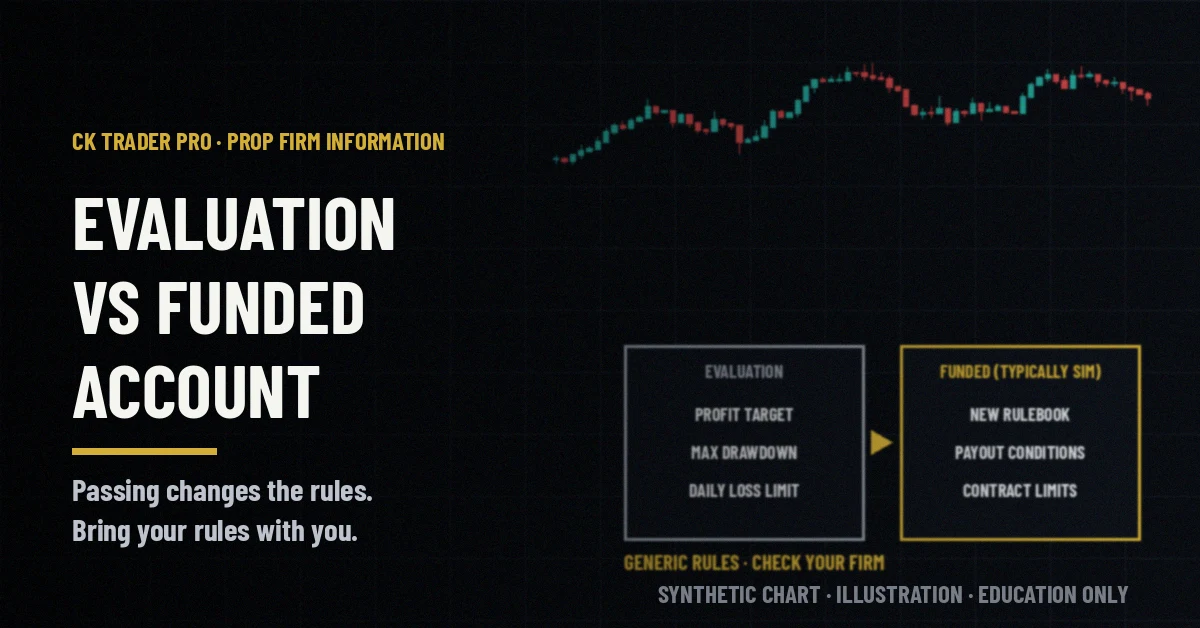
Evaluation vs Funded Account: What Actually Changes
Education only, not financial advice. Trading futures involves substantial risk of loss and is not suitable for everyone.
Many traders don't pass prop evaluations, and evaluation fees can be lost entirely. Rules, costs and payout terms vary by firm and change often, so check the firm's current terms.
By CK · Futures trader since 1998
Evaluation vs funded account, in plain English: what the evaluation is testing, what usually changes once you qualify, what “simulated” means, how payout rules tend to work, and which habits you should carry straight across. Education only. Futures trading involves substantial risk of loss. Not financial advice.
Prop-firm evaluations and funded accounts are typically simulated. CK Trader Pro and NQ Live Trading aren’t owned, run or endorsed by any prop firm.
The day the goal disappears
In my experience, the evaluation gives a trader something they rarely have: a finish line. There’s a profit target, a drawdown floor and a set of rules. Every session points at one number.
Then they qualify, and the finish line is gone.
Nobody tells you how strange that feels. The target that kept you careful is replaced by an open-ended account, a new rulebook and the idea of a payout. And in my experience, that’s exactly where a lot of traders change how they trade, without ever deciding to.
Have you ever noticed this about traders who just passed?
How many traders celebrate the pass and then size up on the very next session?
How many read the evaluation rules ten times and never open the funded account’s rules at all?
And how many treat a payout like the new profit target, and start pressing to reach it?
None of that is about a better setup. It’s about understanding that you’ve moved into a different account with different rules, and the same discipline has to come with you.
What the evaluation tests
An evaluation is a test of whether you can follow a firm’s rules while trading. It usually has a profit target to reach, a maximum drawdown you can’t breach, often a daily loss limit, sometimes a consistency rule, and often a minimum number of trading days. Our explainer on what a prop firm evaluation is walks through each piece.
The important part is what it isn’t testing. It isn’t a test of whether you can make money for a living. It’s a test of whether you can stay inside the lines long enough to hit a number. Evaluation fees are a cost, they’re generally non-refundable, and many evaluations end without a pass.
What changes after you qualify
Once you qualify, the firm typically moves you to a funded account (some firms call it a performance or “PA” account). The details vary by firm and change often, but these are the things that commonly change:
- The goal. There’s usually no profit target to pass anymore. The question shifts from “can I reach the number?” to “can I keep the account and meet the payout conditions?”
- The rulebook. Funded accounts often have their own rule set, which may differ from the evaluation’s. Drawdown type, daily loss limit, contract limits and news restrictions can all be different.
- Fees. Some firms charge an activation or setup fee, a recurring fee, or both, and some don’t. Fee structures vary, so read your firm’s current terms before you buy anything.
- Payouts. The funded account is where payout rules start to matter: when you can request one, how much, and what has to be true first.
- Contract limits. Some firms start funded accounts at a smaller size and let it grow with the balance (a scaling plan).
The only safe rule here is to read the funded account’s terms word for word, the day you qualify, as if you’d never seen the firm before.
Funded accounts are typically simulated: what that means
Here’s the part that surprises a lot of new traders. Prop-firm funded accounts are typically simulated. Your trades are usually not sent to the live market with the firm’s money. The firm tracks your simulated results and pays out according to its own agreement and rules.
That has practical consequences:
- A “funded” account isn’t the same as a live brokerage account with your money or the firm’s money in it.
- Payouts depend on the firm’s terms, and the firm decides how its rules are applied.
- Fills in a simulated account may not match what a live order would have gotten, especially around fast markets.
None of that makes the education less useful. It just means you should know what you’re actually holding. Our funded account guide for futures traders covers this in more depth.
Rules that tighten or loosen
There’s no standard funded account, but here are the patterns I’d check for:
- Drawdown can change type. An account might use a trailing drawdown in the evaluation and a different method once funded, or the trailing floor might stop moving after a certain point. See trailing vs end-of-day drawdown for how each type moves.
- Consistency rules can switch phases. Some firms apply a best-day rule during the evaluation, others only when you request a payout, and some do both. Our prop firm consistency rules page explains the math.
- Contract limits can start lower. A scaling plan can mean fewer contracts at first than you were allowed in the evaluation.
- Rule breaks can cost more. In an evaluation, a breach usually means a reset or a new attempt. On a funded account, it can mean losing the account.
Illustration only, not any firm’s real rules. Say a funded account has a $2,000 drawdown. On MNQ at $2 per point, a 25-point stop on 5 contracts is $250, which is an eighth of that room. On NQ at $20 per point, the same 25-point stop on one contract is $500, a quarter of it (contract values from CME Group’s E-mini Nasdaq-100 and Micro E-mini Nasdaq-100 specifications). Stops can fill worse than the price you set, especially around the 9:30 AM ET open and scheduled news. No stop guarantees a maximum loss. The free prop firm drawdown calculator and the NQ tick value calculator let you run your own numbers.
Payout requirements overview
Payout rules are where funded accounts differ the most. Common conditions include:
- A minimum number of trading days, or of days that meet a profit threshold, before a request
- A consistency condition on the profit you’ve built
- A buffer or minimum balance that has to stay in the account
- Limits on how much, or how often, you can request
- A profit split between you and the firm
Each of those is set by the firm, can change, and is applied by the firm. No rule, method or education guarantees a payout. Our guide to prop firm payout requirements goes through each condition in detail.
Here’s the point
Passing changes the rules. It shouldn’t change the trader.
Habits to keep from the evaluation
In my experience, the traders who handle the switch best don’t invent a new style after they qualify. They keep the boring habits that got them there:
- Write your risk before the open. Dollar risk per trade, maximum losses per day, and the contract count that math gives you.
- Size from the stop, not from the new account. Contracts = risk in dollars ÷ (stop points × dollars per point). Our walkthrough on how to size NQ and MNQ trades from your stop shows the full method.
- Measure risk against the remaining drawdown, not against the account’s headline size.
- Keep a daily stop. A set number of losses or dollars, and you’re done for the day.
- Re-read the rules whenever the firm updates them.
The noise sells the finish line
Here’s what gets in a lot of traders’ way, and it isn’t you. It’s the noise. It makes passing look like the end of the story, and it skips the rulebook that comes after. It talks about getting “funded” and never mentions that the account is typically simulated or that payouts come with conditions.
The CFTC urges people “to be skeptical when promoters… claim that their products and services will earn high profits with minimal risks” (source: CFTC Fraud Advisory). A pass is a milestone, not a promise.
CK has affiliate relationships with some prop firms, including Apex Trader Funding and Lucid Trading, and may earn a commission from sign-ups through his links. That doesn’t change what we teach.
Remember this
The pass is a door, not a finish line. Bring your rules with you.
Where to learn it step by step
Can understanding funded-account rules make you profitable? There’s no guarantee of that. Plenty of traders pass an evaluation and still lose the funded account. What education can do is help you know which rules you’re trading under, and what they cost when you ignore them, before your next session. That’s what I teach. For the bigger picture, start with our prop firm information hub and the prop firm education learning path.
So here’s my question: if you qualified tomorrow, could you name your funded account’s drawdown type, daily loss limit, contract limit and payout conditions without looking them up?
If you’d like to watch first, there’s a free live NQ session on weekdays from 9:30 to 10:30 AM ET at nqlivetrading.com/live, run by the same company. Registration is required. Adults 21+. Sessions are education, not signals.
Join the Academy
Know your rules before the account tests you. CK Trader Pro is prop firm education for futures traders: step-by-step lessons, live sessions and risk planning. It’s the CK Trader Pro Membership, which includes:
- Members-only educational lessons on prop-firm rules, risk and charting
- War Room: CK’s live pre-market planning session, weekdays 8:30–9:30 AM ET, where the day’s risk and news times get written down before the open
- CK’s chart setup, shown and explained live in every session
- Economic news calendar
Education only. No trade signals or personal advice. No results promised.
Billed monthly until you cancel. See pricing at cktraderpro.com.
FAQ
What’s the difference between an evaluation and a funded account?
An evaluation tests whether you can follow a firm’s rules while reaching a profit target. A funded account usually has no target to pass, its own rule set, and payout conditions. Both are typically simulated.
Are prop firm funded accounts real money?
They’re typically simulated. Your trades usually aren’t sent to the live market, and the firm pays out under its own agreement and rules. Check your firm’s terms.
Do the rules change after I pass?
Often, yes. Drawdown type, daily loss limits, contract limits, consistency rules and news restrictions can differ between the evaluation and the funded account. Read the funded account’s current rules word for word.
How do payouts usually work on a funded account?
Firms commonly require a minimum number of trading days, a consistency condition, a buffer or minimum balance, and limits on how much or how often you can request, with a profit split. Each firm sets and applies its own terms, and nothing guarantees a payout.
What habits should I keep after passing?
Write your risk before the open, size from your stop, measure risk against the remaining drawdown, keep a daily stop, and re-read the rules when they change. No habit makes a trade or an account profitable.
Trading futures involves substantial risk of loss and is not suitable for everyone. Past performance is not indicative of future results. Education only, not financial advice. All numbers in this article are illustrations, not results or recommendations. No stop guarantees a maximum loss. Prop-firm evaluations and funded accounts are typically simulated. Fees are generally non-refundable, and rules vary by firm and change often. CK Trader Pro and NQ Live Trading aren’t owned, run or endorsed by any prop firm. See our Risk Disclosure and Disclosures. CK Trader Pro is operated by CK TRADING INSTITUTE OF TECHNOLOGY LLC.
About this article. This is general education from CK Trader Pro. It isn't investment advice, a recommendation to buy or sell, or a trade signal, and it doesn't take your situation into account. Dollar figures and examples are illustrations, not results. Prop-firm rules, costs and payout terms vary by firm and change often; check the firm's current terms before you buy anything. We have paid referral relationships with some prop firms (see Disclosures). We are not owned, run, employed or endorsed by these firms. Mentioning a firm or its evaluations is not a recommendation that you trade. Trading futures involves substantial risk of loss and is not suitable for everyone.