

How to Choose a Prop Firm: A Red-Flag Checklist
Education only, not financial advice. Trading futures involves substantial risk of loss and is not suitable for everyone.
Many traders don't pass prop evaluations, and evaluation fees can be lost entirely. Rules, costs and payout terms vary by firm and change often, so check the firm's current terms.
By CK · Futures trader since 1998
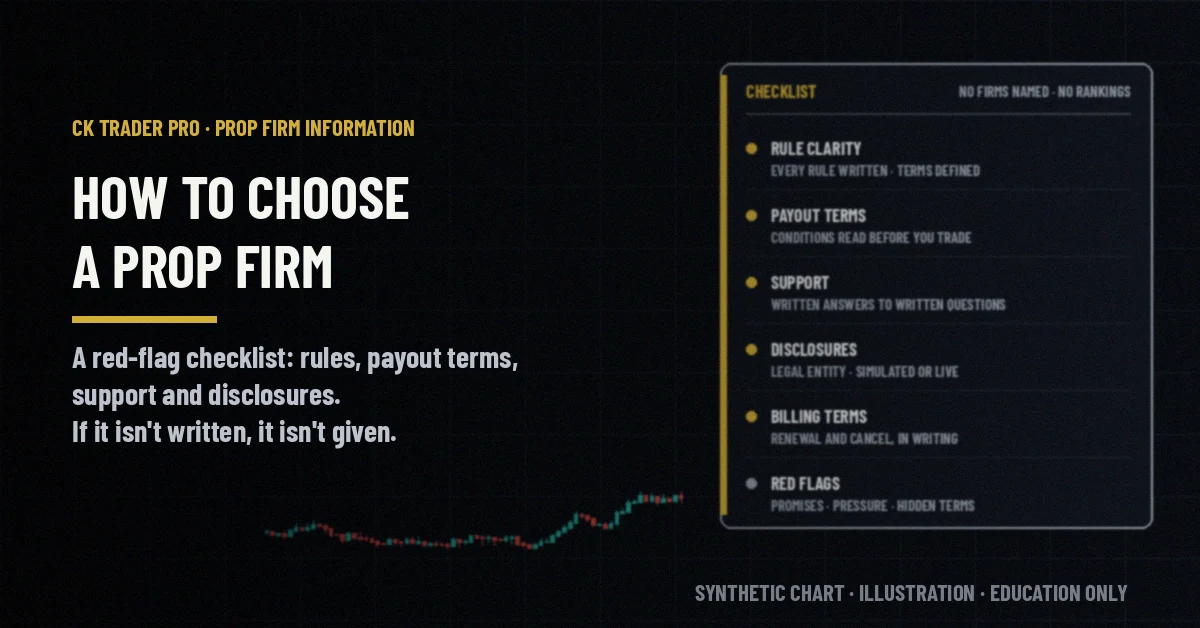
Short answer: To choose a prop firm, judge the paperwork before the marketing. Check four things: rule clarity (can you write every rule that can end your account in your own words?), payout terms (are the conditions written down before you trade?), support (do you get written answers to written questions?) and disclosures (who is the legal entity, and does it say plainly whether accounts are simulated?). Red flags include vague or missing rules, terms that can change without notice, promises of passing, payouts or income, and pressure to buy now. This checklist doesn’t rank firms. Firm names appear only in the affiliate disclosure. Rules differ by firm, by account type and by stage, and they change, so check each firm’s current written rules.
Education only. Futures trading involves substantial risk of loss. Not financial advice.
Some retail futures prop programs use simulated evaluations and simulated funded accounts; some also offer a separate live-funded stage. Verify your specific account type. CK Trader Pro and NQ Live Trading aren’t owned, run or endorsed by any prop firm.
Read the firm before you read the chart
I’ve been trading futures since 1998. In my experience, traders spend weeks picking a setup and minutes picking the firm that judges it.
They look at the account size and what a friend is using. The rules show up later, mid-trade, when there’s no time to read them.
Have you ever noticed this about traders?
How many traders could tell you which firm they joined, but not where its full rules are written?
How many read the payout section only after they think they’ve earned one?
And how many have never sent a single question to support before signing up?
None of that is a trading problem. It’s a reading problem, and reading can happen before you click buy.
Here’s the point
You’re not choosing a logo. You’re choosing a rulebook.
The firm’s written terms decide what counts as a violation and when a payout can be requested. If the rulebook is unclear, that’s the first red flag.
For the basics of how these programs work, start with our prop firm information hub.
Check 1: Rule clarity
Open the firm’s rules page and try to answer these questions without guessing:
- Drawdown: Is it trailing or end-of-day, and does it ever stop trailing? Is it measured on balance or on open equity?
- Daily loss limit: Does hitting it end the day or the account?
- Consistency, news and hours: Is there a consistency rule, a news window or a flat-by time? What time zone is it written in?
- Contract limits: How do micros count against the limit?
- Automated or copied trades: Are they allowed, and is approval needed in advance?
If an answer only exists in a video, a chat message or a social post, it isn’t a rule you can rely on. Copy each answer onto a prop firm rule sheet, with the date you read it. For a map of every rule category, see futures prop firm rules.
Some firms write loss limits in dollars, but your chart moves in points and ticks. If you trade NQ, convert the firm’s limit for your size with the NQ tick value calculator. A stop in the right place still isn’t a ceiling: no stop guarantees a maximum loss, and an order can fill past your stop price in a fast market.
Red flags: rules spread across many pages that don’t agree; key terms like “violation” or “trading day” never defined; a line saying rules can change at any time without saying how you’ll be told.
Check 2: Payout terms
Payout rules describe a process. They don’t promise one. Read them before you trade the account, not after. Write down:
- What has to be true before a payout request is allowed (days, balance conditions, any consistency test)
- How often requests can be made and how they’re reviewed
- Which actions can lead to a request being denied or an account being closed
- Whether the funded stage is simulated or live, and what that means for the payout
The common conditions are explained in prop firm payout requirements.
Red flags: payout conditions you can only find after you’ve paid; broad clauses that let the firm void results for reasons it doesn’t define; marketing that talks about payouts more than it explains the rules for getting one.
Check 3: Support
Before you sign up, send support one specific question in writing, about something the rules page doesn’t fully answer.
Then judge the reply. Did it answer your question? Did it point to a written rule? NFA’s own advice to investors is simple: “Always ask for written materials” (source: NFA 2026 Investor Webinar transcript). In my experience, the answer you get before you buy is the best preview of the answer you’ll get after.
Red flags: no written support channel; answers that contradict the rules page; replies that push an upgrade instead of answering.
Check 4: Disclosures and who you’re dealing with
Find the firm’s legal name, where it’s based and its terms of service. Then read the disclosures:
- Does it say plainly whether evaluations and funded accounts are simulated?
- Does it explain what you’re paying for and what you aren’t getting?
- Is the billing written out, including whether it renews and how to cancel?
Fees and cost math are covered in our guide to prop firm evaluation cost, and how an evaluation differs from trading your own money is in prop evaluation versus brokerage account.
You can also look the entity up. The CFTC tells the public to verify registration “before working with any person or firm to trade in commodity futures” using NFA’s BASIC database, and adds that registration and a clean disciplinary record “won’t protect you from fraud” (source: CFTC, Check Registration & Backgrounds). NFA says, “If an entity does not appear in BASIC, it is not regulated by NFA” (NFA BASIC; NFA webinar transcript). A firm that sells simulated programs may not appear there at all. Treat that as a fact to understand, not a verdict either way.
Red flags: no legal entity name anywhere; no clear statement on simulated accounts; billing terms you can’t find before checkout.
The quick red-flag list
- Rules you can’t find, or that disagree with each other
- Terms that can change with no stated notice process
- Promises of passing, payouts or income
- Countdown timers and pressure to buy before you’ve read the terms
- Payout conditions hidden until after purchase
- No written support channel
- No legal entity name or no plain disclosure on simulated accounts
One red flag doesn’t decide anything by itself. Several together are a reason to slow down. Not choosing a firm today is a valid choice; see is a prop firm worth it? for that question.
Where we fit
Is CK Trader Pro a prop firm? No. We teach futures and prop firm education. We don’t sell evaluations or funded accounts, and we don’t rank firms.
CK has affiliate relationships with some prop firms, including Apex Trader Funding and Lucid Trading, and may earn a commission from sign-ups through his links. That’s exactly why this checklist names no firm and ranks none. Run every firm, including any I link to, through the same checks. A careful choice doesn’t promise you’ll pass anything or make money. It means the rulebook won’t be the thing that surprises you.
The noise sells the logo
Here’s what gets in a new trader’s way, and it isn’t the trader. It’s the noise. Feeds show the payout screenshot and the discount code. They never show the rules page or the clause that ended an account. When all you see is the result, the paperwork looks boring. It isn’t. It’s the part that decides.
Remember this
If it isn’t written, it isn’t given.
So here’s my question: for the firm you’re thinking about right now, could you point to the written rule for drawdown, daily loss, payouts and cancellation, without opening a single social post?
If you’d like to watch rules and risk get planned in real time, there’s a free live NQ session on weekdays from 9:30 to 10:30 AM ET at nqlivetrading.com/live, run by the same company. Registration is required. Adults 21+. Sessions are education, not signals.
Join the Academy
Know the rulebook before you pick the firm. CK Trader Pro is futures and prop firm education: step-by-step lessons, live sessions and risk planning, built for traders who want their rules written down and understood before they commit to any program. It’s the CK Trader Pro Membership, which includes:
- Members-only educational lessons on prop-firm rules, drawdown, daily loss limits, position sizing and NQ and MNQ contract basics
- War Room: CK’s live pre-market planning session, weekdays 8:30–9:30 AM ET, where the day’s levels, news times and risk get written down before the open
- CK’s chart setup, shown and explained live in every session
- Economic news calendar
Education only. No trade signals or personal advice. No results promised.
Billed monthly until you cancel. See pricing at cktraderpro.com.
FAQ
How do I choose a prop firm?
Judge the written terms first. Check rule clarity, payout terms, support and disclosures, and write every rule that can end your account in your own words. If you can’t find or understand a rule, ask support in writing before you sign up.
What are the red flags when choosing a futures prop firm?
Rules you can’t find or that disagree, terms that can change without a stated notice process, promises of passing, payouts or income, pressure to buy before reading, payout conditions hidden until after purchase, no written support and no legal entity name or plain disclosure on simulated accounts.
What should I check in a prop firm’s payout terms?
What has to be true before you can request a payout, how often you can request one, how requests are reviewed, which actions can lead to a denial or account closure, and whether the funded stage is simulated or live. Payout rules describe a process; they don’t promise one.
How do I look up who runs a prop firm?
Find the legal entity name in the firm’s terms of service, then search it in NFA’s BASIC database, as the CFTC suggests. NFA says an entity that doesn’t appear in BASIC isn’t regulated by NFA. A firm selling simulated programs may not appear there, so treat the result as information, not a verdict.
Will choosing the right prop firm help me pass?
No firm choice promises a pass or a payout. A careful choice means you know the rules before you trade, so a rule you didn’t read is less likely to be the surprise. No stop guarantees a maximum loss, whichever firm you choose.
Is CK Trader Pro a prop firm?
No. CK Trader Pro is futures and prop firm education. It doesn’t sell evaluations or funded accounts, and it isn’t owned, run or endorsed by any prop firm.
Trading futures involves substantial risk of loss and is not suitable for everyone. Past performance is not indicative of future results. Education only, not financial advice. Example numbers are illustrations, not recommendations. No stop guarantees a maximum loss. Prop-firm rules vary by firm and change often; check each firm’s current rules. Some retail futures prop programs use simulated evaluations and simulated funded accounts; some also offer a separate live-funded stage. Verify your specific account type. CK Trader Pro and NQ Live Trading aren’t owned, run or endorsed by any prop firm. See our Risk Disclosure and Disclosures. CK Trader Pro is operated by CK TRADING INSTITUTE OF TECHNOLOGY LLC.
About this article. This is general education from CK Trader Pro. It isn't investment advice, a recommendation to buy or sell, or a trade signal, and it doesn't take your situation into account. Dollar figures and examples are illustrations, not results. Prop-firm rules, costs and payout terms vary by firm and change often; check the firm's current terms before you buy anything. We have paid referral relationships with some prop firms (see Disclosures). We are not owned, run, employed or endorsed by these firms. Mentioning a firm or its evaluations is not a recommendation that you trade. Trading futures involves substantial risk of loss and is not suitable for everyone.