

What Does a Prop Firm Evaluation Cost in Total?
Education only, not financial advice. Trading futures involves substantial risk of loss and is not suitable for everyone.
Many traders don't pass prop evaluations, and evaluation fees can be lost entirely. Rules, costs and payout terms vary by firm and change often, so check the firm's current terms.
By CK · Futures trader since 1998
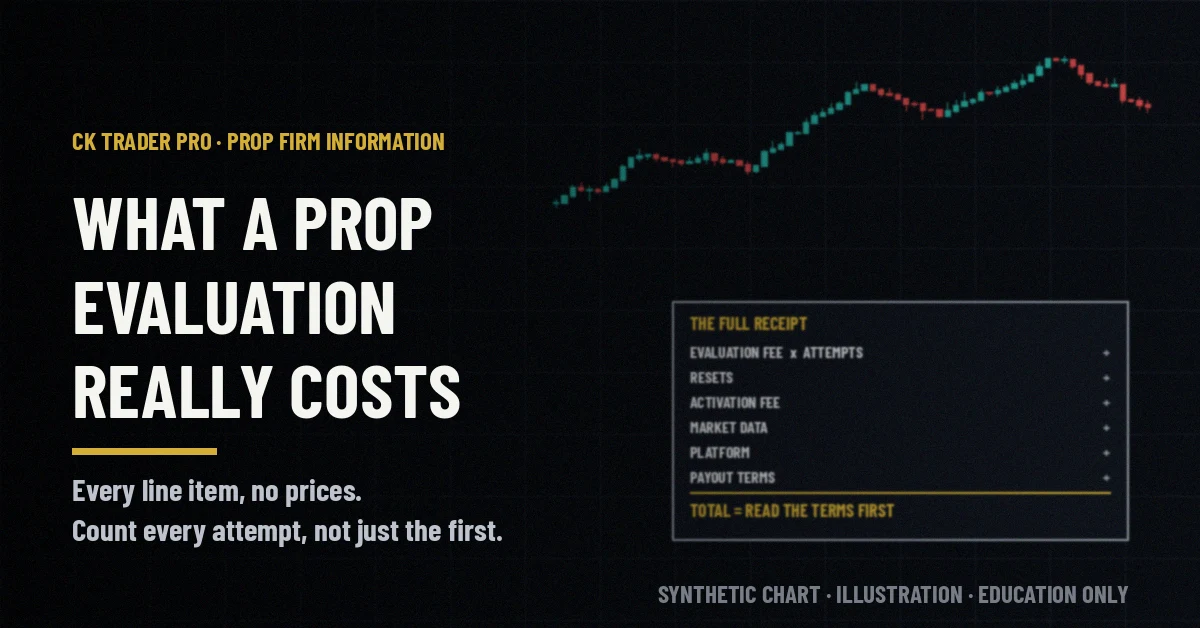
Short answer: The total cost of a prop firm evaluation is more than the number on the sign-up page. Depending on the firm, it can include the evaluation fee (one-time or monthly), resets or retakes, an activation or funded-account fee, exchange market data fees, platform or software fees, and the payout terms you accept if you pass. Multiply the entry cost by the attempts it takes, then add the rest. Firms price these differently and change them often, so read the current terms before you buy.
Education only. Futures trading involves substantial risk of loss. Not financial advice.
Prop-firm evaluations and funded accounts are typically simulated. CK Trader Pro and NQ Live Trading aren’t owned, run or endorsed by any prop firm.
The line item nobody adds up
I’ve been trading futures since 1998, and the cost of an evaluation is often more than the number on the checkout page. That number is the first line on a longer receipt.
The rest shows up later: a reset after a bad day, a second month because the target wasn’t hit, a data fee on the platform, an activation charge after passing. None of it is hidden if you read the terms. It’s just easy not to add it up.
Have you ever noticed this about traders?
How many traders compare evaluations by the entry fee alone, and never ask what happens on attempt two?
How many buy a reset the same afternoon they breach, before they’ve worked out why they breached?
And how many learn about an activation fee or a data fee only after they’ve passed, when it’s too late to compare?
Those aren’t trading problems. They’re reading problems, and the terms can be read before you pay.
The cost components, one by one
Every firm builds its pricing differently, and rules change often. Here are the components to look for. Not every firm charges every one.
1. The evaluation fee
This is the entry price for the simulated account. Some firms charge it once; others bill it monthly until you pass or cancel. That difference matters more than the sticker. A recurring fee keeps running for every month the profit target isn’t reached, so time becomes part of the cost. Some one-time fees come with a fixed access window; if it runs out before you pass, you buy again. New to the format? Start with what a prop firm evaluation is.
2. Resets and retakes
If you breach a rule, like the daily loss limit or the max drawdown, the account usually fails. Some firms sell a reset that restarts the same evaluation, and its price compared with a new evaluation varies by firm. Others sell no resets at all and require a new purchase. Either way, the real question is how many attempts you’re planning for, not just the first one.
In my experience, a reset bought in the same hour as a breach is often a second ticket to the same mistake. Here’s how to recover after a failed prop evaluation before you pay again.
3. Activation or funded-account fees
Some firms charge a one-time activation fee when you move from the evaluation to the funded (still typically simulated) account. Some charge a monthly fee on the funded account instead, and some charge neither. It’s a cost you only meet after passing, so it’s the one people forget to compare. Here’s what changes between evaluation and funded.
4. Market data fees
Real-time futures data is licensed by the exchange. CME Group publishes a market data fee list in which display fees are charged per device and assessed per exchange (source: CME Group Market Data Policy Education Center, fee lists). CME also offers reduced non-professional rates for qualified retail traders (source: CME Group, License Data Products), and its policies set out how those fees apply in simulated trading environments (source: CME Group Information Policies, section 7).
Whether your firm includes data in the evaluation fee or bills it separately varies by firm. Check before you buy, and check whether you’ll be classed as professional or non-professional.
5. Platform and software
Some evaluations include a trading platform. Others ask you to bring or license one. Add any platform, add-on or charting subscription you’ll need for the length of the attempt.
6. Simulated commissions and fees
Many evaluations deduct simulated commissions and fees from your account balance on every trade. That isn’t a charge to your card, but it moves your balance closer to the drawdown floor and further from the target. On NQ every tick counts; use the NQ tick value calculator to see what a tick is worth on NQ and MNQ.
7. Payout terms
If you pass, the payout rules decide what you can actually request: profit splits, minimum balances, minimum trading days, payout caps and request windows. These aren’t a fee you pay up front, but they’re part of what the evaluation “costs” you. Here are the common prop firm payout requirements.
8. Your time
Evaluations run on a clock you might not see on the receipt: practice time, the weeks of a monthly subscription, and the hours spent learning the rules. Rule terms like trailing drawdown and consistency are in our prop firm glossary.
How to add it up
Here’s a simple way to total it before you buy. It’s a template, not a quote, and it uses no firm’s prices:
| Component | Ask the firm | Your number |
|---|---|---|
| Evaluation fee | One-time or monthly? | Fee × expected months or attempts |
| Resets | Price and limits per reset | Reset price × resets you’ll allow yourself |
| Activation / funded fee | Charged after passing? One-time or monthly? | |
| Market data | Included or billed separately? Pro or non-pro? | Per month × months |
| Platform / software | Included or extra? | Per month × months |
| Payout terms | Split, minimums, caps, timing | Read before you pay, not after |
Then add one line to your trading plan: the most you’ll spend on attempts before you stop and review. A written attempt budget can do more for discipline than any reset discount. Before you buy at all, run through this prop firm evaluation checklist.
Here’s the point
The fee isn’t the cost. The attempts are.
What usually drives the total isn’t the first price; it’s the number of times it gets paid. Attempts tend to multiply when the rules aren’t understood, like a trailing drawdown that can rise with open profit or a daily loss limit hit in one fast move. That’s why risk education comes before buying another account. For the rule mechanics, see trailing vs end-of-day drawdown. No stop guarantees a maximum loss: in a fast market an order can fill past the stop price, and a single slipped fill can end an evaluation.
The noise sells the next attempt
Here’s what gets in a lot of traders’ way, and it isn’t them. It’s the noise. Countdown timers, “last chance” banners and screenshots of payouts all point at the next purchase. None of them shows the full receipt.
The CFTC urges people “to be skeptical when promoters… claim that their products and services will earn high profits with minimal risks” (source: CFTC Fraud Advisory). An evaluation isn’t a path to guaranteed income. It’s a paid, simulated test with rules, and it’s worth knowing the whole price of taking it.
CK has affiliate relationships with some prop firms, including Apex Trader Funding and Lucid Trading, and may earn a commission from sign-ups through his links. That doesn’t change what we teach, and it’s one more reason to read every firm’s current terms yourself.
Remember this
Count every attempt, not just the first. Read the terms before the trade.
So here’s my question: if you totaled every evaluation, reset and fee you’ve paid this year, would the number match the one you have in your head?
For the bigger picture, start with our prop firm information hub. And if you’re wondering where we fit: Is CK Trader Pro a prop firm? No. We don’t sell evaluations or funded accounts. We teach the rules and the risk planning behind them.
If you’d like to watch risk planning done in real time, there’s a free live NQ session on weekdays from 9:30 to 10:30 AM ET at nqlivetrading.com/live, run by the same company. Registration is required. Adults 21+. Sessions are education, not signals.
Join the Academy
Learn the rules before you pay for the test. CK Trader Pro is futures and prop firm education: step-by-step lessons, live sessions and risk planning. It’s the CK Trader Pro Membership, which includes:
- Members-only educational lessons on prop-firm rules, drawdown, daily loss limits, position sizing and risk
- War Room: CK’s live pre-market planning session, weekdays 8:30–9:30 AM ET, where the day’s risk and news times get written down before the open
- CK’s chart setup, shown and explained live in every session
- Economic news calendar
Education only. No trade signals or personal advice. No results promised.
Billed monthly until you cancel. See pricing at cktraderpro.com.
FAQ
What’s included in the total cost of a prop firm evaluation?
Depending on the firm: the evaluation fee (one-time or monthly), resets or retakes, an activation or funded-account fee, market data, platform or software, and the payout terms you accept. Not every firm charges every item, and terms change often.
Is a prop firm evaluation fee one-time or monthly?
It depends on the firm. Some charge once per attempt; others bill monthly until you pass or cancel. A monthly fee makes time part of the cost.
What is a prop firm reset?
A reset restarts a failed or struggling evaluation, usually after a rule breach. Some firms sell resets; others require a new purchase. Check the price and any limits first.
Do I pay for market data in a prop firm evaluation?
Some firms include it and some bill it separately. CME Group licenses real-time futures data and offers reduced non-professional rates for qualified retail traders. Check your firm’s terms.
Is CK Trader Pro a prop firm?
No. CK Trader Pro is futures and prop firm education. It doesn’t sell evaluations or funded accounts, and it isn’t owned, run or endorsed by any prop firm.
Trading futures involves substantial risk of loss and is not suitable for everyone. Past performance is not indicative of future results. Education only, not financial advice. This article describes common fee types in general terms; it quotes no firm’s prices and is not a recommendation to buy any evaluation. Fees, rules and terms vary by firm and change often; read each firm’s current terms before you pay. No stop guarantees a maximum loss. Prop-firm evaluations and funded accounts are typically simulated. CK Trader Pro and NQ Live Trading aren’t owned, run or endorsed by any prop firm. See our Risk Disclosure and Disclosures. CK Trader Pro is operated by CK TRADING INSTITUTE OF TECHNOLOGY LLC.
About this article. This is general education from CK Trader Pro. It isn't investment advice, a recommendation to buy or sell, or a trade signal, and it doesn't take your situation into account. Dollar figures and examples are illustrations, not results. Prop-firm rules, costs and payout terms vary by firm and change often; check the firm's current terms before you buy anything. We have paid referral relationships with some prop firms (see Disclosures). We are not owned, run, employed or endorsed by these firms. Mentioning a firm or its evaluations is not a recommendation that you trade. Trading futures involves substantial risk of loss and is not suitable for everyone.