

Prop Firm Scaling Plans and Contract Limits, Explained
Education only, not financial advice. Trading futures involves substantial risk of loss and is not suitable for everyone.
Many traders don't pass prop evaluations, and evaluation fees can be lost entirely. Rules, costs and payout terms vary by firm and change often, so check the firm's current terms.
By CK · Futures trader since 1998
Short answer: A contract limit is the most contracts a prop firm lets you hold at one time. A scaling plan is a schedule some firms use that starts you below that maximum and unlocks more contracts as your account builds a profit buffer. Many firms also count micros against minis at a set ratio. The limit is a ceiling, not a target: your size should still come from your stop and your remaining drawdown.
Education only. Futures trading involves substantial risk of loss. Not financial advice.
Prop-firm evaluations and funded accounts are typically simulated. CK Trader Pro and NQ Live Trading aren’t owned, run or endorsed by any prop firm.
The number on the rule sheet that gets misread
I’ve traded futures since 1998, and if there’s one line on a prop firm rule sheet worth reading twice, it’s the maximum contracts.
Not because it’s complicated. Because it’s so easy to read as permission.
Have you ever noticed this about traders?
How many traders see “max 10 contracts” and quietly decide that 10 is the normal size?
How many add one more contract after a good morning, then find out that a scaling rule hadn’t unlocked it yet?
And how many think about the contract limit and never connect it to the drawdown, which is the number that actually ends the account?
None of those is a strategy problem. They’re rule-reading problems. And a rule, unlike the market, is something you can know in advance.
Here’s the point
A contract limit tells you the most you’re allowed to trade. It doesn’t tell you what you should trade.
The firm sets the ceiling. Your stop, your dollar risk and your remaining drawdown set the size. If those say one MNQ and the rule sheet says ten, the answer is one MNQ.
What a contract limit is
A contract limit (some firms say “max position size”) is the largest total position you can hold at once. It usually applies to every open position together, not to each order. Some firms set one number for the whole account. Others set it by account size, so a larger evaluation allows more contracts.
Going over the limit, even briefly, can be treated as a rule break at some firms. That’s why it belongs on your pre-market checklist next to your daily stop. Check the exact wording on your firm’s current rule sheet: whether the limit counts open orders, what happens if a fill pushes you over, and whether it applies to the evaluation, the funded account or both. If you want the vocabulary first, our prop firm glossary defines these terms in plain English.
What a scaling plan is
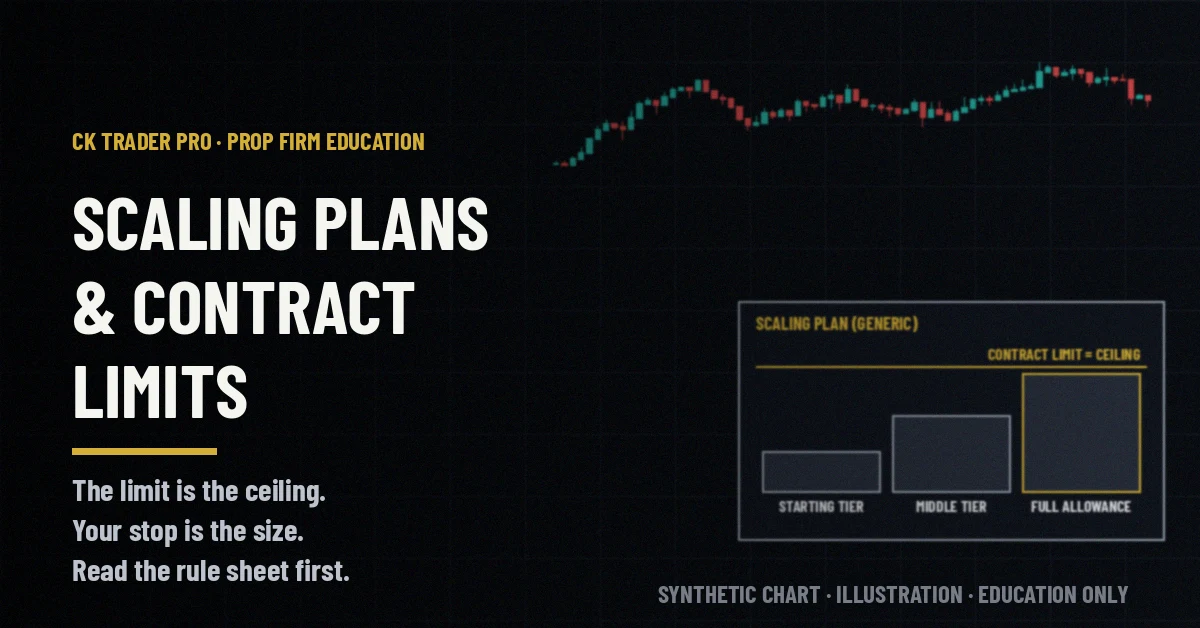
A scaling plan is a step schedule. You start with a smaller contract allowance, and more contracts unlock as the account’s profit buffer grows. If the buffer shrinks, some plans step the allowance back down.
Here’s a generic shape, with no firm’s numbers in it:
| Step | What unlocks it (generic) | Contract allowance |
|---|---|---|
| Starting tier | A new account | Below the account’s maximum |
| Middle tier | Profit buffer reaches the firm’s first milestone | More contracts |
| Full allowance | Profit buffer reaches the firm’s next milestone | The account’s maximum |
Illustration only. Real plans vary by firm and change often; some firms use no scaling plan at all.
Read the details that matter: is the buffer measured on the closed balance or at the end of the day, when does a new tier take effect, and does the plan apply only after you’re funded? Firms answer these differently. Check your firm’s current rules.
Micros and minis: the ratio rule
NQ (E-mini Nasdaq-100) is worth $20 per index point, and MNQ (Micro E-mini Nasdaq-100) is worth $2 per point, so one MNQ is one-tenth the size of one NQ (source: CME Group, E-mini Nasdaq-100 and Micro E-mini Nasdaq-100 contract specifications).
Because of that, many firms count micros against the limit at a ratio, often ten micros for one mini. Some firms instead set a separate micro limit. Don’t assume. Find the line on the rule sheet that tells you how micros count, and use the NQ tick value calculator to see what a tick and a point are worth on each contract.
Why the drawdown matters more than the limit
Here’s where traders get caught. The contract limit is often generous compared with the drawdown.
Illustration only: say an account allows up to 10 MNQ, and you have $1,000 of drawdown left. With a 25-point stop, one MNQ risks 25 × $2 = $50. Ten MNQ risks $500 on one trade, half of the remaining drawdown. The same 25-point stop on one NQ risks $500 too. The limit allows it; the drawdown can’t absorb many of those. No stop guarantees a maximum loss: in a fast market an order can fill past the stop price.
That’s why we size from the stop, not from the ceiling. The formula is contracts = dollar risk ÷ (stop in points × dollars per point), rounded down to a whole contract. See how to size NQ and MNQ trades from your stop, run the numbers in the position sizing calculator, and read prop firm drawdown management to see how the drawdown moves, especially if it trails.
A one-minute contract-limit check
Before the session, write down:
- My account’s maximum contracts today, including any scaling tier I’m on.
- How micros count against that maximum.
- My planned size per trade, from my stop and my dollar risk, not from the maximum.
- My daily stop, set well inside the firm’s daily loss limit. More on that in our daily loss limit strategy.
- Any other rule that ties to size, like a consistency rule. Here’s how prop firm consistency rules work.
If line 3 is ever bigger than line 1, the plan is wrong before the market opens.
The noise wants you to trade the maximum
Here’s what gets in a lot of traders’ way, and it isn’t them. It’s the noise. Screenshots of big size, posts about “maxing out” an account, alerts that say go bigger. None of them shows the drawdown line.
The CFTC urges people “to be skeptical when promoters… claim that their products and services will earn high profits with minimal risks” (source: CFTC Fraud Advisory). A bigger contract allowance isn’t a promise of anything. In my experience, it’s just more room to make the same mistake faster.
CK has affiliate relationships with some prop firms, including Apex Trader Funding and Lucid Trading, and may earn a commission from sign-ups through his links. That doesn’t change what we teach, and it’s one more reason to read every firm’s current rules yourself.
Remember this
The limit is the ceiling. Your stop is the size.
So here’s my question: if you wrote today’s planned size next to your account’s maximum, how much room would be left, and would you keep it?
And if you’re wondering where we fit: Is CK Trader Pro a prop firm? No. We don’t sell evaluations or funded accounts. We teach the rules, the sizing and the risk planning behind them.
If you’d like to see sizing worked out in real time, there’s a free live NQ session on weekdays from 9:30 to 10:30 AM ET at nqlivetrading.com/live, run by the same company. Registration is required. Adults 21+. Sessions are education, not signals.
Join the Academy
Learn the rule sheet before you trade the account. CK Trader Pro is futures and prop firm education: step-by-step lessons, live sessions and risk planning. It’s the CK Trader Pro Membership, which includes:
- Members-only educational lessons on prop-firm rules, drawdown, daily loss limits, position sizing and risk
- War Room: CK’s live pre-market planning session, weekdays 8:30–9:30 AM ET, where the day’s risk and news times get written down before the open
- CK’s chart setup, shown and explained live in every session
- Economic news calendar
Education only. No trade signals or personal advice. No results promised.
Billed monthly until you cancel. See pricing at cktraderpro.com.
FAQ
What is a prop firm scaling plan?
A schedule some prop firms use that starts an account below its maximum contract allowance and unlocks more contracts as the profit buffer grows. Some plans step back down if the buffer shrinks. Rules vary by firm, so check your firm’s current rules.
What is a contract limit at a prop firm?
The largest total position you can hold at one time. It usually applies to all open positions together, and going over it, even briefly, can count as a rule break at some firms.
How do micro contracts count toward a prop firm contract limit?
One MNQ is one-tenth the size of one NQ, so many firms count micros at a ratio, often ten micros for one mini. Some set a separate micro limit. Check how your firm counts them.
Should I trade the maximum number of contracts allowed?
The limit is a ceiling, not a target. Size from your stop, your dollar risk and your remaining drawdown. No stop guarantees a maximum loss.
Is CK Trader Pro a prop firm?
No. CK Trader Pro is futures and prop firm education. It doesn’t sell evaluations or funded accounts, and it isn’t owned, run or endorsed by any prop firm.
Trading futures involves substantial risk of loss and is not suitable for everyone. Past performance is not indicative of future results. Education only, not financial advice. Example numbers are illustrations, not recommendations. No stop guarantees a maximum loss. Prop-firm rules vary by firm and change often; check each firm’s current rules. Prop-firm evaluations and funded accounts are typically simulated. CK Trader Pro and NQ Live Trading aren’t owned, run or endorsed by any prop firm. See our Risk Disclosure and Disclosures. CK Trader Pro is operated by CK TRADING INSTITUTE OF TECHNOLOGY LLC.
About this article. This is general education from CK Trader Pro. It isn't investment advice, a recommendation to buy or sell, or a trade signal, and it doesn't take your situation into account. Dollar figures and examples are illustrations, not results. Prop-firm rules, costs and payout terms vary by firm and change often; check the firm's current terms before you buy anything. We have paid referral relationships with some prop firms (see Disclosures). We are not owned, run, employed or endorsed by these firms. Mentioning a firm or its evaluations is not a recommendation that you trade. Trading futures involves substantial risk of loss and is not suitable for everyone.