

NQ Futures Trading Hours and Quarterly Rollover
Education only, not financial advice. Trading futures involves substantial risk of loss and is not suitable for everyone.
Many traders don't pass prop evaluations, and evaluation fees can be lost entirely. Rules, costs and payout terms vary by firm and change often, so check the firm's current terms.
By CK · Futures trader since 1998
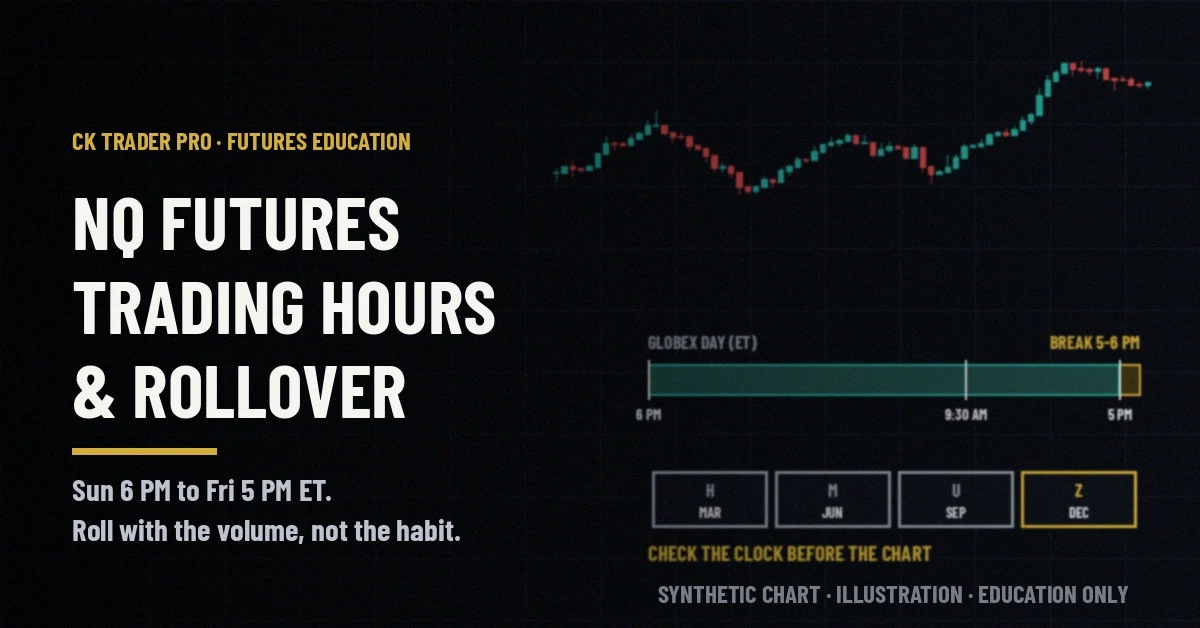
Short answer: NQ (E-mini Nasdaq-100 futures) trades on CME Globex from Sunday 6:00 PM ET to Friday 5:00 PM ET, with a daily break from 5:00 to 6:00 PM ET. Contracts are listed for March, June, September and December (H, M, U, Z). Each stops trading at the scheduled 9:30 AM ET Nasdaq open on its final settlement day, normally the third Friday, and CME’s customary roll date is the Monday before.
Education only. Futures trading involves substantial risk of loss. Not financial advice.
Prop-firm evaluations and funded accounts are typically simulated. CK Trader Pro and NQ Live Trading aren’t owned, run or endorsed by any prop firm.
The clock nobody checks
I’ve been trading futures since 1998, and in my experience the most expensive surprises aren’t about the chart. They’re about the clock.
A position left open into the daily break. An order sitting on a contract that’s about to expire. A chart still pointed at the old month after the volume has moved on. None of that comes from a bad read. It comes from not knowing the schedule.
Have you ever noticed this about traders?
How many traders can tell you their entry setup in detail, but can’t tell you what time the futures market takes its daily break?
How many keep trading the same contract month out of habit, a week after the volume has moved to the next one?
And how many find out about a holiday schedule only when their platform stops filling orders?
Those aren’t strategy problems. They’re calendar problems, and a calendar can be read ahead of time.
NQ futures trading hours, in ET
Here’s the normal weekly schedule for NQ and MNQ on CME Globex. CME’s FAQ for the Micro E-mini contracts lists the trading hours as “Sunday – Friday 6:00 p.m. – 5:00 p.m. ET” (source: CME Group, Micro E-mini Equity Index Futures FAQ). Full contract terms are on CME’s NQ contract specs page.
| When | What happens (ET) |
|---|---|
| Sunday 6:00 PM | Globex opens for the new week |
| Monday–Thursday 5:00 PM | Trading stops for the daily break |
| Monday–Thursday 6:00 PM | Trading resumes; this starts the next trading day |
| Friday 5:00 PM | Market closes for the weekend |
CME’s rulebook for NQ says the start of a trading day “generally shall coincide with the start of the CME Globex trading session at 5:00 p.m.” Chicago time, which is 6:00 PM ET (source: CME Rulebook, Chapter 359). So a trade you place Tuesday at 7:00 PM ET counts toward Wednesday’s trading day.
The daily break, and the old pause that’s gone
The 5:00 to 6:00 PM ET stop is the daily maintenance break. Nothing trades in that window, so either plan for an open position to sit through it or be flat before it.
Some websites, and a few older CME FAQ pages, still list a 4:15 to 4:30 PM ET “trading halt.” CME eliminated that pause for its equity index futures, NQ and MNQ included, effective trade date June 28, 2021. In CME’s filing, the halt “was initially implemented to account for transactions conducted via open outcry in the trading pits and is therefore no longer necessary” (source: CME submission to the CFTC, June 2021; CME notice).
One more afternoon time: CME bases daily settlement for the Micro E-minis on the E-mini’s volume-weighted average price “between 3:59:30 p.m. and 4:00:00 p.m. ET” (source: CME Micro E-mini FAQ). If your prop firm measures daily loss from a settlement or a session close, check which one. Rules vary by firm.
Daylight saving and time zones
CME states that its trading hours “are in U.S. Central Time unless otherwise stated” (source: CME Group Holiday and Trading Hours). Eastern and Central Time switch to and from daylight saving on the same day, so for U.S. traders the ET times above stay the same all year.
Outside the U.S., local times can shift by an hour when your country changes clocks on a different date. U.S. daylight saving ended on Sunday, November 1, 2026: CME’s BrokerTec schedule lists summer time as “Sun, Mar 8, 2026 – Sun, Nov 1, 2026” (source: CME Group Holiday and Trading Hours). Recheck local times each spring and fall.
Holiday hours
For 2026, CME’s Globex calendar lists holiday schedules for Thanksgiving (November 26–28) and Christmas (December 24–26), among others, and notes: “Trading hours are usually finalized approximately two weeks prior to the holiday” (source: CME Group Holiday and Trading Hours).
In my experience, the safest habit is checking CME’s holiday page the week before any U.S. holiday, not the morning of.
Contract months: H, M, U, Z
NQ is a series of contracts, each tied to an expiration month. Since March 2026, CME lists NQ quarterly contracts (Mar, Jun, Sep, Dec) “for 6 consecutive quarters, 2 additional June contracts and 4 additional December contract months” (source: CME Globex Notice, March 2, 2026). CME’s Micro E-mini FAQ lists MNQ for “five months in the March Quarterly Cycle (Mar, Jun, Sep, Dec)” (source: CME Micro E-mini FAQ). CME’s month codes are H for March, M for June, U for September and Z for December (source: CME Group, Contract Month Codes).
So NQZ6 is the December 2026 contract and NQH7 is March 2027. Letter for the month, digit for the year (some platforms show NQZ26). New to the terms? Our futures trading glossary covers contract month and rollover in plain English.
When NQ expires
CME’s rulebook says an expiring NQ contract stops trading “at the regularly scheduled start of trading on the Nasdaq Stock Market” on final settlement day. Final settlement is a special opening quotation of the Nasdaq-100 on the third Friday of the contract month, or the business day before if the index isn’t published that Friday (source: CME Rulebook, Chapter 359). On a normal day, that start is 9:30 AM ET (source: Nasdaq trading hours).
NQ is cash-settled, so nothing is delivered. And it isn’t always a Friday. In June 2026, CME’s calendar shows U.S. index expiration on 6/18, a Thursday, because Friday, June 19 was the Juneteenth market holiday (sources: CME Equity Index Roll Dates; Nasdaq holiday schedule).
The quarterly rollover
CME explains that traders “determine when they need to move to the new contract by watching volume of both the expiring contract and next month contract” (source: CME Group, Understanding Futures Expiration & Contract Roll). For equity index futures, CME’s customary roll date “is the Monday prior to the third Friday of the expiration month,” and after it, the next contract is customarily treated as the lead month (source: CME Equity Index Roll Dates).
Here are CME’s published U.S. index dates for the next five quarters:
| Contract | CME customary roll date | Expiration |
|---|---|---|
| December 2026 (Z6) | Mon, Dec 14, 2026 | Fri, Dec 18, 2026 |
| March 2027 (H7) | Mon, Mar 15, 2027 | Fri, Mar 19, 2027 |
| June 2027 (M7) | Mon, Jun 14, 2027 | Fri, Jun 18, 2027 |
| September 2027 (U7) | Mon, Sep 13, 2027 | Fri, Sep 17, 2027 |
| December 2027 (Z7) | Mon, Dec 13, 2027 | Fri, Dec 17, 2027 |
Source: CME Group, Equity Index Roll Dates, as of November 1, 2026. Dates can change, so check CME before each roll.
In my experience, a simple roll-week checklist covers it:
- Switch your chart to the new month around the roll date, and know how your platform builds continuous charts.
- Move working orders. An order on the old month won’t follow you.
- Recheck your levels. The two months usually trade at different prices.
- Check your prop firm’s rules on which months you can trade. Rules vary by firm and change often.
Here’s the point
The market has a schedule. Your plan should too.
Hours, breaks, holidays and roll weeks are all published ahead of time. In my experience, writing them into your plan removes a whole category of mistakes. For the morning itself, see how to plan the NQ open; for contract count, how to size NQ and MNQ trades from your stop. No stop guarantees a maximum loss: in a fast market an order can fill past the stop price.
The noise ignores the calendar
Here’s what gets in a lot of traders’ way, and it isn’t them. It’s the noise. It shows the big move at 9:30 and never mentions the 5:00 break, the holiday schedule or roll week.
The CFTC urges people “to be skeptical when promoters… claim that their products and services will earn high profits with minimal risks” (source: CFTC Fraud Advisory). Knowing the schedule won’t make anyone profitable. It just removes surprises you never needed.
CK has affiliate relationships with some prop firms, including Apex Trader Funding and Lucid Trading, and may earn a commission from sign-ups through his links. That doesn’t change what we teach.
Remember this
Check the clock before the chart. Roll with the volume, not the habit.
So here’s my question: without looking it up, which NQ contract month are you trading today, and when does its roll week start?
For tick size and point value, read NQ futures contract specs. For the bigger picture, start with futures trading education.
If you’d like to watch the schedule used in real time, there’s a free live NQ session on weekdays from 9:30 to 10:30 AM ET at nqlivetrading.com/live, run by the same company. Registration is required. Adults 21+. Sessions are education, not signals.
Join the Academy
Know the schedule before you trade it. CK Trader Pro is futures and prop firm education: step-by-step lessons, live sessions and risk planning. It’s the CK Trader Pro Membership, which includes:
- Members-only educational lessons on contract specs, the trading calendar, prop-firm rules, risk and charting
- War Room: CK’s live pre-market planning session, weekdays 8:30–9:30 AM ET, where the day’s risk and news times get written down before the open
- CK’s chart setup, shown and explained live in every session
- Economic news calendar
Education only. No trade signals or personal advice. No results promised.
Billed monthly until you cancel. See pricing at cktraderpro.com.
FAQ
What are NQ futures trading hours?
CME Globex, Sunday 6:00 PM ET to Friday 5:00 PM ET, with a daily break from 5:00 to 6:00 PM ET. Holiday hours can differ, so check CME’s calendar.
Is there still a 4:15 PM ET trading halt on NQ?
No. CME eliminated the 4:15 to 4:30 PM ET pause for equity index futures, including NQ and MNQ, effective June 28, 2021. The daily break is 5:00 to 6:00 PM ET.
Do NQ hours change with daylight saving time?
CME sets hours in U.S. Central Time, and Eastern and Central change on the same day, so ET times stay the same for U.S. traders. Local times outside the U.S. may shift by an hour for part of the year.
What are the NQ contract months?
March, June, September and December, coded H, M, U and Z. NQZ6 is December 2026 and NQH7 is March 2027.
When should I roll NQ to the next contract?
CME’s customary roll date for equity index futures is the Monday before the third Friday of the expiration month. CME notes traders watch volume in both months to decide when to move.
Trading futures involves substantial risk of loss and is not suitable for everyone. Past performance is not indicative of future results. Education only, not financial advice. All numbers in this article are illustrations or published exchange schedules, not results or recommendations. Exchange hours and dates can change; check CME Group before you trade. No stop guarantees a maximum loss. Prop-firm evaluations and funded accounts are typically simulated. Rules vary by firm and change often. CK Trader Pro and NQ Live Trading aren’t owned, run or endorsed by any prop firm. See our Risk Disclosure and Disclosures. CK Trader Pro is operated by CK TRADING INSTITUTE OF TECHNOLOGY LLC.
About this article. This is general education from CK Trader Pro. It isn't investment advice, a recommendation to buy or sell, or a trade signal, and it doesn't take your situation into account. Dollar figures and examples are illustrations, not results. Prop-firm rules, costs and payout terms vary by firm and change often; check the firm's current terms before you buy anything. We have paid referral relationships with some prop firms (see Disclosures). We are not owned, run, employed or endorsed by these firms. Mentioning a firm or its evaluations is not a recommendation that you trade. Trading futures involves substantial risk of loss and is not suitable for everyone.