

Prop Firm News Trading Rules, Explained
Education only, not financial advice. Trading futures involves substantial risk of loss and is not suitable for everyone.
Many traders don't pass prop evaluations, and evaluation fees can be lost entirely. Rules, costs and payout terms vary by firm and change often, so check the firm's current terms.
By CK · Futures trader since 1998
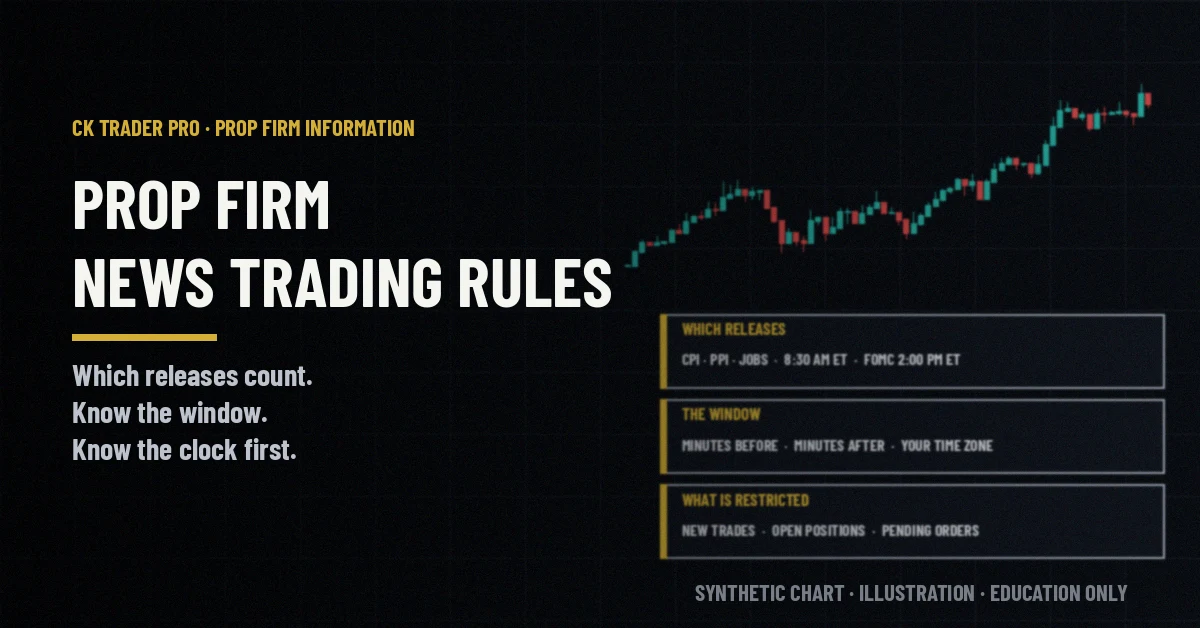
Short answer: Some prop firms restrict trading around major scheduled economic news, and some don’t. Where a rule exists, it usually comes down to four questions: which releases count, how many minutes before and after the release the window covers, whether it applies to opening new trades, holding open ones, or both, and what happens if you break it. The answers differ by firm and by account stage, and they change. Read your firm’s current rule word for word before a news day, not during one.
Education only. Futures trading involves substantial risk of loss. Not financial advice.
Some retail futures prop programs use simulated evaluations and simulated funded accounts; some also offer a separate live-funded stage. Verify your specific account type. CK Trader Pro and NQ Live Trading aren’t owned, run or endorsed by any prop firm.
The rule nobody reads until it’s too late
I’ve been trading futures since 1998, and the scheduled news calendar has been part of my morning the whole time. I check the release times before I check a chart. That habit came from watching the market move faster in a few seconds after a number came out than it had all morning.
Prop firm news rules exist because of those seconds. A firm’s rulebook is written with them in mind, even when the trader’s plan isn’t. If you trade NQ under a prop firm’s rules, the news section of that rulebook deserves the same attention you give the drawdown section.
Have you ever noticed this about traders?
How many traders can recite their daily loss limit, but couldn’t tell you if their firm has a news rule at all?
How many find out what the news window is by reading an email after the fact?
And how many have a perfectly good plan for the trade, but no plan for 8:29 AM?
None of that is about skill. It’s about where attention goes. Entries are exciting. Rulebooks aren’t. But the rulebook decides which trades count.
Here’s the point
A news rule is a timing rule. Treat it like one.
You don’t need to predict the number. You need to know the clock: when the release is, whether your firm restricts that window, and where you’ll be (in or flat) when it hits. Decide that before the session, write it down, and the rule stops being a surprise.
Why news minutes are different
A handful of scheduled U.S. releases tend to move index futures like NQ:
- 8:30 AM ET: the Consumer Price Index (CPI), the Producer Price Index (PPI) and the monthly jobs report from the Bureau of Labor Statistics (source: BLS release schedule). Release dates can shift, so check the schedule each week.
- 2:00 PM ET on FOMC decision days: the Federal Open Market Committee policy statement (source: Federal Reserve FOMC calendar).
In my experience, the minutes around releases like these are when spreads can widen, the order book can thin out and price can jump past levels instead of trading through them. That’s the part that matters for a prop account: a stop is an instruction, not a promise. No stop guarantees a maximum loss; in a fast market, an order can fill past the stop price. On a rule set with a hard loss limit, a few points of slippage can be the difference between a rough trade and a rule break.
Illustration only: NQ is $20 per point and MNQ is $2 per point (source: CME Group E-mini Nasdaq-100 and Micro E-mini Nasdaq-100 contract specifications). Say a stop fills 10 points worse than planned during a release. On 1 MNQ that’s another $20 before commissions and fees. On 1 NQ it’s another $200. Run your own numbers with the NQ tick value calculator. Slippage can be larger than any number you plan for.
How prop firm news rules are usually built
Not every firm has a news rule, and the ones that do don’t all write it the same way. When I read one, I look for four parts.
1. Which releases count. Some rules name specific reports. Some refer to a category, like “tier-1” or “high-impact” news, and point to a calendar the firm uses. If the rule references a calendar, find out which one, because two calendars don’t always rate the same release the same way.
2. The time window. A rule may cover a set number of minutes before and after the release. Write down the exact window for each release on your day’s list, in your time zone.
3. What’s restricted. This is the part traders skim. A rule might restrict opening new positions in the window, holding a position through the release, or both. Some rules treat pending orders that could fill in the window as trades. Read it slowly.
4. The consequence and the stage. A breach might mean a violation on the account, the trades in the window not counting, or a loss of eligibility for something later. The rule can also be different in an evaluation than in a funded or live stage. Check which stage you’re in and read that stage’s version.
If any of the four is unclear, ask the firm’s support in writing and keep the answer. Don’t rely on what someone in a chat room remembers.
A pre-news checklist you can copy
Fill this in before the open on any day with scheduled news:
- Today’s releases and times, from the official schedule.
- My firm’s rule for each: restricted or not, and the exact window.
- My position at release time: flat, or the specific reason I’m allowed to hold.
- Pending orders: cancelled before the window, or confirmed allowed.
- Size if I trade after the window: sized from the stop, with extra points allowed for slippage. See how to size NQ and MNQ trades from your stop.
- Distance to my loss limits at the start of the day. See prop firm drawdown management and daily loss limit strategy.
Put it at the top of your day trading journal template so it gets filled in every time, not just on the days you remember.
How news rules fit with the rest of the rulebook
News rules rarely live alone. A fast release can touch your drawdown, your daily limit and, at some firms, a consistency rule if one big news day dominates your results. Contract limits matter too: some plans cap size in ways that interact with how you’d want to trade a release. See prop firm scaling plans and contract limits. And when you add up what an evaluation really costs, including resets after a rule break, read what a prop firm evaluation costs in total.
For the trading side of news days (what tends to happen at the open and how to plan it), see the 9:30 open and news plan for NQ. For an FOMC afternoon specifically, there’s a walkthrough of trading NQ on FOMC day on our sister site.
And if you’ve wondered where we fit: Is CK Trader Pro a prop firm? No. We teach futures and prop firm education. We don’t sell evaluations or funded accounts.
CK has affiliate relationships with some prop firms, including Apex Trader Funding and Lucid Trading, and may earn a commission from sign-ups through his links. Whichever firm you trade with, its current written rules are the only version that counts. Understanding a news rule doesn’t promise you’ll pass anything. It removes one way to break a rule you didn’t know you had.
The noise talks about the move. Nobody talks about the rule.
Here’s what gets in a trader’s way, and it isn’t the trader. It’s the noise. Feeds replay the big candle after CPI and the trade that caught it. They don’t show the account that was flagged because the trade opened two minutes inside a window. When the clip is all you see, it’s easy to think news days are about catching the move, when the first job is knowing whether you’re allowed to be there.
Remember this
Know the clock before you know the trade.
So here’s my question: if your next session had an 8:30 release, could you write down, right now, your firm’s exact window and what it restricts, or would you be guessing?
If you’d like to watch news times get written into a plan before the open, there’s a free live NQ session on weekdays from 9:30 to 10:30 AM ET at nqlivetrading.com/live, run by the same company. Registration is required. Adults 21+. Sessions are education, not signals.
Join the Academy
Learn the rules before the rules learn you. CK Trader Pro is futures and prop firm education: step-by-step lessons, live sessions and risk planning. It’s the CK Trader Pro Membership, which includes:
- Members-only educational lessons on prop-firm rules, drawdown, daily loss limits, position sizing and risk
- War Room: CK’s live pre-market planning session, weekdays 8:30–9:30 AM ET, where the day’s risk and news times get written down before the open
- CK’s chart setup, shown and explained live in every session
- Economic news calendar
Education only. No trade signals or personal advice. No results promised.
Billed monthly until you cancel. See pricing at cktraderpro.com.
FAQ
Do all prop firms have news trading rules?
No. Some prop firms restrict trading around major scheduled news and some don’t, and a firm’s rule can differ between the evaluation and a funded or live stage. Check your firm’s current written rules for your account type.
What counts as news under a prop firm news rule?
It depends on the firm. Some rules name specific releases; others refer to “tier-1” or “high-impact” news on a calendar the firm uses. Releases that often move NQ include CPI, PPI and the jobs report at 8:30 AM ET and the FOMC statement at 2:00 PM ET on decision days.
Can I hold a trade through news on a prop firm account?
Only if your firm’s rule allows it. Some rules restrict opening new trades in the window, some restrict holding positions through the release, and some restrict both. Read the exact wording and ask support in writing if it’s unclear.
What happens if I break a prop firm news rule?
It varies by firm and stage. A breach might mean a violation on the account, trades in the window not counting, or losing eligibility for something later. Your firm’s current written rules are the only version that counts.
Why do prop firms restrict news trading?
In my experience, the minutes around major releases are when spreads can widen and price can jump past stops. No stop guarantees a maximum loss; in a fast market, an order can fill past the stop price.
Is CK Trader Pro a prop firm?
No. CK Trader Pro is futures and prop firm education. It doesn’t sell evaluations or funded accounts, and it isn’t owned, run or endorsed by any prop firm.
Trading futures involves substantial risk of loss and is not suitable for everyone. Past performance is not indicative of future results. Education only, not financial advice. Example numbers are illustrations, not recommendations. No stop guarantees a maximum loss. Prop-firm rules vary by firm and change often; check each firm’s current rules. Some retail futures prop programs use simulated evaluations and simulated funded accounts; some also offer a separate live-funded stage. Verify your specific account type. CK Trader Pro and NQ Live Trading aren’t owned, run or endorsed by any prop firm. See our Risk Disclosure and Disclosures. CK Trader Pro is operated by CK TRADING INSTITUTE OF TECHNOLOGY LLC.
About this article. This is general education from CK Trader Pro. It isn't investment advice, a recommendation to buy or sell, or a trade signal, and it doesn't take your situation into account. Dollar figures and examples are illustrations, not results. Prop-firm rules, costs and payout terms vary by firm and change often; check the firm's current terms before you buy anything. We have paid referral relationships with some prop firms (see Disclosures). We are not owned, run, employed or endorsed by these firms. Mentioning a firm or its evaluations is not a recommendation that you trade. Trading futures involves substantial risk of loss and is not suitable for everyone.