

Day Trading Journal Template: The Fields That Matter
Education only, not financial advice. Trading futures involves substantial risk of loss and is not suitable for everyone.
Many traders don't pass prop evaluations, and evaluation fees can be lost entirely. Rules, costs and payout terms vary by firm and change often, so check the firm's current terms.
By CK · Futures trader since 1998
Short answer: A useful day trading journal template has a few fields, filled in the same way every day: the plan you wrote before the open, the planned stop and the dollars it represents, your size, the fill you actually got, why you exited, whether you followed your rules, and one lesson. Results matter less than the rule check. The journal’s job isn’t to prove you’re good. It’s to show you, in writing, where you break your own plan.
Education only. Futures trading involves substantial risk of loss. Not financial advice.
Some retail futures prop programs use simulated evaluations and simulated funded accounts; some also offer a separate live-funded stage. Verify your specific account type. CK Trader Pro and NQ Live Trading aren’t owned, run or endorsed by any prop firm.
I didn’t journal for the right reasons at first
I’ve been trading futures since 1998. For a long stretch, the only thing I wrote down was the result. Up or down, a number, done. That page told me how the day felt. It never told me why.
What changed my process wasn’t a better entry. It was a page with the same boxes on it every day, filled in whether the day was good or ugly. The boxes that mattered weren’t about profit. They were about whether I did what I said I’d do before the open.
If you want the case for journaling at all, start with how to journal futures trades and build discipline. This page is the template itself: the fields, what each one is for, and how to review it.
Have you ever noticed this about traders?
How many traders keep a journal that’s only a list of wins and losses?
How many stop writing it the week it starts to look bad, which is the week it would have helped the most?
And how many could tell you, from their own notes, which rule they broke most often last month?
None of that is about talent. It’s about what goes on the page. A journal full of results reads like a scoreboard. A journal full of decisions reads like a coach.
Here’s the point
Journal the decision, not just the result.
A losing trade where you followed your plan can be a good entry in your journal. A winning trade where you moved your stop is a warning, even if the account went up. If your template can’t tell those two apart, it’s measuring the wrong thing.
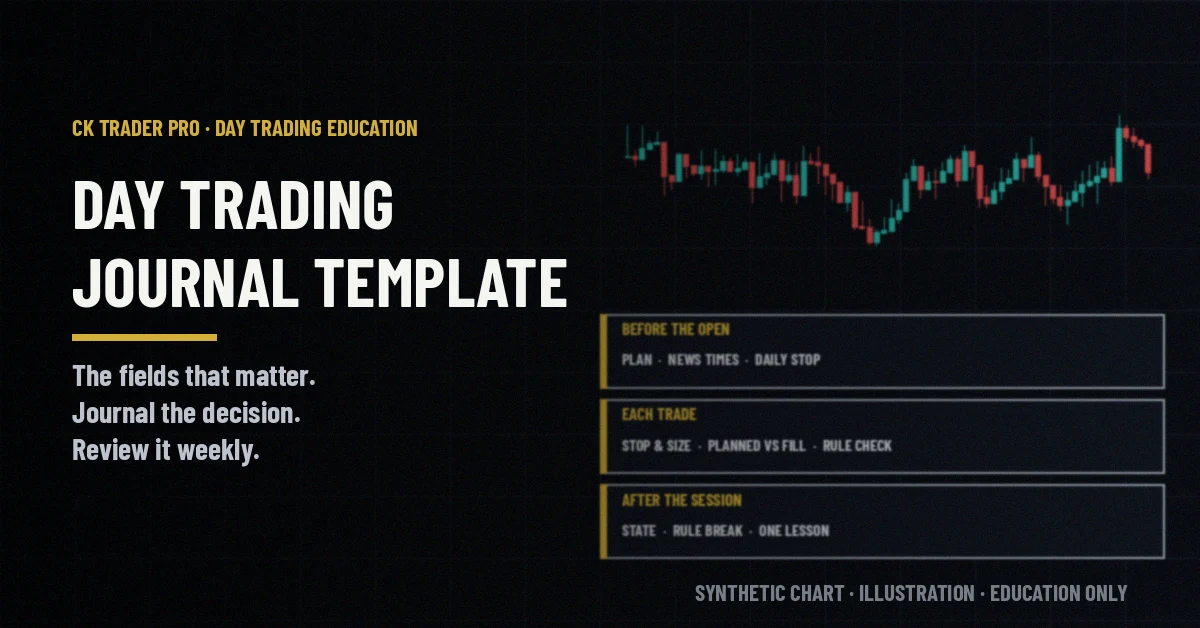
The day trading journal template
Copy this into a notebook, a spreadsheet or a note on your phone. Keep the order the same every day so you can compare weeks later.
Before the open (fill this in before you place any order)
- Date and session. For example, the New York morning session.
- Contract. NQ, MNQ or whatever you trade. Write its dollars per point next to it. NQ is $20 per point and MNQ is $2 per point (source: CME Group E-mini Nasdaq-100 and Micro E-mini Nasdaq-100 contract specifications). Check it any time with the NQ tick value calculator.
- Scheduled news times. Write the times down, and whether you’ll be flat through them.
- Key levels from your pre-market work. Two or three, not ten. See pre-market futures analysis.
- Daily stop in dollars. The number that ends your day. If you trade a prop evaluation, write the firm’s daily and drawdown limits next to yours, and keep yours tighter. See daily loss limit strategy.
- Max trades for the day. A number you decided while calm.
For each trade
- Setup name. One you’ve defined in writing before today.
- Why now. One sentence. If you can’t write it, that’s information.
- Planned stop in points and in dollars. Points × dollars per point × contracts.
- Size. Contracts = dollars you’re willing to risk ÷ (stop in points × dollars per point), rounded down to whole contracts. If the result is less than 1, the trade doesn’t fit your risk at that stop. Don’t round up to one. See how to size NQ and MNQ trades from your stop.
- Planned price vs actual fill. Entry and exit. The gap between them is your slippage, and it belongs on the page.
- Exit reason. Target, stop, time, or “I got nervous.” Be honest; nobody else reads it.
- Result after commissions and fees. Points and dollars. Write it, then move on to the field that matters more.
- Rule check: yes or no. Did you follow every rule you wrote before the open on this trade? If no, write which one.
After the session
- State. One word before the open and one word after. Tired, rushed, calm, frustrated.
- Biggest rule break of the day, if any.
- One lesson, one sentence. Something you’ll do the same or differently tomorrow.
Illustration only: say your plan has a 25-point stop on 1 MNQ. That represents $50 before commissions, fees and slippage (25 × $2). On 1 NQ, the same 25 points represents $500. If the fill comes in 3 points past your stop, write that down too: on 1 MNQ that’s another $6 before costs. No stop guarantees a maximum loss: in a fast market, an order can fill past the stop price. That’s exactly why the planned-vs-actual field exists.
The weekly review: where the journal pays off
A journal you never read back is just a diary. Once a week, take fifteen minutes and answer four questions from your own entries:
- Which rule did I break most often? Count the “no” answers in field 14 and group them by rule.
- When did the breaks happen? First minutes of the open, after a loss, near a news time, or after hitting a target?
- How did my planned stops compare with my actual fills? If slippage keeps showing up in the same window, that’s a timing question, not a courage question.
- What’s the one change for next week? One. Not five.
In my experience, this is where many traders find their real problem, and it’s rarely the setup. It’s the second trade after a loss, the stop that got moved, or the trade that was taken because the room was busy. The why traders fail prop evaluations breakdown and why traders revenge trade cover those patterns in more detail.
Where the journal fits in your day
The template is the bookend of a routine. The “before the open” fields come out of your pre-market plan. The “after the session” fields are your review. If you want the whole day laid out from pre-market to post-session, read building a day trading routine, and for the bigger picture of what to learn first, see day trading education.
And if you’ve wondered where we fit: Is CK Trader Pro a prop firm? No. We teach futures and prop firm education. We don’t sell evaluations or funded accounts.
CK has affiliate relationships with some prop firms, including Apex Trader Funding and Lucid Trading, and may earn a commission from sign-ups through his links. Whichever firm’s rules you trade under, put their limits in your journal in your own words. A journal doesn’t promise you’ll pass anything. It shows you whether you’re trading the plan you wrote.
The noise rewards the screenshot. The journal rewards the process.
Here’s what gets in a trader’s way, and it isn’t the trader. It’s the noise. Feeds show the best trade of someone’s week, never the page where they wrote down the rule they broke. That makes it easy to believe the answer is a new setup, when the answer may already be sitting in your own notes.
Remember this
If it isn’t written down, you can’t review it.
So here’s my question: if someone handed you your last ten trades with only the rule-check column filled in, would you be proud of that column, or would you want to start a new page tomorrow?
If you’d like to watch a written process being followed in real time, there’s a free live NQ session on weekdays from 9:30 to 10:30 AM ET at nqlivetrading.com/live, run by the same company. Registration is required. Adults 21+. Sessions are education, not signals.
Join the Academy
Write the plan, follow it, review it, and keep going. CK Trader Pro is futures and prop firm education: step-by-step lessons, live sessions and risk planning. It’s the CK Trader Pro Membership, which includes:
- Members-only educational lessons on prop-firm rules, drawdown, daily loss limits, position sizing and risk
- War Room: CK’s live pre-market planning session, weekdays 8:30–9:30 AM ET, where the day’s risk and news times get written down before the open
- CK’s chart setup, shown and explained live in every session
- Economic news calendar
Education only. No trade signals or personal advice. No results promised.
Billed monthly until you cancel. See pricing at cktraderpro.com.
FAQ
What should a day trading journal template include?
A few fields, filled in the same way every day: your pre-market plan, scheduled news times, your daily stop in dollars, and max trades. For each trade, the setup, why you took it, the planned stop in points and dollars, size, planned price versus actual fill, exit reason, result after commissions and fees, and a yes-or-no rule check. After the session, your state, your biggest rule break and one lesson.
What is the most important field in a trading journal?
In my experience, the rule check: did you follow every rule you wrote before the open, yes or no, and if not, which one? Results swing day to day. A pattern of the same rule break shows you what to work on.
Should I journal losing trades differently from winning trades?
No. Use the same fields for every trade. A loss where you followed your plan can be a good entry; a win where you moved your stop is a warning. The journal should tell those two apart.
How do I record slippage in my trading journal?
Write the planned price and the actual fill for both entry and exit. For example, a fill 3 points past a stop on 1 MNQ is another $6 before costs, since MNQ is $2 per point (illustration only). No stop guarantees a maximum loss; in a fast market, an order can fill past the stop price.
How often should I review my trading journal?
Daily for one lesson, and weekly for patterns: which rule you broke most, when the breaks happened, how fills compared with plans, and one change for next week.
Is CK Trader Pro a prop firm?
No. CK Trader Pro is futures and prop firm education. It doesn’t sell evaluations or funded accounts, and it isn’t owned, run or endorsed by any prop firm.
Trading futures involves substantial risk of loss and is not suitable for everyone. Past performance is not indicative of future results. Education only, not financial advice. Example numbers are illustrations, not recommendations. No stop guarantees a maximum loss. Prop-firm rules vary by firm and change often; check each firm’s current rules. Some retail futures prop programs use simulated evaluations and simulated funded accounts; some also offer a separate live-funded stage. Verify your specific account type. CK Trader Pro and NQ Live Trading aren’t owned, run or endorsed by any prop firm. See our Risk Disclosure and Disclosures. CK Trader Pro is operated by CK TRADING INSTITUTE OF TECHNOLOGY LLC.
About this article. This is general education from CK Trader Pro. It isn't investment advice, a recommendation to buy or sell, or a trade signal, and it doesn't take your situation into account. Dollar figures and examples are illustrations, not results. Prop-firm rules, costs and payout terms vary by firm and change often; check the firm's current terms before you buy anything. We have paid referral relationships with some prop firms (see Disclosures). We are not owned, run, employed or endorsed by these firms. Mentioning a firm or its evaluations is not a recommendation that you trade. Trading futures involves substantial risk of loss and is not suitable for everyone.