

Building a Day Trading Routine: Pre-Market to Post-Session
Education only, not financial advice. Trading futures involves substantial risk of loss and is not suitable for everyone.
Many traders don't pass prop evaluations, and evaluation fees can be lost entirely. Rules, costs and payout terms vary by firm and change often, so check the firm's current terms.
By CK · Futures trader since 1998
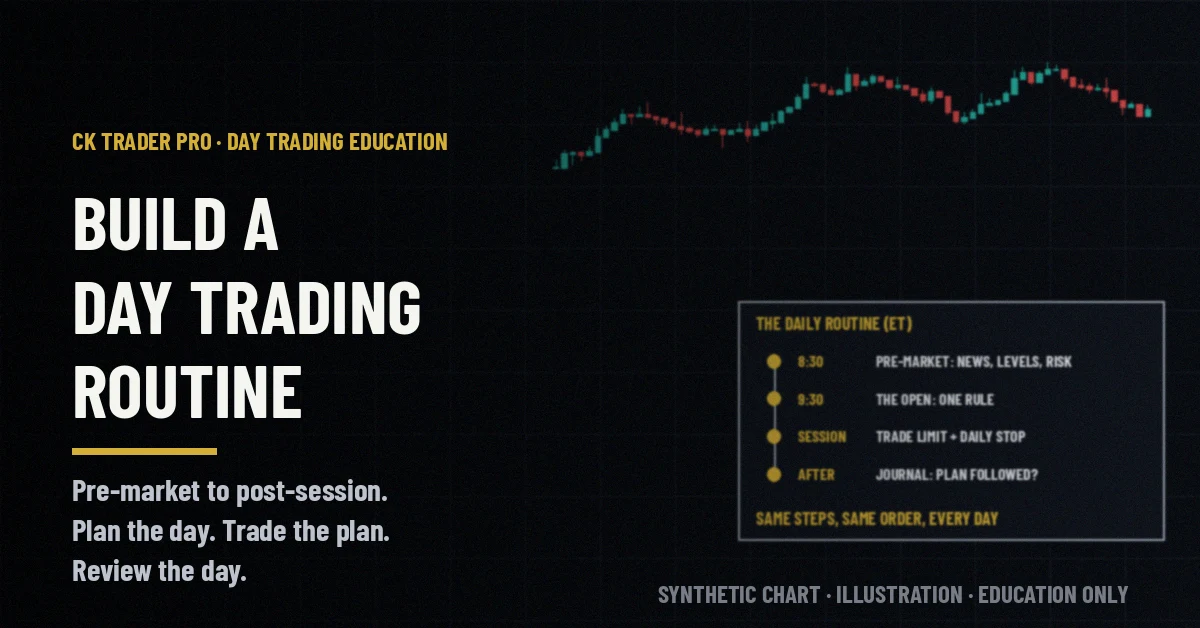
Short answer: A day trading routine for beginners has four parts, done in the same order every day: prepare before the open (news times, key levels, your risk per trade and your daily stop, written down), follow one rule for the open, manage the session with stopping rules you set in advance, and review after the session in a journal that asks whether you followed the plan. The routine doesn’t predict the market. It decides how you’ll behave in it.
Education only. Futures trading involves substantial risk of loss. Not financial advice.
Prop-firm evaluations and funded accounts are typically simulated. CK Trader Pro and NQ Live Trading aren’t owned, run or endorsed by any prop firm.
My trading day starts before the bell
I’ve been trading futures since 1998, and the decisions are on paper before the 9:30 ET open: what news is out, where the levels are, how much I’ll risk, and when I’m done for the day.
That prep isn’t the exciting part. But it can shape how the rest of the day goes.
Have you ever noticed this about traders?
How many traders spend hours looking for a better setup, and no time at all deciding when they’ll stop for the day?
How many open the platform a minute before the open and find out about the 8:30 news from the candles?
And how many close the platform after a rough morning and never look at what happened, so the same morning happens again next week?
None of those is a strategy problem. They’re routine problems. And a routine, unlike the market, is something you control.
Here’s the point
The routine isn’t extra work around the trading. It is the work.
A setup tells you where you might act. A routine tells you whether you’re ready to act at all, how big, and when to walk away. If you’re new, build the routine first and keep the trading simple. The day trading education checklist covers what to learn; this page is about putting it in order, every day.
The routine, phase by phase
Times below are Eastern and assume you trade around the U.S. stock market’s 9:30 AM to 4:00 PM core session (source: NYSE, Holidays and Trading Hours). Nasdaq-100 futures trade nearly around the clock on CME Globex, so a day trader has to pick a window on purpose.
Phase 1: Pre-market (about an hour before the open)
Answer the same questions every morning, in writing:
- What news is out today, and when? Many U.S. reports, like the Consumer Price Index, are released at 8:30 AM ET (source: BLS, CPI release schedule). FOMC meeting dates are set in advance (source: Federal Reserve, FOMC calendar). Know them before you sit down.
- Where are the reference levels? The overnight high and low, and yesterday’s high and low. Our guide to pre-market futures analysis goes deeper.
- Is the market calm or wild lately? A stop that fits a quiet week may be too tight in a fast one. Look at the recent range before you set a stop.
- What’s my dollar risk per trade, and my daily stop? Size from the stop, not from how sure you feel. On NQ, every point is worth real money; use the NQ tick value calculator to see what a tick and a point are worth on NQ and MNQ, and see how to size NQ and MNQ trades from your stop.
- What am I looking for, and what am I skipping? One or two setups, written in plain words. Everything else is a pass.
Illustration only: if your risk for one trade is $250 and your stop is 25 points on MNQ ($2 per point), that’s 250 ÷ (25 × 2) = 5 MNQ. The same trade on NQ ($20 per point) works out to half a contract, which isn’t possible, so the plan uses MNQ (contract values: CME Group E-mini Nasdaq-100 and Micro E-mini Nasdaq-100 specifications). No stop guarantees a maximum loss: in a fast market an order can fill past the stop price.
Phase 2: The open (9:30 ET)
The cash open often brings a burst of volume and fast two-way moves, and spreads and slippage can widen. So the routine needs one rule for the open, chosen before 9:30:
- Wait for the first minutes to settle, or
- Let an opening range form and act only on a break or a test of it, or
- Sit out the open entirely.
Any of those can be a choice. Improvising isn’t. For one structured approach, read how to trade the opening range, and for a full open plan, see how to plan the NQ open.
Phase 3: The session
This is where routines usually break, because nothing tells you to stop. Decide in advance:
- A trade limit: the maximum number of trades for today.
- A daily stop: a dollar loss or a number of losing trades, and when you hit it, you’re done.
- A time window: when your trading day ends, even if nothing happened.
If you trade a prop firm evaluation, the firm may have its own daily loss limit. Your personal daily stop should sit well inside it, not on top of it. Rules vary by firm and change often, so check your firm’s current rules. Here’s more on when traders should stop trading.
Phase 4: Post-session review (15 minutes)
When the session ends, close the charts and open the journal. Don’t score the day by profit or loss. Score it by process:
- Did I follow my opening rule?
- Did I size every trade from my stop?
- Did I stop when my rules said stop?
- What’s one thing I’ll do the same tomorrow, and one thing I’ll change?
In my experience, rule breaks show up in the journal before they show up in the account. Start with how to journal futures trades.
Once a week, read the week’s entries in one sitting. Look for the pattern, not the single bad trade, and change one thing at a time. If you’re still practicing in simulation, here’s how to practice with purpose.
A one-page routine you can copy
| Phase | When (ET) | What you write down |
|---|---|---|
| Pre-market | About an hour before 9:30 | News times, overnight and prior-day highs and lows, recent range, risk per trade, daily stop, setups and skips |
| The open | 9:30 | Your one opening rule: wait, opening range, or sit out |
| Session | After the open until your end time | Trade limit, daily stop, end time |
| Review | Right after you stop | Plan followed? Yes or no, rule by rule. One keep, one change |
| Weekly | Once a week | The pattern across the week, and the one change for next week |
The noise wants you to skip the routine
Here’s what gets in a lot of traders’ way, and it isn’t them. It’s the noise. Alerts, feeds and screenshots all say the same thing: act now, trade more, don’t miss it. None of them says “write your daily stop first.”
The CFTC urges people “to be skeptical when promoters… claim that their products and services will earn high profits with minimal risks” (source: CFTC Fraud Advisory). A routine promises nothing either. It gives you the same steps, in the same order, when the screen gets loud.
CK has affiliate relationships with some prop firms, including Apex Trader Funding and Lucid Trading, and may earn a commission from sign-ups through his links. That doesn’t change what we teach, and it’s one more reason to read every firm’s current rules yourself.
Remember this
Plan the day. Trade the plan. Review the day.
So here’s my question: if someone read only your notes from this morning, could they tell what you were going to do at 9:30, and when you’d stop?
And if you’re wondering where we fit: Is CK Trader Pro a prop firm? No. We don’t sell evaluations or funded accounts. We teach the routine, the rules and the risk planning behind them.
If you’d like to watch a routine done in real time, there’s a free live NQ session on weekdays from 9:30 to 10:30 AM ET at nqlivetrading.com/live, run by the same company. Registration is required. Adults 21+. Sessions are education, not signals.
Join the Academy
Build the routine before you build the account. CK Trader Pro is futures and prop firm education: step-by-step lessons, live sessions and risk planning. It’s the CK Trader Pro Membership, which includes:
- Members-only educational lessons on prop-firm rules, drawdown, daily loss limits, position sizing and risk
- War Room: CK’s live pre-market planning session, weekdays 8:30–9:30 AM ET, where the day’s risk and news times get written down before the open
- CK’s chart setup, shown and explained live in every session
- Economic news calendar
Education only. No trade signals or personal advice. No results promised.
Billed monthly until you cancel. See pricing at cktraderpro.com.
FAQ
What is a good day trading routine for beginners?
Four parts in the same order every day: pre-market preparation (news times, levels, risk per trade and a daily stop, written down), one rule for the open, stopping rules for the session, and a post-session journal review that scores whether you followed the plan.
How long before the open should a day trader start preparing?
There’s no fixed rule. Starting early enough to check any 8:30 AM ET economic releases before the 9:30 AM ET cash open is a common approach. What matters is that the plan is written before the open.
What should I do after the trading session?
Stop trading, close the charts and journal. Check whether you followed your opening rule, sized from your stop and honored your daily stop. Note one thing to keep and one to change.
Does a routine guarantee better results?
No. A routine doesn’t predict the market or guarantee any outcome. It’s a way to make your decisions before the market is moving, and to review them afterward.
Is CK Trader Pro a prop firm?
No. CK Trader Pro is futures and prop firm education. It doesn’t sell evaluations or funded accounts, and it isn’t owned, run or endorsed by any prop firm.
Trading futures involves substantial risk of loss and is not suitable for everyone. Past performance is not indicative of future results. Education only, not financial advice. Example numbers are illustrations, not recommendations. No stop guarantees a maximum loss. Prop-firm rules vary by firm and change often; check each firm’s current rules. Prop-firm evaluations and funded accounts are typically simulated. CK Trader Pro and NQ Live Trading aren’t owned, run or endorsed by any prop firm. See our Risk Disclosure and Disclosures. CK Trader Pro is operated by CK TRADING INSTITUTE OF TECHNOLOGY LLC.
About this article. This is general education from CK Trader Pro. It isn't investment advice, a recommendation to buy or sell, or a trade signal, and it doesn't take your situation into account. Dollar figures and examples are illustrations, not results. Prop-firm rules, costs and payout terms vary by firm and change often; check the firm's current terms before you buy anything. We have paid referral relationships with some prop firms (see Disclosures). We are not owned, run, employed or endorsed by these firms. Mentioning a firm or its evaluations is not a recommendation that you trade. Trading futures involves substantial risk of loss and is not suitable for everyone.