

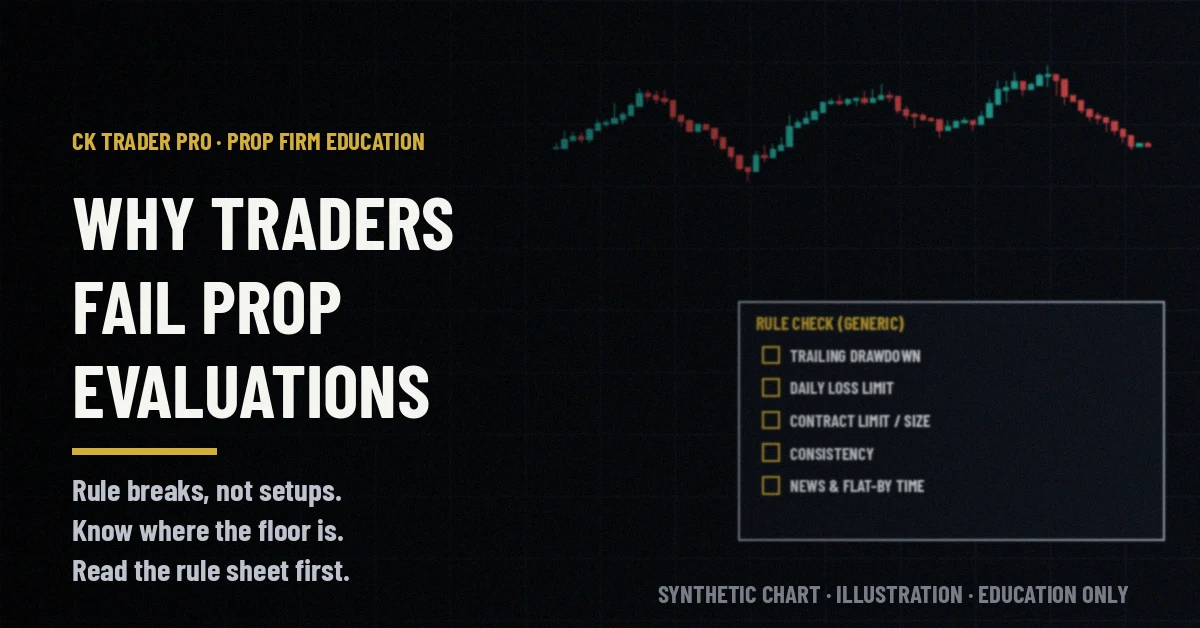
Why Traders Fail Prop Evaluations (Rule Breaks, Not Strategy)
Education only, not financial advice. Trading futures involves substantial risk of loss and is not suitable for everyone.
Many traders don't pass prop evaluations, and evaluation fees can be lost entirely. Rules, costs and payout terms vary by firm and change often, so check the firm's current terms.
By CK · Futures trader since 1998
Short answer: Many traders who fail a prop firm challenge don’t fail because their setup was wrong. They fail because they broke a rule: the trailing drawdown moved up under them, a bad morning turned into a daily loss limit, they traded more contracts than their room allowed, one big day ran into a consistency rule, or they held a position through restricted news. The fix starts with the firm’s rule sheet, not with a new strategy.
Education only. Futures trading involves substantial risk of loss. Not financial advice.
Prop-firm evaluations and funded accounts are typically simulated. CK Trader Pro and NQ Live Trading aren’t owned, run or endorsed by any prop firm.
The account usually ends on a rule
I’ve been trading futures since 1998, and when I look at a failed evaluation, I ask one question first: which rule ended it?
Not “was the entry bad?” Not “was the market against me?” Which rule. Because an evaluation isn’t graded on how good your analysis is. It’s graded on whether you stayed inside the rules long enough to hit the target.
Have you ever noticed this about traders?
How many traders can explain their setup in detail, but can’t tell you, to the dollar, where their account’s drawdown floor is right now?
How many hit a profit target in their head on day three, then size up on day four to “finish it”?
And how many blow an evaluation, buy another one the same afternoon, and trade it exactly the same way?
None of those is a strategy problem. They’re rule problems. And a rule, unlike the market, is written down before you ever place a trade.
Here’s the point
A prop evaluation is a rule test with a profit target attached.
The profit target gets the attention. The rules decide whether you’re still in the account when you get there. If you’re new to this, start with the prop firm education learning path. This page goes through the rule breaks one by one, and what to do about each.
The five rule breaks that end evaluations
Rules vary by firm and change often. Everything below is generic. Check your firm’s current rules before you trade.
1. The trailing drawdown moved, and nobody was watching it
Many evaluations use a trailing maximum drawdown: the floor follows the account’s highest balance or equity. On an intraday trailing rule, open profit can raise the floor, even if you never take that profit.
Illustration only: say you have $2,000 of trailing drawdown. A trade goes $600 into profit, then comes all the way back and you close it at breakeven. Your balance didn’t change. But on an intraday trailing rule, the floor may have moved up $600 with that open profit, so you now have about $1,400 of room, not $2,000. On an end-of-day rule, the floor usually only moves at the close. That’s why it matters which one your firm uses.
That’s the rule many new traders misunderstand. A trade that runs up and then reverses can cost you room even when it closes flat. Here’s trailing vs end-of-day drawdown, side by side, and a prop firm drawdown calculator to check your numbers.
The fix: before every session, write down where the floor is and how much room you have left. Your risk comes from that number, not from the account’s name.
2. A bad morning became a daily loss limit
A daily loss limit is the most you can lose in one day. Hitting it usually ends the day, and at some firms it ends the account.
The limit itself is rarely the problem. The trades after the second loss are. A trader takes a loss, wants it back, takes a bigger trade with less patience, and the limit arrives before lunch. That’s revenge trading, and here’s why traders revenge trade.
The fix: set a personal daily stop that sits well inside the firm’s limit. A dollar amount or a number of losing trades. When you hit it, you’re done, even if you “see something.” More on daily loss limit strategy for prop traders.
3. The size didn’t fit the room
On NQ, every point is worth $20. On MNQ, it’s $2, one-tenth of NQ (source: CME Group E-mini Nasdaq-100 and Micro E-mini Nasdaq-100 contract specifications). Small moves are real money. Check what a tick and a point are worth with the NQ tick value calculator.
Illustration only: with $2,000 of drawdown left, a 40-point stop is $800 on 1 NQ. That’s 40% of your remaining room on one trade. The same stop on 1 MNQ is $80, or 4%. No stop guarantees a maximum loss: in a fast market an order can fill past the stop price, so the real loss can be bigger than the plan.
A firm’s contract limit is a ceiling, not a suggestion to use all of it. Trading over the limit, even briefly, can be treated as a rule break at some firms. Here’s how scaling plans and contract limits work, and how to size NQ and MNQ trades from your stop.
The fix: contracts = dollar risk ÷ (stop points × dollars per point). Pick the dollar risk as a small part of your remaining drawdown, then let the math choose the size.
4. One big day ran into a consistency rule
Some firms cap how much of your total profit can come from a single day. A trader who makes most of the target in one session can find out they still have to keep trading, sometimes for many more days, before they qualify. That’s when overtrading starts: more trades, bigger size, trying to “balance” the days.
The fix: read the consistency rule before day one, and know what a “too big” day looks like for your account. Here are prop firm consistency rules, explained, and how to avoid overtrading futures.
5. The trade was held through restricted news or past the cutoff
Some firms restrict trading around major scheduled news, and many have times by which positions must be flat. Many big U.S. reports, like the Consumer Price Index, come out at 8:30 AM ET (source: BLS, CPI release schedule). FOMC meeting dates are published in advance (source: Federal Reserve, FOMC calendar). Around those times, NQ can move fast and slippage can widen.
The fix: put every news time and your firm’s flat-by time on the page before the open. If the firm restricts it, you don’t trade it. If you’re not sure whether it’s restricted, treat it as restricted and check the rule sheet.
A one-page rule check before every session
| Rule | Question to answer in writing | Where to look |
|---|---|---|
| Trailing drawdown | Where’s the floor right now, and is it intraday or end-of-day? | Firm dashboard and rule sheet |
| Daily loss limit | What’s the firm’s limit, and what’s my personal stop inside it? | Rule sheet |
| Contract limit and size | What’s my max size, and what does my stop say I should trade? | Rule sheet, sizing math |
| Consistency | How big can one day be before it causes a problem? | Rule sheet |
| News and hours | Which releases are out today, and when must I be flat? | Economic calendar, rule sheet |
If you can’t answer a line, that’s your homework before you trade. And keep a journal that scores rule-following, not just profit and loss. Start with how to journal futures trades, or build the whole day trading routine.
The noise sells you the next attempt, not the lesson
Here’s what gets in many traders’ way, and it isn’t them. It’s the noise. Ads, screenshots and feeds say the same thing: you were close, buy another one, try again today. None of them says “find the rule that ended it first.”
The CFTC urges people “to be skeptical when promoters… claim that their products and services will earn high profits with minimal risks” (source: CFTC Fraud Advisory). An evaluation is a cost, and another attempt with the same habits is the same test with the same result risk. If you’ve just failed one, read what to do after a failed prop evaluation before you buy anything, and see what goes into the total cost of an evaluation. When you’re ready for a plan, here’s how to approach a prop firm evaluation.
CK has affiliate relationships with some prop firms, including Apex Trader Funding and Lucid Trading, and may earn a commission from sign-ups through his links. That doesn’t change what we teach, and it’s one more reason to read every firm’s current rules yourself.
Remember this
Know the rule. Size for the room. Stop before the limit stops you.
So here’s my question: if your last evaluation ended today, could you name the exact rule that ended it, and what you’d do differently on that rule tomorrow?
And if you’re wondering where we fit: Is CK Trader Pro a prop firm? No. We don’t sell evaluations or funded accounts. We teach the rules, the sizing math and the risk planning behind them.
If you’d like to see rule-first risk planning done in real time, there’s a free live NQ session on weekdays from 9:30 to 10:30 AM ET at nqlivetrading.com/live, run by the same company. Registration is required. Adults 21+. Sessions are education, not signals.
Join the Academy
Learn the rule sheet before the rule sheet teaches you. CK Trader Pro is futures and prop firm education: step-by-step lessons, live sessions and risk planning. It’s the CK Trader Pro Membership, which includes:
- Members-only educational lessons on prop-firm rules, drawdown, daily loss limits, position sizing and risk
- War Room: CK’s live pre-market planning session, weekdays 8:30–9:30 AM ET, where the day’s risk and news times get written down before the open
- CK’s chart setup, shown and explained live in every session
- Economic news calendar
Education only. No trade signals or personal advice. No results promised.
Billed monthly until you cancel. See pricing at cktraderpro.com.
FAQ
Why do traders fail prop firm challenges?
Many fail on a rule rather than a setup: the trailing drawdown moves up and the account runs out of room, a losing morning reaches the daily loss limit, position size is too big for the remaining drawdown, one large day conflicts with a consistency rule, or a position is held through restricted news or past a flat-by time. Rules vary by firm, so check your firm’s current rules.
Can you fail a prop evaluation on a trade that closed at breakeven?
On some rules, yes in effect. With an intraday trailing drawdown, open profit can raise the floor, so a trade that runs up and comes back to breakeven can leave you with less room than before, even though your balance didn’t change. Check whether your firm trails intraday or end-of-day.
How should I size trades in a prop evaluation?
Size from your stop and your remaining drawdown, not from the account’s name. Contracts equal dollar risk divided by stop points times dollars per point. NQ is $20 per point and MNQ is $2 per point. No stop guarantees a maximum loss, because orders can fill past the stop in fast markets.
What should I do after failing a prop firm evaluation?
Find the exact rule that ended the account before you start another one, write down what you’ll change on that rule, and practice that change. Buying a new evaluation without changing the habit repeats the same test.
Is CK Trader Pro a prop firm?
No. CK Trader Pro is futures and prop firm education. It doesn’t sell evaluations or funded accounts, and it isn’t owned, run or endorsed by any prop firm.
Trading futures involves substantial risk of loss and is not suitable for everyone. Past performance is not indicative of future results. Education only, not financial advice. Example numbers are illustrations, not recommendations. No stop guarantees a maximum loss. Prop-firm rules vary by firm and change often; check each firm’s current rules. Prop-firm evaluations and funded accounts are typically simulated. CK Trader Pro and NQ Live Trading aren’t owned, run or endorsed by any prop firm. See our Risk Disclosure and Disclosures. CK Trader Pro is operated by CK TRADING INSTITUTE OF TECHNOLOGY LLC.
About this article. This is general education from CK Trader Pro. It isn't investment advice, a recommendation to buy or sell, or a trade signal, and it doesn't take your situation into account. Dollar figures and examples are illustrations, not results. Prop-firm rules, costs and payout terms vary by firm and change often; check the firm's current terms before you buy anything. We have paid referral relationships with some prop firms (see Disclosures). We are not owned, run, employed or endorsed by these firms. Mentioning a firm or its evaluations is not a recommendation that you trade. Trading futures involves substantial risk of loss and is not suitable for everyone.