

Futures Tick Sizes by Contract: A Reference Table
Education only, not financial advice. Trading futures involves substantial risk of loss and is not suitable for everyone.
Many traders don't pass prop evaluations, and evaluation fees can be lost entirely. Rules, costs and payout terms vary by firm and change often, so check the firm's current terms.
By CK · Futures trader since 1998
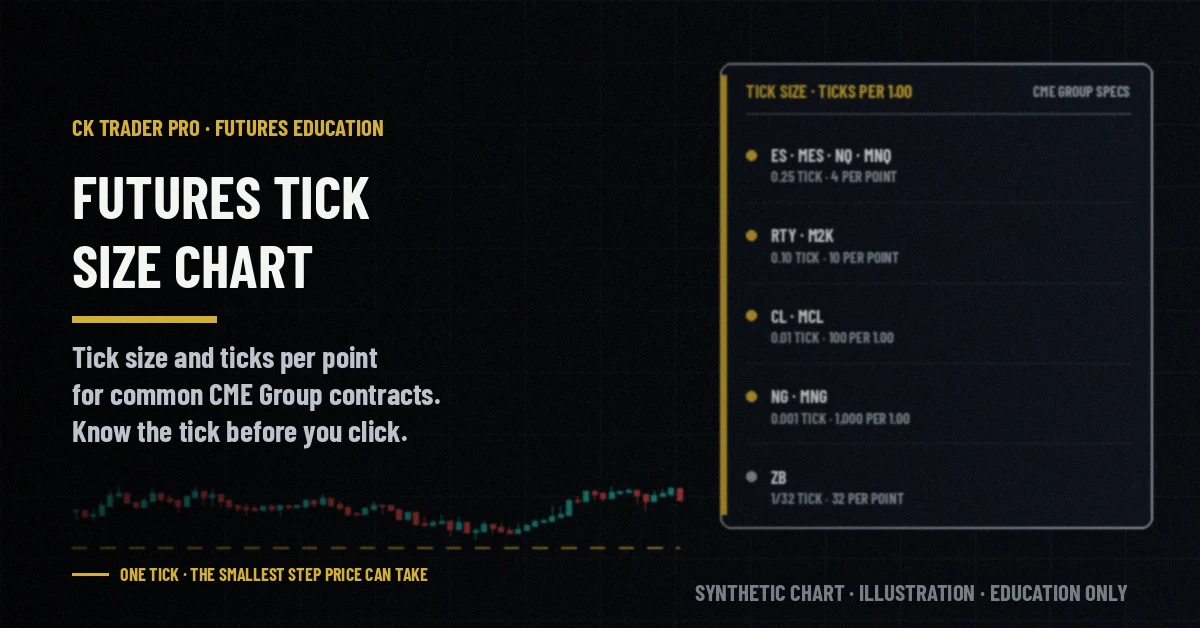
Short answer: A tick is the smallest step a futures price can move, and it’s set by the exchange for each contract. On CME Group’s E-mini S&P 500 and E-mini Nasdaq-100 it’s 0.25 index points, so there are 4 ticks in a point. On the E-mini Russell 2000 it’s 0.10 (10 ticks), on crude oil 0.01 per barrel (100 ticks in a 1.00 move), and on Henry Hub natural gas 0.001 per MMBtu (1,000 ticks in a 1.00 move). The full chart below links each row to its CME Group contract specs page.
Education only. Futures trading involves substantial risk of loss. Not financial advice.
Some retail futures prop programs use simulated evaluations and simulated funded accounts; some also offer a separate live-funded stage. Verify your specific account type. CK Trader Pro and NQ Live Trading aren’t owned, run or endorsed by any prop firm.
I learned the step before the setup
I’ve been trading futures since 1998. In my experience, the quickest way to get confused on a new chart is to assume it moves like the last one you traded.
Early on, I’d glance at a new market and think in the same “points” I used every day. Then a move that looked small on screen turned out to be dozens of ticks, and the stop I’d written down meant something completely different. Nothing was wrong with the chart. I just hadn’t learned its step.
Have you ever noticed this about traders?
How many traders say “ten ticks” as if a tick were the same size on every contract?
How many switch from an index contract to crude oil or natural gas and carry the same idea of “a point” with them?
And how many have never opened the exchange’s contract specs page for the market they trade every day?
None of that is a talent problem. It’s a units problem. Many traders learn the pattern before they learn the ruler it’s measured with.
Here’s the point
A point isn’t the same distance on every chart. The tick is the ruler, and every contract has its own.
Before a stop, a target or a daily limit means anything, you need to know how many steps it is on the contract in front of you.
Futures tick size chart
Outright minimum price fluctuation from each contract’s CME Group specs page, checked Nov 26, 2026. “Ticks per 1.00” counts the ticks in a move of 1.00 in the quoted price (one full point for index and Treasury futures). Spreads and some special order types use different increments. Check the linked page before you trade.
| Contract | Symbol | Minimum tick (outright) | Ticks per 1.00 | CME Group source |
|---|---|---|---|---|
| E-mini S&P 500 | ES | 0.25 index points | 4 | ES contract specs |
| Micro E-mini S&P 500 | MES | 0.25 index points | 4 | MES contract specs |
| E-mini Nasdaq-100 (points in dollars: one point on NQ and MNQ) | NQ | 0.25 index points | 4 | NQ contract specs |
| Micro E-mini Nasdaq-100 (any move at your size: NQ tick value calculator) | MNQ | 0.25 index points | 4 | MNQ contract specs |
| E-mini Dow Jones Industrial Average | YM | 1.00 index point | 1 | YM contract specs |
| Micro E-mini Dow Jones Industrial Average | MYM | 1.00 index point | 1 | MYM contract specs |
| E-mini Russell 2000 | RTY | 0.10 index points | 10 | RTY contract specs |
| Micro E-mini Russell 2000 | M2K | 0.10 index points | 10 | M2K contract specs |
| Crude Oil (WTI) | CL | 0.01 per barrel | 100 | CL contract specs |
| Micro WTI Crude Oil | MCL | 0.01 per barrel | 100 | MCL contract specs |
| Henry Hub Natural Gas | NG | 0.001 per MMBtu | 1,000 | NG contract specs |
| Micro Henry Hub Natural Gas | MNG | 0.001 per MMBtu | 1,000 | MNG contract specs |
| Gold | GC | 0.10 per troy ounce | 10 | GC contract specs |
| Micro Gold | MGC | 0.10 per troy ounce | 10 | MGC contract specs |
| Silver | SI | 0.005 per troy ounce | 200 | SI contract specs |
| Copper | HG | 0.0005 per pound | 2,000 | HG contract specs |
| 10-Year T-Note | ZN | 1/2 of 1/32 of one point (0.015625) | 64 | ZN contract specs |
| U.S. Treasury Bond | ZB | 1/32 of one point (0.03125) | 32 | ZB contract specs |
Source: CME Group contract specifications, linked in each row. Tick sizes only; this chart doesn’t list what a tick is worth.
How to read the chart
A tick is the minimum price fluctuation: the smallest amount the price of that contract can change. A point is a move of 1.00 in the quoted price. To get ticks per point, divide 1 by the tick size: 1 ÷ 0.25 is 4, 1 ÷ 0.10 is 10, 1 ÷ 0.001 is 1,000.
Index futures are quoted in index points, so “a point” is natural there. Energy and metals are quoted per unit of the commodity (per barrel, per MMBtu, per troy ounce, per pound), so traders in those markets often talk in ticks or in the price itself instead of points. Treasury futures are quoted in points and fractions of a point, which is why their ticks are written as fractions of 1/32. If a term here is new, the futures trading glossary defines it.
How many ticks are in a point on futures?
It depends on the contract. That’s the whole reason a chart like this exists:
- 4 ticks per point: ES, MES, NQ and MNQ (0.25 tick).
- 10 ticks per point: RTY and M2K (0.10 tick).
- 1 tick per point: YM and MYM (1.00 tick).
- 32 ticks per point: the Treasury bond (1/32 tick).
- 64 ticks per point: the 10-year note (half of 1/32).
So “ten ticks” is two and a half points on ES, one point on RTY and ten points on YM. Same words, three different distances.
Natural gas futures tick size
Henry Hub natural gas (NG) moves in ticks of 0.001 per MMBtu on an outright, according to its CME Group contract specs. That means a move of 0.01 is 10 ticks, a move of 0.10 is 100 ticks, and a full 1.00 move is 1,000 ticks. The Micro Henry Hub contract (MNG) uses the same 0.001 tick; it’s a smaller contract, not a different ruler.
CME also lists a smaller increment for natural gas intercommodity spreads. That applies to spreads, not to a single outright contract, so it isn’t the number in the chart.
Micros: same ruler, smaller contract
In every pair in this chart, the micro moves in the same tick size as its larger contract: MES and ES, MNQ and NQ, MYM and YM, M2K and RTY, MCL and CL, MNG and NG, MGC and GC. The tick count for a move is identical. What changes is the size of the contract, and so what each tick is worth. That figure sits on each CME specs page, right next to the tick size.
If you trade NQ or MNQ, you don’t need to work it out by hand. The NQ tick value calculator does it at your size, and the full NQ sheet (hours, contract months, rollover) is on the NQ futures contract specs page.
Why ticks matter more than points when you plan
A stop, a target and a daily limit are all distances. Written in ticks for one contract, each of those numbers means something else on the next. Write them for the contract you’re actually trading, and recount when you switch.
One caution about stops. A stop is an instruction, not a promise: no stop guarantees a maximum loss, and in a fast market an order can fill past the stop price, many ticks away from where you set it.
What this chart is, and what it isn’t
This is a reference for tick size and ticks per point, sourced to CME Group. It isn’t a list of what to trade, and it doesn’t cover every contract CME lists. Exchanges can change contract terms, platforms can display prices differently, and prop firms set their own lists of allowed contracts. Check the CME specs page and your firm’s current rules before you trade any of these.
How I think about it
In my experience, learning a new contract starts with one question: what’s the smallest step it can take? I’d rather spend five minutes on the specs page than find out mid-trade that my plan was written in the wrong units.
Where we fit
Is CK Trader Pro a prop firm? No. We teach futures and prop firm education. We don’t sell evaluations or funded accounts, and we don’t send trade signals or setups to follow.
CK has affiliate relationships with some prop firms, including Apex Trader Funding and Lucid Trading, and may earn a commission from sign-ups through his links. A tick chart doesn’t promise anything about results. It means your plan is written in the right units. This chart is one reference in our futures trading education path.
The noise skips the units
Here’s what gets in a new trader’s way, and it isn’t the trader. It’s the noise. It talks about entries, levels and “a few points” as if every chart moved the same way. It never stops to ask what a point is on the contract you’re looking at. When the noise sets your units, your plan is measured with someone else’s ruler.
Remember this
Know the tick before you click.
So here’s my question: could you name the tick size of the contract you traded last, without looking it up?
Join the Academy
Know your contract before the open. CK Trader Pro is futures and prop firm education: step-by-step lessons, live sessions and risk planning, built for traders who want their contract, rules and limits written down before the bell. It’s the CK Trader Pro Membership, which includes:
- Members-only educational lessons on prop-firm rules, drawdown, daily loss limits, position sizing and NQ and MNQ contract basics
- War Room: CK’s live pre-market planning session, weekdays 8:30–9:30 AM ET, where the day’s levels, news times and risk get written down before the open
- CK’s chart setup, shown and explained live in every session
- Economic news calendar
Education only. No trade signals or personal advice. No results promised.
Billed monthly until you cancel. See pricing at cktraderpro.com.
Registration is required. Adults 21+.
FAQ
What is a tick size in futures?
It’s the minimum price fluctuation: the smallest amount a futures price can move. The exchange sets it for each contract, and CME Group lists it on every contract specs page.
How many ticks are in a point on futures?
It depends on the contract. ES and NQ have 4 ticks per point (0.25 tick), RTY has 10 (0.10 tick), YM has 1 (1.00 tick), the Treasury bond has 32 and the 10-year note has 64. Divide 1 by the tick size to get the count.
What is the natural gas futures tick size?
Henry Hub natural gas (NG) moves in ticks of 0.001 per MMBtu on an outright, so a 1.00 move is 1,000 ticks and a 0.10 move is 100 ticks, according to CME Group’s contract specs. Micro Henry Hub natural gas uses the same tick.
Do micro futures have a different tick size?
Not in the contracts in this chart. MES, MNQ, MYM, M2K, MCL, MNG and MGC move in the same tick size as their larger contracts. The contract is smaller, so each tick is worth less; check the CME specs page for that figure.
Why doesn’t this chart show what a tick is worth?
This page is about tick size and tick counts. What a tick is worth depends on the contract size, and it’s listed on each CME Group specs page. For NQ and MNQ, use the NQ tick value calculator at cktraderpro.com.
Does a stop placed in ticks limit my loss?
A stop is an instruction, not a promise. No stop guarantees a maximum loss; in a fast market, an order can fill past the stop price.
Is CK Trader Pro a prop firm?
No. CK Trader Pro is futures and prop firm education. It doesn’t sell evaluations or funded accounts, and it isn’t owned, run or endorsed by any prop firm.
Trading futures involves substantial risk of loss and is not suitable for everyone. Past performance is not indicative of future results. Education only, not financial advice. Example numbers are illustrations, not recommendations. No stop guarantees a maximum loss. Prop-firm rules vary by firm and change often; check each firm’s current rules. Some retail futures prop programs use simulated evaluations and simulated funded accounts; some also offer a separate live-funded stage. Verify your specific account type. CK Trader Pro and NQ Live Trading aren’t owned, run or endorsed by any prop firm. See our Risk Disclosure and Disclosures. CK Trader Pro is operated by CK TRADING INSTITUTE OF TECHNOLOGY LLC.
About this article. This is general education from CK Trader Pro. It isn't investment advice, a recommendation to buy or sell, or a trade signal, and it doesn't take your situation into account. Dollar figures and examples are illustrations, not results. Prop-firm rules, costs and payout terms vary by firm and change often; check the firm's current terms before you buy anything. We have paid referral relationships with some prop firms (see Disclosures). We are not owned, run, employed or endorsed by these firms. Mentioning a firm or its evaluations is not a recommendation that you trade. Trading futures involves substantial risk of loss and is not suitable for everyone.