

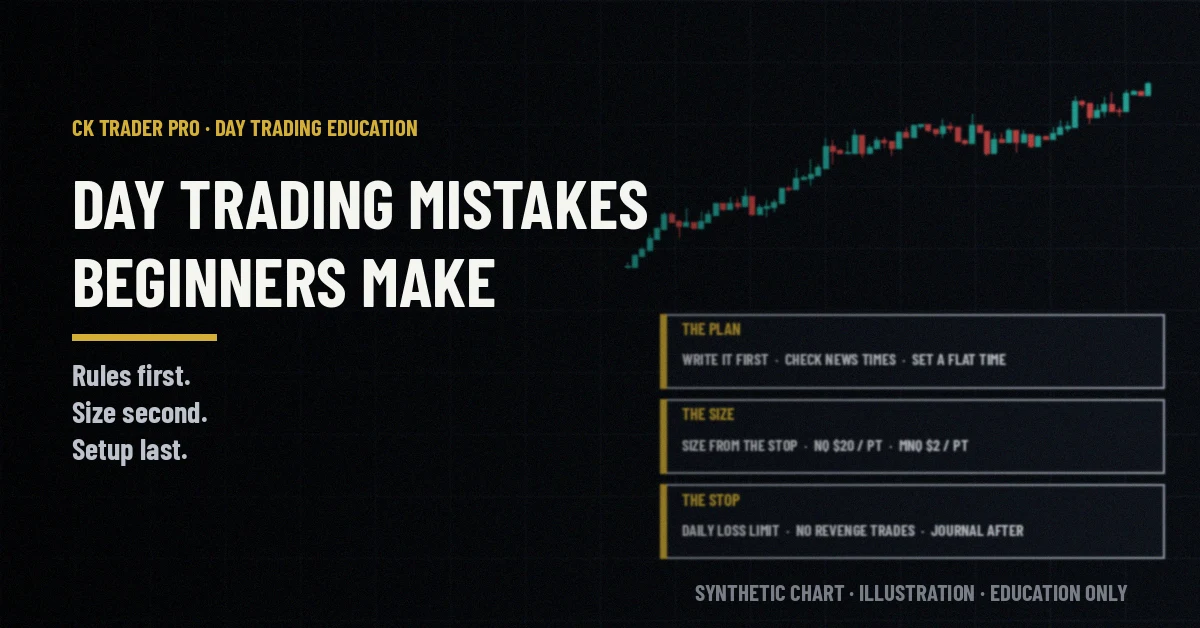
Day Trading Mistakes Beginners Make (and How to Fix Them)
Education only, not financial advice. Trading futures involves substantial risk of loss and is not suitable for everyone.
Many traders don't pass prop evaluations, and evaluation fees can be lost entirely. Rules, costs and payout terms vary by firm and change often, so check the firm's current terms.
By CK · Futures trader since 1998
Short answer: The day trading mistakes beginners make are usually process mistakes, not prediction mistakes: trading without a written plan, sizing from confidence instead of the stop, having no daily loss limit, revenge trading after a loss, overtrading, trading into scheduled news without knowing it’s coming, and skipping the journal. Each one has a plain fix you can put in place before your next session.
Education only. Futures trading involves substantial risk of loss. Not financial advice.
Some retail futures prop programs use simulated evaluations and simulated funded accounts; some also offer a separate live-funded stage. Verify your specific account type. CK Trader Pro and NQ Live Trading aren’t owned, run or endorsed by any prop firm.
What I’ve noticed after all these years
I’ve been trading futures since 1998. In my experience, the trades that do the most damage to a new trader rarely come from a bad read of the chart. They come from what happens around the chart: the size they picked, the trade they took right after a loss, the plan they never wrote down.
That’s good news, because process can be learned. You don’t need a better crystal ball. You need better habits.
Have you ever noticed this about traders?
How many traders spend hours hunting for the perfect entry, but never decide how much they’ll lose before they stop for the day?
How many take one loss calmly, then take the next three trades angry?
And how many say they have a plan, but couldn’t show it to you on paper?
None of that is about intelligence. It’s about structure. Many traders build the exciting part first and the guardrails last. Day trading goes better the other way around.
Here’s the point
In my experience, beginner losses usually come from the process, not the prediction.
You can’t control what the market does next. You can control your size, your daily limit, your plan and when you walk away. Those are the levers this page is about.
The beginner day trading mistakes, and the fix for each
1. Trading without a written plan
A plan in your head changes the moment price moves. A written plan doesn’t. In my experience, the traders who struggle most early on are the ones deciding what to do while the candle is still printing.
The fix: before the session, write down which market and session window you’ll trade, the levels you care about, your size, your maximum loss per trade and per day, and the time you’ll be flat. If a trade isn’t in the plan, it isn’t a trade. The day trading education path walks through building that foundation step by step.
2. Sizing from confidence instead of the stop
In my experience, this is one of the most common futures day trading mistakes. A setup looks strong, so the trader adds contracts. But the market doesn’t know how confident you feel.
On NQ (E-mini Nasdaq-100), one point is $20; on MNQ (Micro E-mini Nasdaq-100), one point is $2, one-tenth the size (source: CME Group E-mini Nasdaq-100 and Micro E-mini Nasdaq-100 contract specifications). Illustration only: if you’re willing to risk $250 on a trade with a 25-point stop, that’s 250 ÷ (25 × $2) = 5 MNQ. On NQ the same math gives 0.5 contracts, which you can’t trade, so one NQ would put $500 at risk, double your plan, before commissions and fees.
And a stop is an instruction, not a promise. No stop guarantees a maximum loss; in a fast market, an order can fill past the stop price.
The fix: size from the stop, every time: contracts = dollars you’re willing to risk ÷ (stop in points × dollars per point). Check any move with the NQ tick value calculator, and see the full walkthrough in how to size NQ and MNQ trades from your stop.
3. No daily loss limit
Without a daily limit, a bad morning can turn into a bad week. One loss leads to “just one more,” and there’s no line that says stop.
The fix: pick a daily loss limit before the open and treat it as the end of the day, not a suggestion. Some traders also cap the number of losing trades per day. If you trade under a prop firm’s rules, your own limit should sit inside the firm’s, not on top of it. More in daily loss limit strategy for prop traders.
4. Revenge trading after a loss
A loss stings, and the urge is to win it back right now. That’s when beginners skip their rules, size up and take setups they’d never take with a clear head.
The fix: decide in advance what happens after a loss: a set pause, a step away from the screen, or a size cut for the rest of the session. Write the rule down so you don’t have to negotiate with yourself in the moment. Here’s why traders revenge trade and how to see it coming.
5. Overtrading
More trades can feel like more chances. In practice, costs are charged per contract per side, so exchange, clearing and NFA fees plus broker commission add up with every trade, along with decisions made while tired or frustrated.
The fix: set a maximum number of trades per session and stop when you reach it, win or lose. Quiet stretches are part of the market, not a signal to force something. See how to avoid overtrading futures.
6. Trading into scheduled news without knowing it’s coming
Many major U.S. economic reports, like CPI and the monthly jobs report, are released at 8:30 AM ET (source: U.S. Bureau of Labor Statistics release schedule). NQ can move fast around those releases, and slippage can widen.
The fix: check the economic calendar before every session and decide in advance whether you’ll be flat, smaller or waiting through the release. If you trade a prop account, check your firm’s current written news rules too.
7. Skipping the journal
If you don’t write down what happened, you’ll repeat it. Memory keeps the big win and the painful loss, and drops the pattern in between.
The fix: after every session, log each trade: the plan, the size, whether you followed your rules, and how you felt. Over a few weeks, your real mistakes show up in your own handwriting. Start with the day trading journal template.
Where prop firms come in
Many beginners meet day trading through a prop firm evaluation, and these same mistakes show up there as rule breaks: a blown daily limit, a drawdown breach, a news violation. I broke that down rule by rule in why traders fail prop evaluations.
And if you’ve wondered where we fit: Is CK Trader Pro a prop firm? No. We teach futures and prop firm education. We don’t sell evaluations or funded accounts.
CK has affiliate relationships with some prop firms, including Apex Trader Funding and Lucid Trading, and may earn a commission from sign-ups through his links. Whichever firm you trade with, its current written rules are the only version that counts. Fixing these mistakes doesn’t promise you’ll pass anything or make money. It gives you a process you can actually follow.
The noise sells the setup. Nobody sells the guardrails.
Here’s what gets in a beginner’s way, and it isn’t the beginner. It’s the noise. Feeds show the one perfect entry and the screenshot of the green day. They don’t show the size behind it, the daily limit, or the rule that said stop. When the highlight is all you see, it’s easy to think trading is about finding the entry, when the first job is protecting yourself from your own worst session.
Remember this
Rules first, size second, setup last.
So here’s my question: if you looked back at your last ten losing trades, how many were bad reads, and how many were broken rules?
If you’d like to watch a trading day get planned and run with rules in real time, there’s a free live NQ session on weekdays from 9:30 to 10:30 AM ET at nqlivetrading.com/live, run by the same company. Registration is required. Adults 21+. Sessions are education, not signals.
Join the Academy
Build the process before you chase the setup. CK Trader Pro is futures and prop firm education: step-by-step lessons, live sessions and risk planning, built for traders who want guardrails they understand and can follow. It’s the CK Trader Pro Membership, which includes:
- Members-only educational lessons on day trading foundations, position sizing, drawdown, daily loss limits and prop-firm rules
- War Room: CK’s live pre-market planning session, weekdays 8:30–9:30 AM ET, where the day’s levels, news times and risk get written down before the open
- CK’s chart setup, shown and explained live in every session
- Economic news calendar
Education only. No trade signals or personal advice. No results promised.
Billed monthly until you cancel. See pricing at cktraderpro.com.
FAQ
What are the most common day trading mistakes beginners make?
In my experience, the most common ones are process mistakes: trading without a written plan, sizing from confidence instead of the stop, having no daily loss limit, revenge trading after a loss, overtrading, trading into scheduled news unprepared, and not keeping a journal.
How should a beginner size a futures day trade?
Size from the stop: contracts = dollars you’re willing to risk ÷ (stop in points × dollars per point). According to CME Group’s contract specifications, NQ is $20 per point and MNQ is $2 per point, so MNQ lets you size in smaller steps.
What is revenge trading?
Revenge trading is taking trades to win back a loss quickly, often bigger or outside your plan. A pre-set rule for what happens after a loss, like a pause or a size cut, helps stop it before it starts.
Why does a daily loss limit matter for day traders?
A daily loss limit ends the session at a set loss you chose in advance, so one bad morning doesn’t turn into a bad week. If you trade under prop firm rules, keep your own limit inside the firm’s.
Can a stop limit my loss when day trading futures?
A stop is an instruction, not a promise. No stop guarantees a maximum loss; in a fast market, an order can fill past the stop price. Size from the stop and allow for slippage.
Is CK Trader Pro a prop firm?
No. CK Trader Pro is futures and prop firm education. It doesn’t sell evaluations or funded accounts, and it isn’t owned, run or endorsed by any prop firm.
Trading futures involves substantial risk of loss and is not suitable for everyone. Past performance is not indicative of future results. Education only, not financial advice. Example numbers are illustrations, not recommendations. No stop guarantees a maximum loss. Prop-firm rules vary by firm and change often; check each firm’s current rules. Some retail futures prop programs use simulated evaluations and simulated funded accounts; some also offer a separate live-funded stage. Verify your specific account type. CK Trader Pro and NQ Live Trading aren’t owned, run or endorsed by any prop firm. See our Risk Disclosure and Disclosures. CK Trader Pro is operated by CK TRADING INSTITUTE OF TECHNOLOGY LLC.
About this article. This is general education from CK Trader Pro. It isn't investment advice, a recommendation to buy or sell, or a trade signal, and it doesn't take your situation into account. Dollar figures and examples are illustrations, not results. Prop-firm rules, costs and payout terms vary by firm and change often; check the firm's current terms before you buy anything. We have paid referral relationships with some prop firms (see Disclosures). We are not owned, run, employed or endorsed by these firms. Mentioning a firm or its evaluations is not a recommendation that you trade. Trading futures involves substantial risk of loss and is not suitable for everyone.