

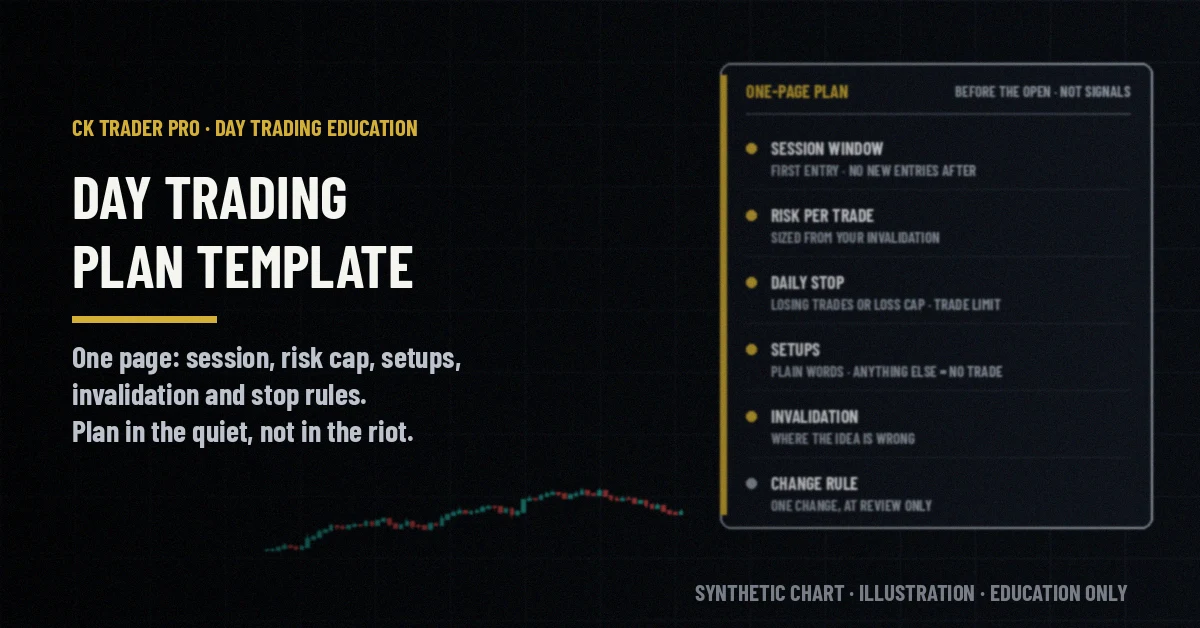
Day Trading Plan Template for Futures: The One-Page Plan
Education only, not financial advice. Trading futures involves substantial risk of loss and is not suitable for everyone.
Many traders don't pass prop evaluations, and evaluation fees can be lost entirely. Rules, costs and payout terms vary by firm and change often, so check the firm's current terms.
By CK · Futures trader since 1998
Short answer: A day trading plan template is one page of rules you write before you trade and keep the same every day: which contract you trade, the hours you trade, your risk per trade and per day, the setups you allow in plain words, where each idea is wrong, when you won’t trade, and when you’re allowed to change the plan. It isn’t a forecast and it isn’t a list of signals. It’s a record of decisions made while the screen is quiet, so you aren’t making them in a fast market.
Education only. Futures trading involves substantial risk of loss. Not financial advice.
Some retail futures prop programs use simulated evaluations and simulated funded accounts; some also offer a separate live-funded stage. Verify your specific account type. CK Trader Pro and NQ Live Trading aren’t owned, run or endorsed by any prop firm.
I write the rules when nothing is moving
I’ve been trading futures since 1998. In my experience, the worst decisions to make in a hurry are the ones new traders often make in a hurry: how big, how many, how long, and when to quit for the day.
So I don’t make them at 9:30. I make them on paper, before the bell, and the paper doesn’t change because a candle got big.
Have you ever noticed this about traders?
How many traders can explain a setup for ten minutes, but can’t say how much they’ll risk on it?
How many have a daily stop in their head that quietly moves after the second loss?
And how many rewrite the whole approach after one bad day, then again after the next?
None of that is a chart problem. It’s a plan problem, and a plan is something you can finish before the market opens.
Here’s the point
A plan doesn’t tell you what the market will do. It tells you what you’ll do.
The market will do whatever it does. The plan is the part you control: size, hours, setups, exits and when you stop.
What a trading plan is
CME Group’s education course puts it simply: “A trading plan is a business plan for your trading career.” It calls the plan “a working document,” and lists five components: objective, methodology, risk management, trading strategies and a trader log (source: CME Group, Building a Trade Plan). In its Master the Trade course, CME also says one benefit of a trade plan is to help the trader “minimize or reduce emotional decision-making” (source: CME Group, Download the Trade Plan).
That’s the job of the page below. It doesn’t make decisions for you. It makes them earlier.
Plan, routine, checklist, journal: which is which?
New traders often blur these together. Each has one job:
- The plan (this page): the standing rules. Written once, changed only at a scheduled review.
- The routine: the order you do things in each day. See our day trading routine.
- The daily prep: today’s news times, levels and notes, filled in each morning. For NQ, see how to plan the NQ open.
- The journal: what actually happened, trade by trade. See our day trading journal template.
If your daily prep keeps changing your risk rules, the plan isn’t doing its job.
The day trading plan template
Copy this into a notebook, a text file or a printed sheet. Fill in every line. If you can’t fill one in yet, that’s what to learn next.
MY DAY TRADING PLAN            Last reviewed: ________

1. MARKET AND CONTRACT
   I trade: ________   Contract size (full or micro): ________
   Max contracts per trade: ____

2. SESSION WINDOW (ET)
   First possible entry: ____   No new entries after: ____
   Session definition I use for "prior day": ________

3. RISK PER TRADE
   Max risk per trade, in ticks or points: ____
   I size from the distance to my invalidation, not from how sure I feel.

4. DAILY STOP RULES
   I stop for the day after ____ losing trades, or after ____ of loss.
   Max trades per day: ____

5. SETUPS I'M ALLOWED TO TAKE (plain words)
   Setup A: what has to be true before I enter ________
   Setup B: ________
   Anything not written here = no trade.

6. INVALIDATION AND EXITS
   Each idea is wrong when: ________
   Stop placed before or with entry: yes / no
   Planned exit, written before entry: ________

7. WHEN I DON'T TRADE
   Scheduled news times I stand aside for: ________
   Other no-trade conditions: ________

8. ACCOUNT RULES (if trading a prop evaluation)
   Firm's daily loss limit, drawdown type, flat-by time: ________
   My daily stop sits inside the firm's limit: yes / no

9. CHANGE RULE
   I review this plan on: ________ (day of week)
   One change at a time, only at review, never mid-session.
How to fill in the hard lines
Market and contract. Pick one market to start. Fewer markets means fewer rules to remember when it’s fast.
Risk per trade. Write it in ticks or points first, because that’s how the chart measures distance. On NQ, the minimum tick is 0.25 index points (source: CME Group, E-mini Nasdaq-100 contract specs). Then use the NQ tick value calculator to turn that distance into dollars for NQ or MNQ at your size. If the distance to your invalidation is too wide for your planned risk, trade smaller or don’t trade.
Setups in plain words. If you can’t describe a setup so a stranger could check it, it isn’t ready for the plan. Our guide on how to plan trade entries covers what to write.
Invalidation. Write where the idea is wrong before you write where it might go. A stop marks that point, but it isn’t a ceiling on risk: no stop guarantees a maximum loss, and an order can fill past your stop price in a fast market or on a gap.
Account rules. If you’re in a prop evaluation, copy the firm’s current rules onto your page and keep your own daily stop inside theirs. Rules vary by firm and change often. Our prop firm rule sheet template lays out what to look up.
What a plan can’t do
A plan can’t tell you how the next trade will turn out. It won’t stop a market from gapping or a fill from slipping. And a plan you don’t read during the session is just paper.
In my experience, the value shows up in the review. Your journal tells you which line on the page you broke, and the plan tells you what to fix. Change one line at a time, at the review, and never in the middle of a session.
Where we fit
Is CK Trader Pro a prop firm? No. We teach futures and prop firm education. We don’t sell evaluations or funded accounts, and we don’t send trade signals or setups to follow.
CK has affiliate relationships with some prop firms, including Apex Trader Funding and Lucid Trading, and may earn a commission from sign-ups through his links. A written plan doesn’t promise you’ll pass anything or make money. It means your size, hours and limits are decided before the market gets a vote. For the bigger picture, start with our day trading education guide.
The noise sells the next trade
Here’s what gets in a new trader’s way, and it isn’t the trader. It’s the noise. Feeds and alerts always have a next trade, a new setup, a reason to stay at the screen one more hour. None of them asks what your daily stop was, or whether this trade was on your page. When the noise sets the agenda, the plan gets rewritten every session.
Remember this
Plan in the quiet, not in the riot.
So here’s my question: if someone read only your plan, could they tell how much you’d risk tomorrow, which trades you’d take, and when you’d stop?
If you’d like to watch a plan get written and followed in real time, there’s a free live NQ session on weekdays from 9:30 to 10:30 AM ET at nqlivetrading.com/live, run by the same company. Registration is required. Adults 21+. Sessions are education, not signals.
Join the Academy
Write the plan before the open. CK Trader Pro is futures and prop firm education: step-by-step lessons, live sessions and risk planning, built for traders who want their size, hours, setups and stop rules written down and understood before the bell. It’s the CK Trader Pro Membership, which includes:
- Members-only educational lessons on prop-firm rules, drawdown, daily loss limits, position sizing and NQ and MNQ contract basics
- War Room: CK’s live pre-market planning session, weekdays 8:30–9:30 AM ET, where the day’s levels, news times and risk get written down before the open
- CK’s chart setup, shown and explained live in every session
- Economic news calendar
Education only. No trade signals or personal advice. No results promised.
Billed monthly until you cancel. See pricing at cktraderpro.com.
FAQ
What should a day trading plan template include?
The market and contract you trade, your session window, your risk per trade and per day, a maximum number of trades, the setups you allow in plain words, where each idea is wrong, when you won’t trade, any prop firm rules that apply, and when you review the plan. CME Group lists objective, methodology, risk management, trading strategies and a trader log as the five components of a trading plan.
What’s the difference between a trading plan and a trading routine?
The plan is the set of standing rules: size, hours, setups, exits and stop rules. The routine is the order you do things in each day, from pre-market prep to the post-session review. The plan stays the same day to day; the routine is how you apply it.
How often should I change my day trading plan?
Only at a scheduled review, such as once a week, and one change at a time. Changing the plan in the middle of a session usually means the market wrote the rule, not you.
Does a trading plan limit my losses?
It sets the limits you intend to follow, such as a risk per trade and a daily stop, but it can’t guarantee them. Orders can fill past a stop price in a fast market or on a gap. No stop guarantees a maximum loss.
Is CK Trader Pro a prop firm?
No. CK Trader Pro is futures and prop firm education. It doesn’t sell evaluations or funded accounts, and it isn’t owned, run or endorsed by any prop firm.
Trading futures involves substantial risk of loss and is not suitable for everyone. Past performance is not indicative of future results. Education only, not financial advice. Example numbers are illustrations, not recommendations. No stop guarantees a maximum loss. Prop-firm rules vary by firm and change often; check each firm’s current rules. Some retail futures prop programs use simulated evaluations and simulated funded accounts; some also offer a separate live-funded stage. Verify your specific account type. CK Trader Pro and NQ Live Trading aren’t owned, run or endorsed by any prop firm. See our Risk Disclosure and Disclosures. CK Trader Pro is operated by CK TRADING INSTITUTE OF TECHNOLOGY LLC.
About this article. This is general education from CK Trader Pro. It isn't investment advice, a recommendation to buy or sell, or a trade signal, and it doesn't take your situation into account. Dollar figures and examples are illustrations, not results. Prop-firm rules, costs and payout terms vary by firm and change often; check the firm's current terms before you buy anything. We have paid referral relationships with some prop firms (see Disclosures). We are not owned, run, employed or endorsed by these firms. Mentioning a firm or its evaluations is not a recommendation that you trade. Trading futures involves substantial risk of loss and is not suitable for everyone.