

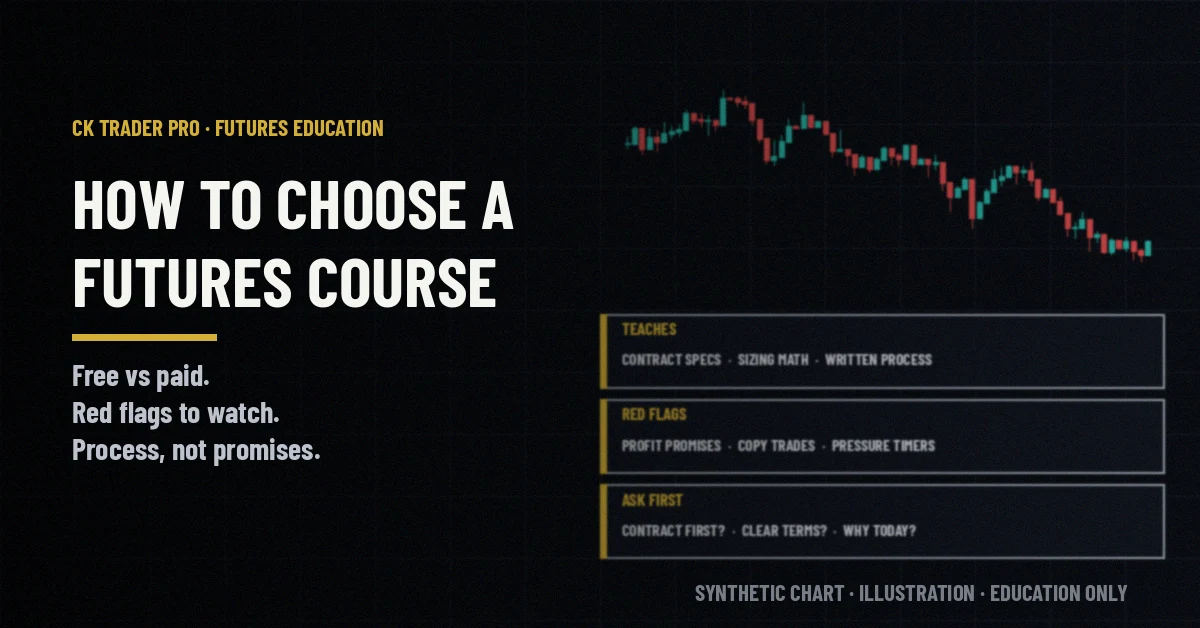
How to Choose a Futures Trading Course
Education only, not financial advice. Trading futures involves substantial risk of loss and is not suitable for everyone.
Many traders don't pass prop evaluations, and evaluation fees can be lost entirely. Rules, costs and payout terms vary by firm and change often, so check the firm's current terms.
By CK · Futures trader since 1998
Short answer: Choose a futures trading course by what it teaches, not by whether it’s free or paid. Useful education — free or paid — teaches contract specs, sizing from the stop, risk including slippage, and a written process you can follow without copying anyone’s trades. Walk away from profit, income, payout or pass promises. If you can’t yet say what one point on NQ costs, you aren’t choosing a course. You’re hoping one will do that work for you.
Education only. Futures trading involves substantial risk of loss. Not financial advice.
Some retail futures prop programs use simulated evaluations and simulated funded accounts; some also offer a separate live-funded stage. Verify your specific account type. CK Trader Pro and NQ Live Trading aren’t owned, run or endorsed by any prop firm.
I get asked which course to buy
I’ve been trading futures since 1998. When a trader asks me how to choose a futures trading course, I don’t name a favorite and I don’t rank a list. I ask a different question: what do you need it to teach you that you can’t already write down?
If the honest answer is “I don’t know what I don’t know yet,” start with the futures trading education roadmap. That page is what to learn, in order. This page is the choosing checklist: free versus paid, the questions to ask before you join, and the red flags that mean you should walk away.
Have you ever noticed this about traders?
How many traders pick a course because a countdown timer is running?
How many pick the free video with the loudest claim, then still can’t say what the contract is worth per point?
And how many could write down, in dollars, what a planned stop would cost on one NQ and one MNQ before they handed over a card?
None of those is a market problem. They’re shopping problems. And a shopping decision, unlike the next candle, is something you can make before you spend a dollar.
Here’s the point
Free or paid isn’t the test. What it teaches is.
A futures trading course — or a free room, or a long article — is useful when it leaves you with a process you can write on one page: the contract, the stop, the size, the daily stop, and what you’ll do when news hits. It isn’t useful when it asks you to copy someone else’s trades, or when it sells you a result.
The daily skills live on a separate checklist: what to learn before your first live trade. Use that page for the routine. Use this one to decide what you’ll learn from, and what you won’t pay for.
Free vs paid: what actually changes
Free futures education can be real education: a clear article, a live session that explains a process out loud, or a calculator that shows you the math. Paid education can be real education too: a structured path, lessons you can replay, and live planning where the day’s risk gets written down before the open.
Neither one promises a result. Paying more doesn’t make a claim true. Free doesn’t make a claim safe.
In my experience, free is the right first step when you still need the contract, the session clock and a written plan. Paid can make sense later, when you want that material in order, with live process you can watch, and you’re buying the teaching — not a shortcut around it.
Seven questions before you join anything
Whether the offer is free or paid, ask these before you sign up.
1. Does it teach the contract first?
Can you walk away knowing tick size, point value, session hours and what margin is — and isn’t? NQ is $20 per point and MNQ is $2 per point (source: CME Group E-mini Nasdaq-100 and Micro E-mini Nasdaq-100 contract specifications). If a course jumps to entries before those numbers, it skipped the part that turns a candle into dollars. Check the math with the NQ tick value calculator, then read why futures education matters before NQ and the NQ futures contract specs.
2. Does it teach you to size from your stop?
Contracts = dollars you’re willing to risk ÷ (stop in points × dollars per point), rounded down to whole contracts. If the result is less than 1, the trade doesn’t fit your risk at that stop; don’t round up to one. Allow for commissions, fees and possible slippage.
Illustration only: a 40-point move to a planned stop represents $800 on 1 NQ and $80 on 1 MNQ before commissions, fees and slippage. No stop guarantees a maximum loss: in a fast market, an order can fill past the stop price.
See how to size NQ and MNQ trades from your stop.
3. Does it explain risk in plain English?
That includes slippage, the fact that losses in a real futures account are real money and can exceed what you deposit (the CFTC’s Fraud Advisory asks whether you can afford to risk losing much more than the initial margin amount), and that no stop guarantees a maximum loss. If risk is a footnote under a highlight reel, the course isn’t finished.
4. Does it give you a process you can write down, or ask you to copy trades?
Education shows you how a plan is built. A signal asks you to follow someone else’s. If you can’t explain the plan without the teacher’s voice in your ear, you don’t have a plan yet. Practice with purpose, not as a way to chase a result: paper trading vs live futures.
5. Are the billing and cancellation terms written clearly before you join?
You should be able to see how you’re billed, how you cancel, and what you get, without a timer pushing you through checkout. If those terms only appear after you pay, wait.
6. Does it promise profits, income, payouts or a pass?
If yes, walk away. Education can help you understand contracts, risk and rules. It can’t promise any result. You can learn the material and still lose money.
7. Why are you joining today?
A gap in your process that you can name? Or a bad day, a countdown, or a screenshot in a feed? If the honest answer is the second list, wait a week.
If you answered “no” or “not sure” to questions 1 through 6, that isn’t failure. It’s a study list. Work through the futures trading education roadmap and come back to this checklist.
Red flags that mean you should walk away
No educator, firm or course is named here. These are patterns. If you see them, you already have your answer.
- It claims high profits with little risk, a fast payout, or a guaranteed evaluation pass.
- It treats stops as a cap on what you can lose, and never mentions slippage.
- It skips contract specs, margin and sizing, and starts with entries.
- It asks you to mirror or follow trades in real time.
- It uses countdown timers or “last chance” language to replace a written decision.
- It hides how billing and cancellation work until after you pay.
- It pushes a paid prop firm evaluation before you can explain the drawdown rule. An evaluation is a test, not a course. Read what a prop firm evaluation is and whether an evaluation is worth it before you treat one as education.
The CFTC urges people “to be skeptical when promoters… claim that their products and services will earn high profits with minimal risks” (source: CFTC Fraud Advisory). You can also check whether a firm or professional is registered, and look at disciplinary history, through the CFTC’s Check a Professional page.
CK has affiliate relationships with some prop firms, including Apex Trader Funding and Lucid Trading, and may earn a commission from sign-ups through his links. That doesn’t change what we teach, and it’s one more reason to judge any offer — including a prop firm evaluation — by the questions above, not by a sales page.
And if you’ve wondered where we fit: Is CK Trader Pro a prop firm? No. We teach futures and prop firm education. We don’t sell evaluations or funded accounts.
Who a paid course is — and isn’t — for
A paid futures trading course is probably not the right next step if you’d pay with money you can’t afford to spend on education that may not produce any trading result, you want someone else to tell you what to trade, you haven’t yet learned what one point costs, or you’re hoping education will replace a paycheck soon. Nothing about a course promises income.
None of that says paid education is bad. In my experience, it fits best when the trader already knows they need a structured path — specs, sizing, a written plan, live process they can watch, and review — and they’re buying that teaching. Paying sooner, before that list is clear, doesn’t speed the learning up. It just starts the billing sooner.
The noise sells the shortcut. It skips the syllabus.
Here’s what can get in a trader’s way, and it isn’t the trader. It’s the noise. Highlight reels, “funded fast” headlines and countdown timers all push the same thing: join now, read later. They rarely show the contract specs, the sizing math, or the sessions where nothing happens and the teacher waits.
Remember this
Pay for a process, not a promise.
So here’s my question: if you had to write down, tonight, what one point costs, where your stop would go, how you’d size, and what the course in front of you actually teaches — would that page be complete?
And if you’d like to watch futures process education in real time, there’s a free live NQ session on weekdays from 9:30 to 10:30 AM ET at nqlivetrading.com/live, run by the same company. Registration is required. Adults 21+. Sessions are education, not signals.
Join the Academy
Learn the contract, the size and the written plan — then keep going. CK Trader Pro is futures and prop firm education: step-by-step lessons, live sessions and risk planning. It’s the CK Trader Pro Membership, which includes:
- Members-only educational lessons on prop-firm rules, drawdown, daily loss limits, position sizing and risk
- War Room: CK’s live pre-market planning session, weekdays 8:30–9:30 AM ET, where the day’s risk and news times get written down before the open
- CK’s chart setup, shown and explained live in every session
- Economic news calendar
Education only. No trade signals or personal advice. No results promised.
Billed monthly until you cancel. See pricing at cktraderpro.com.
FAQ
How do I choose a futures trading course?
Choose it by what it teaches, not by whether it’s free or paid. Ask whether it teaches contract specs, sizing from the stop, risk including slippage, and a written process you can follow without copying anyone’s trades. Walk away from profit, income, payout or pass promises. If you can’t yet say what one point on your contract costs, start with a futures trading education roadmap before you buy.
Is free futures trading education enough?
It can be, if it actually teaches the contract, the size, the risk and a written plan. Free doesn’t make a claim safe, and paid doesn’t make a claim true. In my experience, free is the right first step when you still need those basics. Paid can make sense later if you want that material in a structured path, with live process you can watch, and you’re buying the teaching — not a result.
What are red flags in a futures trading course?
Walk away if it promises profits, income, payouts or a pass; treats stops as a cap on losses without mentioning slippage; skips specs and sizing; asks you to mirror trades; uses countdown timers in place of a written decision; hides billing and cancellation terms; or pushes a paid prop firm evaluation before you understand the rules. The CFTC urges people to be skeptical of promoters who claim high profits with minimal risks.
Do I need a paid course before I trade NQ or MNQ?
No. You need to understand the contract and how to size from your stop. NQ is $20 per point and MNQ is $2 per point. A planned stop that is 40 points away represents $800 on 1 NQ and $80 on 1 MNQ before commissions, fees and slippage (illustration only). No stop guarantees a maximum loss; in a fast market, an order can fill past the stop price. A paid course is optional; the math isn’t.
Is CK Trader Pro a prop firm?
No. CK Trader Pro is futures and prop firm education. It doesn’t sell evaluations or funded accounts, and it isn’t owned, run or endorsed by any prop firm.
Trading futures involves substantial risk of loss and is not suitable for everyone. Past performance is not indicative of future results. Education only, not financial advice. Example numbers are illustrations, not recommendations. No stop guarantees a maximum loss. Prop-firm rules vary by firm and change often; check each firm’s current rules. Some retail futures prop programs use simulated evaluations and simulated funded accounts; some also offer a separate live-funded stage. Verify your specific account type. CK Trader Pro and NQ Live Trading aren’t owned, run or endorsed by any prop firm. See our Risk Disclosure and Disclosures. CK Trader Pro is operated by CK TRADING INSTITUTE OF TECHNOLOGY LLC.
About this article. This is general education from CK Trader Pro. It isn't investment advice, a recommendation to buy or sell, or a trade signal, and it doesn't take your situation into account. Dollar figures and examples are illustrations, not results. Prop-firm rules, costs and payout terms vary by firm and change often; check the firm's current terms before you buy anything. We have paid referral relationships with some prop firms (see Disclosures). We are not owned, run, employed or endorsed by these firms. Mentioning a firm or its evaluations is not a recommendation that you trade. Trading futures involves substantial risk of loss and is not suitable for everyone.