

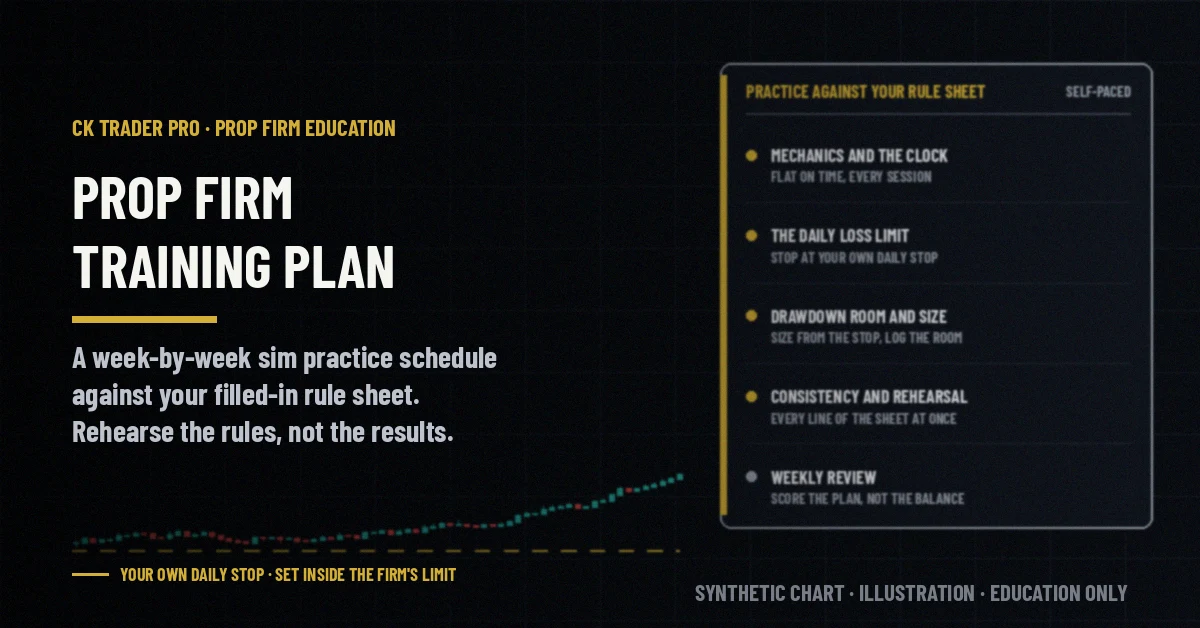
Prop Firm Training Plan: A Four-Week Practice Schedule
Education only, not financial advice. Trading futures involves substantial risk of loss and is not suitable for everyone.
Many traders don't pass prop evaluations, and evaluation fees can be lost entirely. Rules, costs and payout terms vary by firm and change often, so check the firm's current terms.
By CK · Futures trader since 1998
Short answer: A prop firm training plan is a practice schedule, not a shortcut. Fill in a rule sheet for the account you plan to trade, then practice in sim against those exact rules: week one on mechanics and the flat-by time, week two on the daily loss limit, week three on drawdown room and size, week four on consistency and full rehearsal sessions. Review every week. The plan builds habits; it doesn’t promise any result.
Education only. Futures trading involves substantial risk of loss. Not financial advice.
Some retail futures prop programs use simulated evaluations and simulated funded accounts; some also offer a separate live-funded stage. Verify your specific account type. CK Trader Pro and NQ Live Trading aren’t owned, run or endorsed by any prop firm.
I learned to practice the rules, not just the setups
I’ve been trading futures since 1998. In my experience, the trades people practice are rarely the ones that end an account. The rules do.
Early on, I practiced entries over and over. What I didn’t practice was stopping at my limit, being flat on time and trading at the size I’d really use. So the first time a rule mattered, I was meeting it for the first time.
Have you ever noticed this about traders?
How many traders spend weeks in sim on entries, and never once practice stopping at a daily loss limit?
How many practice at a size they’d never trade, then wonder why the real account feels different?
And how many could name their setup in detail, but not the time their account has to be flat?
None of that is a talent problem. It’s a practice problem.
Here’s the point
A training plan isn’t more screen time. It’s practice against the rules you’ll actually be measured by.
If your sim has no rules, you’re practicing a different game.
Before week one: fill in the rule sheet
Start with the account you plan to trade. Fill in a prop firm rule sheet from the firm’s current written rules, and date it. For this schedule, four lines matter first:
- Drawdown room: how far the account can fall before it ends, and whether the floor is static or trailing.
- Daily loss limit: the amount, whether open trades count and when “the day” resets.
- Flat-by time: the time, the time zone and what counts as flat.
- Consistency: any cap on how much of your gains can come from one day, and any minimum number of trading days.
Then add your own limits below the firm’s: a daily stop, a maximum contract count and a rule for when you stop for the day. If you trade NQ or MNQ, limits are often written in dollars while your chart moves in points. The NQ tick value calculator converts one into the other at your size.
The four-week practice schedule
Concept only. A self-paced sim schedule, not any firm’s rules. Stretch any week that isn’t solid yet.
| Week | Focus | Drills | Review checkpoint |
|---|---|---|---|
| 1 | Mechanics and the clock | Order entry, stop placement, flattening, a flat-by alarm | Flat on time every session? |
| 2 | The daily loss limit | Stop at your own daily stop; write it down before the open | Stopped at the limit every time? |
| 3 | Drawdown room and size | Size from the stop at your real size; log room left each day | Size matched the plan on every trade? |
| 4 | Consistency and rehearsal | Full sessions under every line of the rule sheet | Any session that broke a rule? |
Week 1: Mechanics and the clock
Practice the actions you’ll need under pressure: placing an order at your planned size, placing a stop, moving it only by your plan, and flattening everything at once. Set an alarm ahead of the flat-by time and close out when it goes off, every session. If you start in a holiday week, check the exchange’s holiday schedule and your firm’s announcements first, since the clock can change.
Checkpoint: were you flat by the time on the sheet in every session, with no working orders left?
Week 2: The daily loss limit
Write your own daily stop before each session, inside the firm’s limit. When you hit it, you’re done, even if the next setup looks perfect. That’s the drill. A stop is an instruction, not a promise: no stop guarantees a maximum loss, and in a fast market an order can fill past the stop price. That’s why your own daily stop sits well inside the firm’s. More on setting it: daily loss limit strategy for prop traders.
Checkpoint: did you stop at your daily stop every time it was reached, without one more trade?
Week 3: Drawdown room and size
Trade only the size you’d use in the real account, sized from your stop. At the end of each session, write down how much drawdown room is left, in points at your size. With a trailing floor, that number can change as the account moves, so log it fresh each day. Managing that room is covered in prop firm drawdown management.
Checkpoint: did every trade match the size your plan allowed?
Week 4: Consistency and full rehearsal
Now run full sessions under every line of the sheet at once: flat-by time, daily stop, size and the consistency line. If your firm has a consistency rule, note what share of the week’s result came from each day, as a practice exercise, so you can see how one big day would read against it. Check how your firm measures consistency. How those rules work is in prop firm consistency rules.
Checkpoint: did any session break a rule on the sheet? If so, which one, and what happened just before?
Review checkpoints, every week
At the end of each week, score the plan, not the balance. For every session, answer yes or no:
- Did I write my plan and limits before the open?
- Did I follow my size on every trade?
- Did I stop at my daily stop if I reached it?
- Was I flat by the time on the sheet?
Record the answers in a day trading journal template. If a week has more “no” answers than you’d accept in a real account, repeat that week before moving on. The calendar doesn’t decide when you’re ready; the checkpoints do.
What this schedule is, and what it isn’t
This is a practice schedule. It builds the habits the rules will test. It doesn’t predict how you’ll do in any account. A simulator can teach mechanics and routine, but it can’t fully reproduce fills or the pressure of real risk; that trade-off is laid out in paper trading vs live futures. If you’re heading into a test stage, read how to prepare for a prop firm evaluation next.
How I think about it
In my experience, a good training plan is boring on purpose. The same checks, the same limits, the same flat-by alarm, session after session, until sticking to the rules takes no effort. I’d rather repeat a week than move on with a habit that only works on good days.
Where we fit
Is CK Trader Pro a prop firm? No. We teach futures and prop firm education. We don’t sell evaluations or funded accounts, and we don’t send trade signals or setups to follow.
CK has affiliate relationships with some prop firms, including Apex Trader Funding and Lucid Trading, and may earn a commission from sign-ups through his links. Sticking to a practice schedule doesn’t promise you’ll pass anything or make money. It means the rules aren’t new to you when they count. This schedule is one module of our prop firm training path; for definitions and firm-rule basics, see the prop firm information hub.
The noise sells the shortcut
Here’s what gets in a new trader’s way, and it isn’t the trader. It’s the noise. It sells speed: skip the practice, buy the account, figure out the rules later. When the noise sets your schedule, the first time you meet a rule is the moment it ends your day.
Remember this
Rehearse the rules, not the results.
So here’s my question: if you started week one tomorrow, could you fill in all four lines of your rule sheet before the open?
Join the Academy
Practice the rules before they count. CK Trader Pro is futures and prop firm education: step-by-step lessons, live sessions and risk planning, built for traders who want their rules, limits and practice written down before the bell. It’s the CK Trader Pro Membership, which includes:
- Members-only educational lessons on prop-firm rules, drawdown, daily loss limits, position sizing and NQ and MNQ contract basics
- War Room: CK’s live pre-market planning session, weekdays 8:30–9:30 AM ET, where the day’s levels, news times and risk get written down before the open
- CK’s chart setup, shown and explained live in every session
- Economic news calendar
Education only. No trade signals or personal advice. No results promised.
Billed monthly until you cancel. See pricing at cktraderpro.com.
Registration is required. Adults 21+.
FAQ
What is a prop firm training plan?
It’s a practice schedule built around the rules of the account you plan to trade. You fill in a rule sheet from the firm’s current terms, then practice in sim against those rules, with set drills and a weekly review.
How do I train for a prop firm evaluation?
Start with the rules, not the setups. Write down the drawdown, daily loss limit, flat-by time and any consistency rule, set your own limits inside them, and practice in sim at the size you’d really trade. Score each session on whether you followed the plan.
Do I have to follow the schedule in four weeks?
No. It’s self-paced. Four weeks is a simple structure, not a deadline. If a week’s checkpoint isn’t solid, repeat that week before moving on.
Can I use this plan for any prop firm?
The structure works for any account with written rules, but the rules themselves differ by firm and change often. Fill in a fresh rule sheet from the firm’s current terms for each account type, and date it.
Does a stop keep me inside my daily loss limit?
A stop is an instruction, not a promise. No stop guarantees a maximum loss; in a fast market, an order can fill past the stop price, so many traders keep their own daily stop well inside the firm’s limit.
Is CK Trader Pro a prop firm?
No. CK Trader Pro is futures and prop firm education. It doesn’t sell evaluations or funded accounts, and it isn’t owned, run or endorsed by any prop firm.
Trading futures involves substantial risk of loss and is not suitable for everyone. Past performance is not indicative of future results. Education only, not financial advice. Example numbers are illustrations, not recommendations. No stop guarantees a maximum loss. Prop-firm rules vary by firm and change often; check each firm’s current rules. Some retail futures prop programs use simulated evaluations and simulated funded accounts; some also offer a separate live-funded stage. Verify your specific account type. CK Trader Pro and NQ Live Trading aren’t owned, run or endorsed by any prop firm. See our Risk Disclosure and Disclosures. CK Trader Pro is operated by CK TRADING INSTITUTE OF TECHNOLOGY LLC.
About this article. This is general education from CK Trader Pro. It isn't investment advice, a recommendation to buy or sell, or a trade signal, and it doesn't take your situation into account. Dollar figures and examples are illustrations, not results. Prop-firm rules, costs and payout terms vary by firm and change often; check the firm's current terms before you buy anything. We have paid referral relationships with some prop firms (see Disclosures). We are not owned, run, employed or endorsed by these firms. Mentioning a firm or its evaluations is not a recommendation that you trade. Trading futures involves substantial risk of loss and is not suitable for everyone.