

Prop Firm Evaluation Types: One-Step, Two-Step, Instant, and Combines
Education only, not financial advice. Trading futures involves substantial risk of loss and is not suitable for everyone.
Many traders don't pass prop evaluations, and evaluation fees can be lost entirely. Rules, costs and payout terms vary by firm and change often, so check the firm's current terms.
By CK · Futures trader since 1998
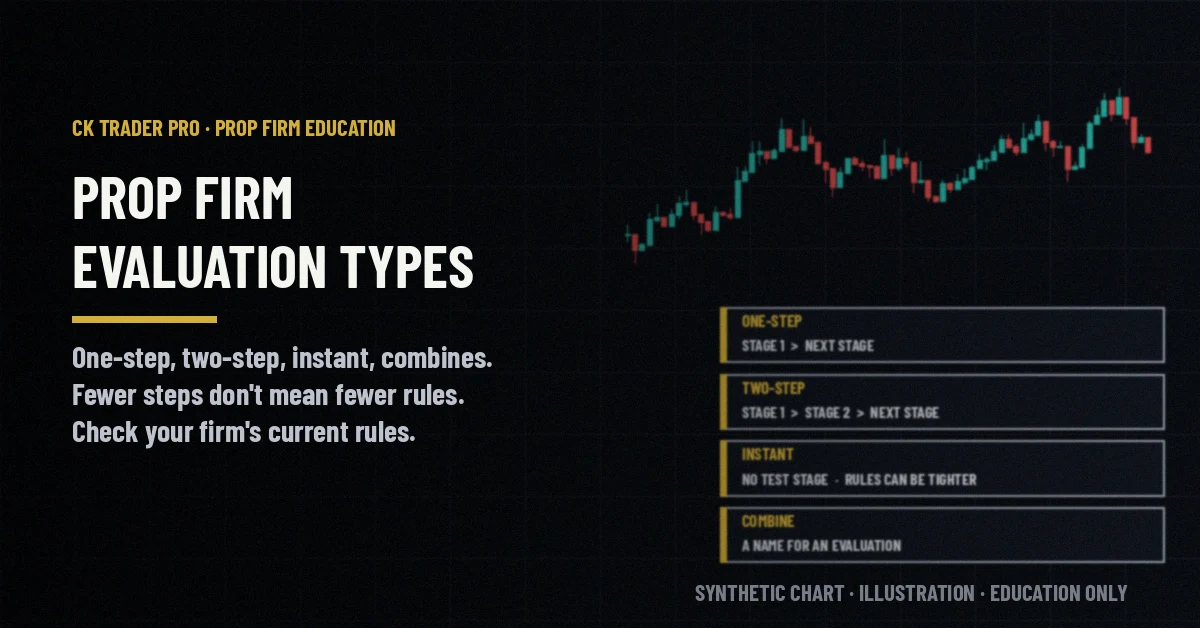
Short answer: Common structures in retail futures prop programs include four types. A one-step evaluation has a single stage with one profit target. A two-step evaluation splits the test into two stages, each with its own target and rules. An instant (or “direct”) account skips a separate evaluation stage, and at some firms its rules are tighter from day one. A combine is a name some firms use for their evaluation; under the label, it usually works like a one-step or two-step evaluation. The labels are less important than the rules underneath them, and those rules differ by firm and change, so always read your firm’s current written rules.
Education only. Futures trading involves substantial risk of loss. Not financial advice.
Some retail futures prop programs use simulated evaluations and simulated funded accounts; some also offer a separate live-funded stage. Verify your specific account type. CK Trader Pro and NQ Live Trading aren’t owned, run or endorsed by any prop firm.
The label on the box
I’ve been trading futures since 1998. In my experience, when a new trader picks a prop account, the first thing they look at is the label: one-step, two-step, instant. It sounds like a menu.
But a label isn’t a rule. Two accounts with the same name can behave very differently once the first trade is on. What decides your experience is what sits underneath: how many stages there are, what each stage asks for, and what ends the account.
Have you ever noticed this about traders?
How many traders pick an account type because it sounds faster, without asking what “faster” means?
How many choose “instant” without reading how the drawdown works on that account?
And how many pass the first stage of a two-step, then find out the second stage is a different test?
None of that is a talent problem. It’s a reading problem. The structure is written down before you start. The question is whether you read it before you choose.
Here’s the point
The type tells you how many doors there are. The rules tell you what’s behind each one.
So don’t ask “which type is best?” Ask “which set of rules fits the way I actually trade, and do I understand every one of them?”
The four structures, side by side
Here’s how each structure is usually built. These are general patterns, not any firm’s terms. The numbers, the order of the steps and even the names vary by firm and by account.
One-step evaluation
One stage, one profit target. You reach the target while staying inside the drawdown, the daily loss limit (if there is one) and any consistency or minimum-day rules, and you move to the next stage of that program.
What to check: the drawdown type (static, or trailing intraday or end of day), whether a consistency rule applies, and whether there’s a minimum number of trading days. In my experience, one stage can feel simpler, but it puts a lot of weight on a single set of rules, so read them closely.
Two-step evaluation
Two stages, back to back. Each stage usually has its own profit target, and the rules can be different in each one. Some programs ask for more in stage one and less in stage two; others keep them similar.
What to check: whether the drawdown resets between stages, whether stage two has new minimum days or consistency rules, and whether a rule break in stage two sends you back to the start. Treat each stage as its own test.
Instant (direct) account
No separate evaluation stage. You start in the account type the program calls funded, which at some retail firms is still simulated, so verify yours. Because there’s no test stage, some firms build the screening into the rules themselves, for example: tighter drawdown, smaller contract limits, stricter consistency rules or extra conditions before a payout request.
What to check: everything you’d check in an evaluation, plus the payout conditions, because they can come up sooner. “Instant” describes when the account starts. It doesn’t describe the rules, and it doesn’t promise anything about results or payouts.
Combines
“Combine” is a term some firms use for their evaluation. In practice it’s usually a one-step or two-step test with its own name. If you’re comparing a combine to an evaluation, compare the rules, not the word. The term itself is explained in what is a trading combine.
The same rules show up in every type
Whatever the label, the same rule categories decide the account: the profit target, the maximum drawdown and how it’s measured, the daily loss limit, consistency rules, contract limits, news restrictions, flat-by times and payout rules. The full list is in futures prop firm rules, and the drawdown types are compared in trailing vs end-of-day drawdown.
If you’re new to the idea of a test account, start with what a prop firm evaluation really is. And for what changes after a test stage ends, read evaluation vs funded account. Fee structures also differ by type; for the cost categories, see what a prop firm evaluation costs in total.
Turning any account’s rules into points
Whichever type you look at, the rules are written in dollars and your chart is in points. NQ is $20 per point and MNQ is $2 per point (source: CME Group E-mini Nasdaq-100 and Micro E-mini Nasdaq-100 contract specifications).
Illustration only, hypothetical numbers, not any firm’s rule: say an account allows a $2,000 maximum drawdown. On 1 NQ, that’s 100 points. On 1 MNQ, it’s 1,000 points. On 4 MNQ, it’s 250 points. Same account, very different room on the chart, before commissions and fees. Run your own numbers with the NQ tick value calculator.
And a stop is an instruction, not a promise. No stop guarantees a maximum loss; in a fast market, an order can fill past the stop price. In my experience, it’s wiser to leave a buffer between your planned loss and the account’s limit, on any account type.
How I’d compare two account types
- Write down the steps. How many stages, and what does each one ask for?
- Write down what ends the account at each stage: drawdown, daily limit, rule breaks.
- Note whether anything resets between stages, such as the drawdown or minimum days. This varies by firm, so check, don’t assume.
- Convert the dollar rules into points for the contract you trade.
- Read the payout conditions even if they feel far away. On an instant account, they can come up sooner.
- Check the date. Firms change rules, so use the firm’s own current rules page and ask support about anything unclear, in writing.
For the bigger map of how prop accounts work, start at prop firm information.
Where we fit
Is CK Trader Pro a prop firm? No. We teach futures and prop firm education. We don’t sell evaluations or funded accounts, and we don’t set anyone’s rules.
CK has affiliate relationships with some prop firms, including Apex Trader Funding and Lucid Trading, and may earn a commission from sign-ups through his links. Whichever account type you choose, the firm’s current written rules are the only version that counts. Choosing a type doesn’t promise you’ll pass anything or make money. Understanding it means you know what you’re agreeing to.
The noise sells the shortcut
Here’s what gets in a new trader’s way, and it isn’t the trader. It’s the noise. Feeds sell the shortcut: fewer steps, faster start, no test. What they don’t show is the rule that came with the shortcut. When all you hear is “instant,” it’s easy to miss that the rules didn’t get any easier. They just moved.
Remember this
Fewer steps don’t mean fewer rules.
So here’s my question: if someone asked you right now what ends your account at each stage, could you answer without looking it up?
If you’d like to watch a trading day get planned around written rules in real time, there’s a free live NQ session on weekdays from 9:30 to 10:30 AM ET at nqlivetrading.com/live, run by the same company. Registration is required. Adults 21+. Sessions are education, not signals.
Join the Academy
Understand the rules before you choose the account. CK Trader Pro is futures and prop firm education: step-by-step lessons, live sessions and risk planning, built for traders who want to understand how account types and their rules work before they trade one. It’s the CK Trader Pro Membership, which includes:
- Members-only educational lessons on prop-firm rules, drawdown, daily loss limits, position sizing and NQ and MNQ contract basics
- War Room: CK’s live pre-market planning session, weekdays 8:30–9:30 AM ET, where the day’s levels, news times and risk get written down before the open
- CK’s chart setup, shown and explained live in every session
- Economic news calendar
Education only. No trade signals or personal advice. No results promised.
Billed monthly until you cancel. See pricing at cktraderpro.com.
FAQ
What are the main prop firm evaluation types?
Common structures include a one-step evaluation, a two-step evaluation, an instant (direct) account with no separate evaluation stage, and a combine, which is a name some firms use for their evaluation. Details differ by firm and change, so check each firm’s current rules.
What is the difference between a one-step and a two-step prop firm evaluation?
A one-step evaluation has a single stage with one profit target. A two-step evaluation has two stages, each with its own target and rules. Whether the drawdown or other rules reset between stages varies by firm, so check the program’s current rules.
How is an instant account different from an evaluation?
An instant account skips a separate evaluation stage, so some firms build the screening into the account’s rules instead, such as tighter drawdown, smaller contract limits or extra payout conditions. At some retail firms these accounts are still simulated, so verify yours.
Is a trading combine the same as an evaluation?
Usually, yes. “Combine” is a term some firms use for their evaluation. Compare the rules underneath, such as drawdown type, daily loss limit and consistency rules, not the name.
Which prop firm evaluation type is easiest?
No type is easy, and none promises a pass or a payout. In my experience, the better question is which set of rules you understand and can follow on every trade.
Does a stop keep me inside an account’s drawdown?
A stop is an instruction, not a promise. No stop guarantees a maximum loss; in a fast market, an order can fill past the stop price, so many traders leave a buffer before the limit.
Is CK Trader Pro a prop firm?
No. CK Trader Pro is futures and prop firm education. It doesn’t sell evaluations or funded accounts, and it isn’t owned, run or endorsed by any prop firm.
Trading futures involves substantial risk of loss and is not suitable for everyone. Past performance is not indicative of future results. Education only, not financial advice. Example numbers are illustrations, not recommendations. No stop guarantees a maximum loss. Prop-firm rules vary by firm and change often; check each firm’s current rules. Some retail futures prop programs use simulated evaluations and simulated funded accounts; some also offer a separate live-funded stage. Verify your specific account type. CK Trader Pro and NQ Live Trading aren’t owned, run or endorsed by any prop firm. See our Risk Disclosure and Disclosures. CK Trader Pro is operated by CK TRADING INSTITUTE OF TECHNOLOGY LLC.
About this article. This is general education from CK Trader Pro. It isn't investment advice, a recommendation to buy or sell, or a trade signal, and it doesn't take your situation into account. Dollar figures and examples are illustrations, not results. Prop-firm rules, costs and payout terms vary by firm and change often; check the firm's current terms before you buy anything. We have paid referral relationships with some prop firms (see Disclosures). We are not owned, run, employed or endorsed by these firms. Mentioning a firm or its evaluations is not a recommendation that you trade. Trading futures involves substantial risk of loss and is not suitable for everyone.