

What Is Day Trading in Futures? A Plain-English Guide
Education only, not financial advice. Trading futures involves substantial risk of loss and is not suitable for everyone.
Many traders don't pass prop evaluations, and evaluation fees can be lost entirely. Rules, costs and payout terms vary by firm and change often, so check the firm's current terms.
By CK · Futures trader since 1998
Short answer: Day trading in futures means opening and closing your positions within the same trading session, so you’re flat (holding no contracts) before that session ends. Instead of owning shares, you trade standardized contracts on an index, a commodity or a rate, like the E-mini Nasdaq-100 (NQ) or its smaller version, the Micro E-mini Nasdaq-100 (MNQ). Each contract moves a fixed dollar amount per point, which is why sizing and risk rules matter more than the entry.
Education only. Futures trading involves substantial risk of loss. Not financial advice.
Some retail futures prop programs use simulated evaluations and simulated funded accounts; some also offer a separate live-funded stage. Verify your specific account type. CK Trader Pro and NQ Live Trading aren’t owned, run or endorsed by any prop firm.
The question I wish someone had asked me first
I’ve been trading futures since 1998. When I started, nobody sat me down and explained what a trading day actually was. I knew what a chart looked like. I didn’t know when my day started, when it ended, or what one point would cost me.
That’s still where a lot of new traders begin: with the chart, not the definition. And the definition is where the rules live.
Have you ever noticed this about traders?
How many traders can name three setups, but can’t say what one point on their contract is worth?
How many call themselves day traders, but have never decided what time they’re flat?
And how many open their first futures account thinking it works like a stock app, then find out the hard way that it doesn’t?
None of that is about intelligence. It’s about order. Many traders learn the exciting part first and the foundation last. Day trading futures goes better the other way around.
Here’s the point
Day trading futures is a time rule and a size rule before it’s a strategy.
You’re in and out within one session, and every point has a fixed dollar value. If you know those two things cold, when you’re flat and what a point costs, every strategy you learn afterward sits on solid ground. If you don’t, no setup can protect you.
What “day trading” means in futures terms
1. You trade contracts, not shares
A futures contract is a standardized agreement on an underlying market, listed on an exchange. For Nasdaq-100 traders, the two contracts people talk about are:
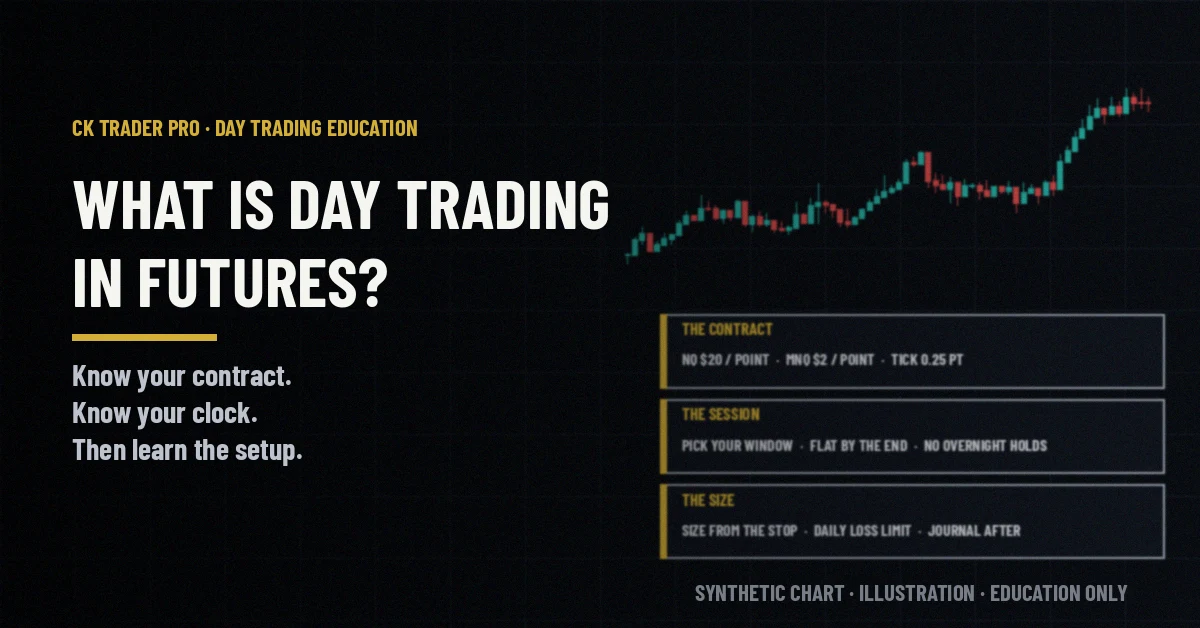
- NQ (E-mini Nasdaq-100): $20 per index point. The minimum move (one tick) is 0.25 point, or $5.
- MNQ (Micro E-mini Nasdaq-100): $2 per index point. One tick is 0.25 point, or $0.50. It’s one-tenth the size of NQ.
(Source: CME Group E-mini Nasdaq-100 and Micro E-mini Nasdaq-100 contract specifications.) The full specs are on our NQ futures contract specs page, and you can check any point or tick move with the NQ tick value calculator.
2. The trading day isn’t 9:30 to 4:00
Equity index futures like NQ trade on CME Globex nearly around the clock: Sunday 6:00 PM to Friday 5:00 PM ET, with a daily maintenance break from 5:00 to 6:00 PM ET (source: CME Group E-mini Nasdaq-100 contract specifications). Holiday schedules can change those hours, so check CME’s holiday and trading hours calendar.
That means “the session” needs a definition. Many day traders focus on the U.S. cash-market hours, especially the 9:30 AM ET open, because that’s often when volume picks up. Others trade overnight hours. Either way, a day trader decides in advance which window they trade and when they’ll be flat. For hours, holidays and contract rollover, see NQ futures trading hours and rollover.
3. Flat means flat
Being a day trader means you’re flat by a set time: no open position past your session’s end, typically before the session close or the daily maintenance break. In my experience, that one rule removes a whole category of problems: overnight gaps from earnings or news, and the higher margin that applies when a position is held through the close. Intraday (day-trading) margins are set by the broker and vary. Exchange (overnight) margin applies to positions held through the close. Both can change, so check your broker’s current numbers. CME notes that brokers require more margin for positions held into the next trading day than for positions opened and closed the same day (source: CME Group, Position and Risk Management). For how margin differs from the money you actually have at risk, read futures margin vs account size.
If you trade under a prop firm’s rules, the firm may set its own flat-by time. Check your firm’s current written rules.
4. Leverage cuts both ways
A small move in the index is real money on a futures contract. Illustration only: a 40-point stop is $800 on 1 NQ or $80 on 1 MNQ, before commissions and fees. A stop is an instruction, not a promise. No stop guarantees a maximum loss; in a fast market, an order can fill past the stop price.
That’s why futures day traders size from the stop, not from how confident they feel. The math is simple: contracts = dollars you’re willing to risk ÷ (stop in points × dollars per point). The walkthrough is in how to size NQ and MNQ trades from your stop.
How it compares with day trading stocks
Stocks and futures can both be day traded, but the mechanics differ: contract size, hours, how margin works and which rules apply. If you’re deciding between the two, I laid out the differences in futures vs stocks for day trading. This page is about what the futures version actually is.
What a futures day trader’s day looks like
The definition is simple. Doing it well is a process. In my experience, a workable day has three parts:
- Before the open: check the scheduled news times, mark your reference levels, set your daily loss limit and decide your size.
- During the session: take only the trades your plan allows, at the size your stop allows, and stop when your daily limit says stop.
- After the session: flat, then journal what happened and why.
The full version, step by step, is in a day trading routine for futures. The journal side is in the day trading journal template. And if the vocabulary is still new, keep the futures trading glossary open in another tab.
Many traders practice on a simulator first. That has real value, and it has limits too; see paper trading vs live futures.
Where prop firms come in
A lot of people meet futures day trading through a prop firm evaluation. That’s a separate product with its own rule set (daily loss limits, drawdown, sometimes news and consistency rules), layered on top of everything above. Learn the base first, then the firm’s rules. Start with daily loss limit strategy for prop traders.
And if you’ve wondered where we fit: Is CK Trader Pro a prop firm? No. We teach futures and prop firm education. We don’t sell evaluations or funded accounts.
CK has affiliate relationships with some prop firms, including Apex Trader Funding and Lucid Trading, and may earn a commission from sign-ups through his links. Whichever firm you trade with, its current written rules are the only version that counts. Understanding how day trading works doesn’t promise you’ll pass anything or make money. It gives you the foundation to make your decisions on purpose.
The noise sells the trade. Nobody sells the definition.
Here’s what gets in a trader’s way, and it isn’t the trader. It’s the noise. Feeds show the one clean candle and the screenshot of the green day. They don’t show the trader who held past the session by accident, or sized NQ like it was MNQ. When the highlight is all you see, it’s easy to think day trading is about finding the entry, when the first job is knowing what you’re actually trading and when you’re done.
Remember this
Know your clock and your contract before you know your setup.
So here’s my question: if someone asked you right now what time you’re flat tomorrow and what one point on your contract is worth, could you answer both without looking?
If you’d like to watch a futures trading day get planned and run in real time, there’s a free live NQ session on weekdays from 9:30 to 10:30 AM ET at nqlivetrading.com/live, run by the same company. Registration is required. Adults 21+. Sessions are education, not signals.
Join the Academy
Build the foundation before you build the strategy. CK Trader Pro is futures and prop firm education: step-by-step lessons, live sessions and risk planning, built for traders who want to understand what they’re doing and why. It’s the CK Trader Pro Membership, which includes:
- Members-only educational lessons on day trading foundations, position sizing, drawdown, daily loss limits and prop-firm rules
- War Room: CK’s live pre-market planning session, weekdays 8:30–9:30 AM ET, where the day’s levels, news times and risk get written down before the open
- CK’s chart setup, shown and explained live in every session
- Economic news calendar
Education only. No trade signals or personal advice. No results promised.
Billed monthly until you cancel. See pricing at cktraderpro.com.
FAQ
What is day trading in futures?
Day trading in futures means opening and closing futures positions within the same trading session, so you hold no contracts when that session ends. You trade standardized exchange-listed contracts, like NQ or MNQ, where each point has a fixed dollar value.
What hours can you day trade NQ futures?
NQ trades on CME Globex from Sunday 6:00 PM to Friday 5:00 PM ET, with a daily maintenance break from 5:00 to 6:00 PM ET. Holiday schedules can differ. Many day traders focus on the U.S. cash-market hours around the 9:30 AM ET open, but each trader defines their own session.
How much is one point on NQ and MNQ?
According to CME Group’s contract specifications, NQ is $20 per index point ($5 per 0.25-point tick) and MNQ is $2 per point ($0.50 per tick). MNQ is one-tenth the size of NQ.
Is day trading futures different from day trading stocks?
Yes. Futures use standardized contracts with a fixed dollar value per point and trade nearly around the clock from Sunday evening through Friday. Intraday margins are set by the broker and vary; exchange (overnight) margin applies to positions held through the close. The rules and mechanics differ from stocks, so learn the futures version on its own terms.
Can a stop limit my loss when day trading futures?
A stop is an instruction, not a promise. No stop guarantees a maximum loss; in a fast market, an order can fill past the stop price. Size from the stop and allow for slippage.
Is CK Trader Pro a prop firm?
No. CK Trader Pro is futures and prop firm education. It doesn’t sell evaluations or funded accounts, and it isn’t owned, run or endorsed by any prop firm.
Trading futures involves substantial risk of loss and is not suitable for everyone. Past performance is not indicative of future results. Education only, not financial advice. Example numbers are illustrations, not recommendations. No stop guarantees a maximum loss. Prop-firm rules vary by firm and change often; check each firm’s current rules. Some retail futures prop programs use simulated evaluations and simulated funded accounts; some also offer a separate live-funded stage. Verify your specific account type. CK Trader Pro and NQ Live Trading aren’t owned, run or endorsed by any prop firm. See our Risk Disclosure and Disclosures. CK Trader Pro is operated by CK TRADING INSTITUTE OF TECHNOLOGY LLC.
About this article. This is general education from CK Trader Pro. It isn't investment advice, a recommendation to buy or sell, or a trade signal, and it doesn't take your situation into account. Dollar figures and examples are illustrations, not results. Prop-firm rules, costs and payout terms vary by firm and change often; check the firm's current terms before you buy anything. We have paid referral relationships with some prop firms (see Disclosures). We are not owned, run, employed or endorsed by these firms. Mentioning a firm or its evaluations is not a recommendation that you trade. Trading futures involves substantial risk of loss and is not suitable for everyone.